Author Archives: curiouscat

Kids on Scientists: Before and After

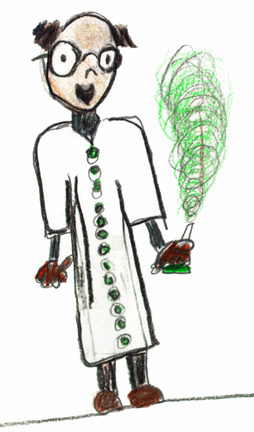
Fermilab offers some drawing of scientists by seventh graders before and after a visit to Fermilab. Wonderful visuals.

Before After
I think of a scientist as very dedicated to his work. He is kind of crazy, talking always quickly. He constantly is getting new ideas. He is always asking questions and can be annoying. He listens to others’ ideas and questions them. I know scientists are just normal people with a not so normal job. . . . Scientists lead a normal life outside of being a scientist. They are interested in dancing, pottery, jogging and even racquetball. Being a scientist is just another job which can be much more exciting.
by Amy

This is one of the more extreme ones but there are lots of other great comparisons. Very reminiscent of: Children’s view of Scientists in England.

Related: Scientists and StudentsKids in the Lab: Getting High-Schoolers Hooked on ScienceCurious Cat Science and Engineering SearchSaving FermilabMatter to Anti-Matter 3 Trillion Times a Second

Do Dolphins Sleep?

Do dolphins sleep?, MIT:

Dolphins do sleep, but not quite in the same way that people do. They sleep with one half of the brain at a time and with one eye closed. Dolphins rest this way on and off throughout the day, switching which side of the brain they shut down. During these periods, everything inside the dolphin slows down, and the mammal moves very little.

Related: Why do We Sleep?Energy Efficiency of Digestioninteresting science factsWhy is the Sky Blue?

NASA’s Carl Sagan Fellowships

NASA Exoplanet Science Institute announces the introduction of the Sagan Postdoctoral Fellowship

The NASA Exoplanet Science Institute announces the introduction of the Sagan Postdoctoral Fellowship Program and solicits applications for fellowships to begin in the fall of 2009.

The Sagan Fellowships support outstanding recent postdoctoral scientists to conduct independent research that is broadly related to the science goals of the NASA Exoplanet Exploration area. The primary goal of missions within this program is to discover and characterize planetary systems and Earth-like planets around nearby stars.

The proposed research may be theoretical, observational, or instrumental. This program is open to applicants of any nationality who have earned (or will have earned) their doctoral degrees on or after January 1, 2006, in astronomy, physics, or related disciplines. The fellowships are tenable at U.S. host institutions of the fellows’ choice, subject to a maximum of one new fellow per host institution per year. The duration of the fellowship is up to three years: an initial one-year appointment and two annual renewals contingent on satisfactory performance and availability of NASA funds.

We anticipate awarding 3 – 4 fellowships in 2009. Please note that these are postdoctoral Fellowships only. Previous Michelson Fellowship holders are fully eligible to apply.

Related: Science and Engineering Scholarships and Fellowships DirectoryNSF Graduate Research Fellows 2008

Study Finds No Measurable Benefit to Flu Shots

Do Flu Shots For The Elderly Save Lives? Just Washing Hands Works Better, Says Study

The widely-held perception that the influenza vaccination reduces overall mortality risk in the elderly does not withstand careful scrutiny, according to researchers in Alberta. The vaccine does confer protection against specific strains of influenza, but its overall benefit appears to have been exaggerated by a number of observational studies that found a very large reduction in all-cause mortality among elderly patients who had been vaccinated.

The study included more than 700 matched elderly subjects, half of whom had taken the vaccine and half of whom had not. After controlling for a wealth of variables that were largely not considered or simply not available in previous studies that reported the mortality benefit, the researchers concluded that any such benefit “if present at all, was very small and statistically non-significant and may simply be a healthy-user artifact that they were unable to identify.”

“Over the last two decades in the United Sates, even while vaccination rates among the elderly have increased from 15 to 65 percent, there has been no commensurate decrease in hospital admissions or all-cause mortality

Related: New and Old Ways to Make Flu VaccinesStudy Shows Why the Flu Likes WinterOver-reliance on Prescription Drugs to Aid Children’s Sleep?

Algorithmic Self-Assembly

Paul Rothemund, scientist at Cal Tech, provides a interesting look at DNA folding and DNA based algorithmic self-assembly. In the talk he shows the promise ahead for using biological building blocks using DNA origami — to create tiny machines that assemble themselves from a set of instructions.

Algorithmic Self-Assembly of DNA Sierpinski Triangles, PLoS paper.

I posted a few months ago about how you can participate in the protein folding, with the Protein Folding Game.

Related: Viruses and What is LifeDNA Seen Through the Eyes of a CoderSynthesizing a Genome from ScratchEvidence of Short DNA Segment Self AssemblyScientists discover new class of RNA

8 Percent of the Human Genome is Old Virus Genes

In Our Genes, Old Fossils Take On New Roles

It turns out that about 8 percent of the human genome is made up of viruses that once attacked our ancestors. The viruses lost. What remains are the molecular equivalents of mounted trophies, insects preserved in genomic amber, DNA fossils.

The thousands of human endogenous retroviruses, or HERVs, sketch a history of rough times during the 550 million years of vertebrate evolution. The best-preserved one, HERV-K113, probably arrived less than 200,000 years ago, long after human beings and chimpanzees diverged from a common ancestor.

But these retroviruses are more than just curiosities. They are some of the most important enemies we ever had. They helped mold the immune system that is one of the evolutionary marvels of life on Earth.

I must say there is tons of amazing stuff I learn about but I still find retroviruses amazing.

Related: Amazing Science: RetrovirusesOld Viruses Resurrected Through DNAOne Species’ Genome Discovered Inside Another’sOur Genome Changes as We Ageposts on genes and genome

Autonomous Helicopters Teach Themselves to Fly

photo of Stanford Autonomous Learning Helicopters

Stanford’s “autonomous” helicopters teach themselves to fly

Stanford computer scientists have developed an artificial intelligence system that enables robotic helicopters to teach themselves to fly difficult stunts by watching other helicopters perform the same maneuvers.

The dazzling airshow is an important demonstration of “apprenticeship learning,” in which robots learn by observing an expert, rather than by having software engineers peck away at their keyboards in an attempt to write instructions from scratch.

It might seem that an autonomous helicopter could fly stunts by simply replaying the exact finger movements of an expert pilot using the joy sticks on the helicopter’s remote controller. That approach, however, is doomed to failure because of uncontrollable variables such as gusting winds.

Very cool. Related: MIT’s Autonomous Cooperating Flying VehiclesThe sub-$1,000 UAV Project6 Inch Bat PlaneKayak Robots

Saving Lives with Smarter Hurricane Evacuations

A sign indicating a hurricane evacuation route near Boca Raton, Florida. Photo / Wikimedia Commons

Software developed by a MIT student is aiding emergency officials as they decide on evacuation plans:
Saving lives through smarter hurricane evacuations

Michael Metzger’s software tool, created as part of the research for his PhD dissertation, could allow emergency managers to better decide early on whether and when to order evacuations — and, crucially, to do so more efficiently by clearing out people in stages. The tool could also help planners optimize the location of relief supplies before a hurricane hits.

“All in all, this is a complex balancing act,” Metzger says.

The concept of evacuating an area in stages — focusing on different categories of people rather than different geographical locations — is one of the major innovations to come out of Metzger’s work, since congestion on evacuation routes has been a significant problem in some cases, such as hurricanes Katrina and Rita. Metzger suggests that, for example, the elderly might be evacuated first, followed by tourists, families with children, and then the remaining population. The determination of the specific categories and their sequence could be determined based on the demographics of the particular area.

By spacing out the evacuation of different groups over a period of about two days, he says, the process would be more efficient, while many traditional systems of evacuating a given location all at once can and have caused serious congestion problems.
….
Other factors that could help to make evacuations more effective, he says, include better planning in the preparation of places for evacuees to go to, making sure buses and other transportation are ready to transport people, and preparing supplies in advance at those locations.

Related: Engineering the Boarding of AirplanesMIT Hosts Student Vehicle Design SummitLighting in Slow Motion