Author Archives: curiouscat

Working as a Software Developer

For most of my career I have been focused on management improvement – helping organizations improve results. Technology plays a big role in that and along the way I found myself becoming a programer for a while; and then a software development program manager. This is a good post on working as a software developer:

reading code is a very important skill. Before a program can be modified, you need to understand what it does, and how it does it. Only then can new functionality be added so it fits in with the existing structure, and without breaking anything. Reading and understanding a program can be a major effort, and one sign of a well-designed program is that it is relatively straight-forward to modify it.

Write for people first, computer second. The code you write will be read many times in the future (by you, or another developer). The computer doesn’t care how the code is written, so make it as easy as possible to understand for the next person that has to read it. A corollary to this is: don’t be too clever. It’s better to be clear than to be clever.

When there is a compelling need to write for the computer first and people second make sure to document that code well. For example, some code that is extremely dense and complex and confusing but greatly enhances the efficiency of a critical area of code.

I recently wrote a book, Management Matters: Building Enterprise Capability. There are many great things about a career in software development. It certainly is also challenging and not for someone looking for the easiest career but I have seem a higher percentage of happy software developers than I have seen in any other discipline.

Related: How To Become A Software Engineer/ProgrammerThe Software Developer Labor MarketAvoiding Tragedy of the Commons for Software DevelopmentPreparing Computer Science Students for JobsHiring the Best Fit For Your Company in an Inefficient Job MarketWant to be a Computer Game Programmer?What Graduates Should Know About an IT Career

Promoting Innovation in Sierra Leone

Another inspirational kid that shows that the potential for human good is much greater than the talking heads and politicians that litter the TV screen so often.

In the video Kelvin says, “That is my aim: to Promote Innovation in Seira Leone, among young people.” See another video as Kelvin explains his homemade battery.

Support these young engineers in Sierra Leone via innovate Salone.

Related: Inspirational Engineer Build Windmill Using TrashSupporting the Natural Curiosity of KidsWhat Kids can Learn If Given a ChanceI was Interviewed About Encouraging Kids to Pursue Engineering

Arduino Introduction Video Tutorial

Arduino is a very cool open source programable hardware engineering initiative. It is great for kids and adults who like to learn and create electronic devices. The Arduino Starter Kit is a great education gift for those interested in such things.

The video explains how to build a basic circuit with the Arduino board, and how to use each of the basic components such as LEDs, switches, and resistors. See more videos on related topics. Massimo Banzi, the co-creator and CEO of Arduino, and seen in the videos, also has a book: Getting Started with Arduino.

Related: Schematics of Electronic CircuitsEZ-Builder Robot Control Software

Cancer Risks From Our Food

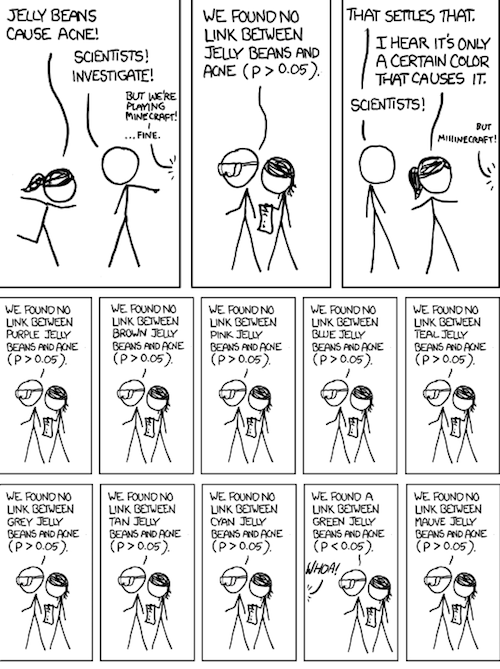
comic showing the dangers of drawing false conclusion based on statistical significance

Randall Munroe illustrates RA Fisher’s point that you must think to draw reasonable conclusions from data. Click the image to see the full xkcd comic.

Pretty much everything you eat is associated with cancer. Don’t worry about it. by Sarah Kliff

The changes in cancer risk were all over the map: 39 percent found an increased risk, 33 percent found a decreased risk and 23 percent showed no clear evidence either way.

The vast majority of those studies, Schoenfeld and Ioannidis found, showed really weak associations between the ingredient at hand and cancer risk. A full 80 percent of the studies had shown statistical relationships that were “weak or nominally significant,” as measured by the study’s P-values. Seventy-five percent of the studies purporting to show a higher cancer risk fell into this category, as did 76 percent of those showing a lower cancer risk.

Sadly the evidence is often not very compelling but creates uncertainly in the public. Poorly communicated results and scientific illiteracy (both from publishers and the public) leads to more confusion than is necessary. Even with well done studies, good communication and a scientifically literate population nutrition and human health conclusion are more often questionable than they are clear.

Related: Researchers Find Switch That Allows Cancer Cells to SpreadGlobal Cancer Deaths to Double by 2030Physical Inactivity Leads to 5.3 Million Early Deaths a Year

Drug Company Funding Taints Published Medical Research

Science provide the opportunity for us to achieve great benefits for society. However, especially in medical research money can make what are already very difficult judgments even less reliable. Add that to a very poor understanding of science in those we elect and you have a dangerous combination. That combination is one of the largest risks we face and need to manage better. I wish we would elect people with a less pitiful appreciation for science but that doesn’t seem likely. That makes doing a better job of managing the conflicts of interest money puts into our current medical research a top priority.

How Drug Company Money Is Undermining Science by Charles Seife

In the past few years the pharmaceutical industry has come up with many ways to funnel large sums of money—enough sometimes to put a child through college—into the pockets of independent medical researchers who are doing work that bears, directly or indirectly, on the drugs these firms are making and marketing. The problem is not just with the drug companies and the researchers but with the whole system—the granting institutions, the research labs, the journals, the professional societies, and so forth. No one is providing the checks and balances necessary to avoid conflicts.

Peer-reviewed journals are littered with studies showing how drug industry money is subtly undermining scientific objectivity. A 2009 study in Cancer showed that participants somehow survived longer when a study’s authors had conflicts of interest than when the authors were clean. A 1998 study in the New England Journal of Medicine found a “strong association” between researchers’ conclusions about the safety of calcium channel blockers, a class of drugs used to reduce blood pressure, and their financial relationships with the firms producing the drugs.

Most of those in the system have an interest in minimizing an effort to clean this up. It is just more work they don’t want to do. Or it goes directly against their interest (drug companies that want to achieve favorable opinions by buying influence). The main political message in the USA for a couple decades has been to reduce regulation. Allowing research that is tainted because you find regulation politically undesirable is a bad idea. People that understand science and how complex medical research is appreciate this.

Sadly when we elect people that by and large are scientifically illiterate they don’t understand the risks of the dangerous practices they allow. Even if they were scientifically illiterate but understood their ignorance they could do a decent job by getting scientific consultation from experts but they don’t (to an extent they listen to the scientists that those that give them lots of money tell them to which does help make sure those giving the politicians cash have their interests served but it is not a good way to create policy with the necessary scientific thinking needed today).

Related: Problems with the Existing Funding System for Medical ResearchMedical Study Integrity (or Lack Thereof)Merck and Elsevier Publish Phony Peer-Review JournalAnti-Science PoliticsStand with Science, Late is Better than Never

Solar Powered Water Jug to Purify Drinking Water

Deepika Kurup, a 14-year-old New York student, won the Discovery Education 3M Young Scientist Challenge for her invention of a solar-powered water jug that changes dirty water into purified drinking water. She won the top prize of $25,000.

During “the 5 minutes of my presentation 15 children have died from lack of clean drinking water.”

I am thankful we have kids like this to create solutions for us that will make the world a better place. We rely on hundreds of thousands of such people to use science and engineering methods to benefit society.

Related: Strawjet: Invention of the YearCheap Drinking Water From SeawaterWater and Electricity for AllThanksgiving, Appropriately (power of capitalism and people to provide long term increases in standards of living)

Parrots Given “Names” by Their Parents and Use Them Throughout Their Lives

Parrots learn their ‘names’ from their parents

Parrots, which have long amused us for their ability to imitate our vocal patterns, actually learn to caw their “names” from their parents, says a new Cornell study. The research offers the first evidence that parrots learn their unique signature calls from their parents and shows that vocal signaling in wild parrots is a socially acquired rather than a genetically wired trait.

Previous research had shown that all wild parrots use unique “contact calls” that not only distinguish each bird individually, but also communicate their gender, and the mate and larger group they belong to.

“Parrots can have extremely long periods [leading up] to independence, and this is thought to be related to their large brains,” explained Berg. The same goes for primates, he said, with humans in particular being “off the charts” when it comes to a lengthy stage of child dependence.

More research is required, to better understand the evolution of and interaction between these physical and behavioral traits, he said. “We still don’t have good explanations of how these behaviors help wild individuals survive and reproduce in nature,” he said.

The paper offers some possible explanations: Perhaps the parrots’ far-ranging journeys to “communal foraging sights” are what impress upon each parent the need to have their fledglings’ names sorted out — not unlike human parents’ need to call for their children by name at a crowded fair.

I enjoy learning more fun and cool stuff about the animals we share the world with. They are quite an interesting bunch of creatures.

Related: Crow Using a Sequence of Three ToolsFriday Fun: Crow Sledding, Flying Back Up and Sledding Down AgainBackyard Wildlife: HawkFriday Fun: Dancing Parrot

How Caffeine Affects Your Body

From the video by Alex Dainis: Caffeine prevents adenosine from slowing down your nervous system, by binding to the same receptors adenosine would. Caffeine also stimulates the production of adrenaline. And it increases the amount of dopamine present. The average half life of caffeine in the human body is about 6 hours.

Related: Does Diet Soda Result in Weight Gain?Mental Pick-Me-Ups: The Coming BoomRitalin Doesn’t Show Long Term Effectiveness for ADHD

I have been curious about the caffeine content of various drinks and writing this post is a good enough reason to actually look it up.

  • expresso (2oz) 100 mg (varies – 60 mg to 180 mg)
  • coffee (8oz) 100 mg – this can vary quite a bit, 50 to over 100 mg is common. Brewed coffee has more caffeine 100-200 mg.
  • Red Bull (8.2 oz) 80 mg
  • tea (8oz) 20 to 80 mg (depending on strength and type, can also be higher, green tea is on the lower end)
  • Mountain Dew (12 oz) 54 mg (diet has 54 mg also)
  • Diet Coke 46 mg (regular Coke 34mg)
  • Pepsi 38 mg, Diet Pepsi 36 mg

Sprite, 7Up and some root beers have no caffeine.
Chocolate can also be a significant source of caffeine – dark chocolate can have over 80 mg per 100 g (approximately 4 ounces).