Author Archives: curiouscat

Biologists Identified a New Way in Which Bacteria Hijack Healthy Cells

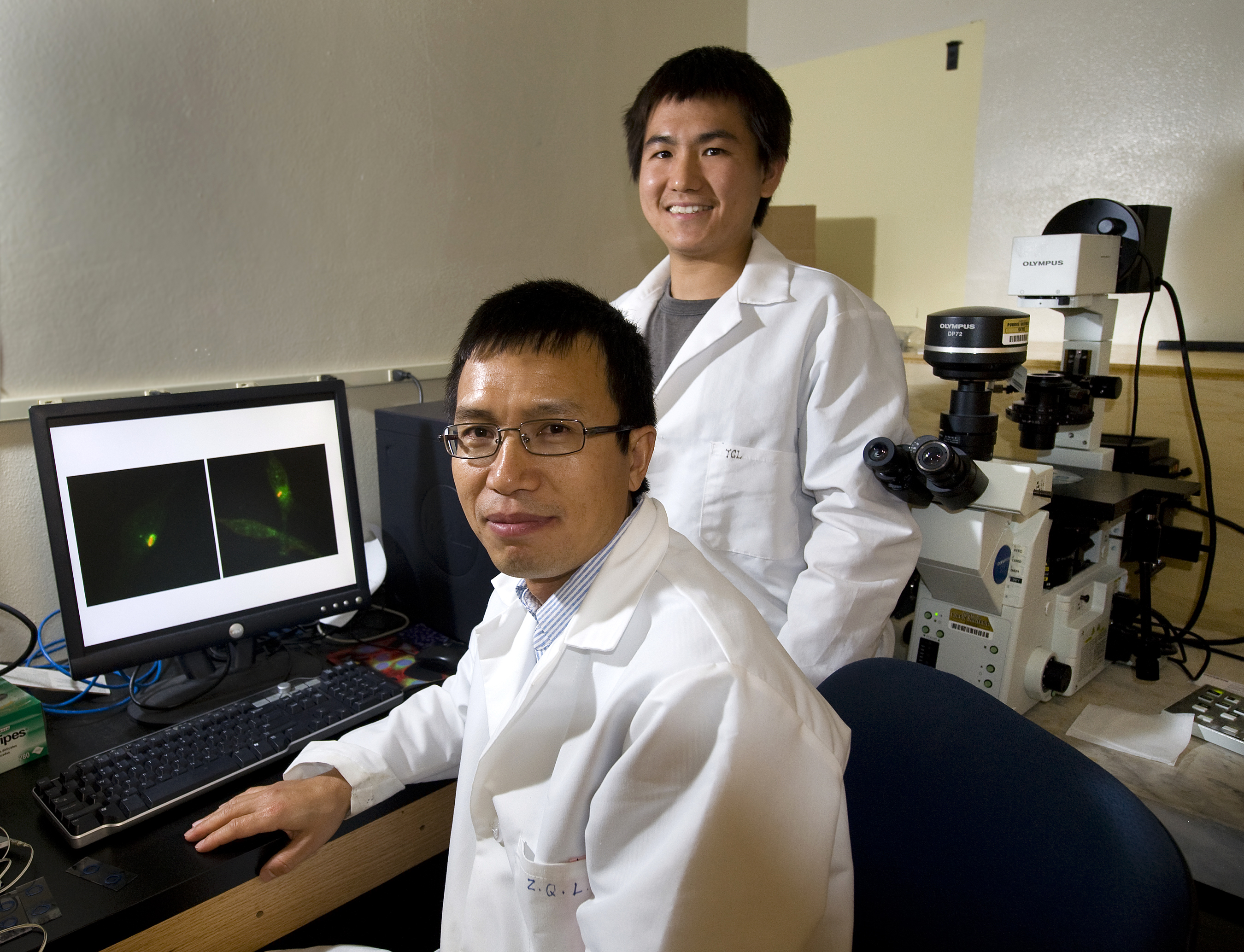
photo of Zhao-Qing Luo and Yunhao Tan

Associate professor of biological sciences Zhao-Qing Luo, foreground, and graduate student Yunhao Tan identified a new way in which bacteria modify healthy cells during infection. Shown on the computer screen are cells infected with a mutant strain of the bacteria Legionella pneumophila used in their research.

Purdue University biologists identified a new way in which bacteria hijack healthy cells during infection, which could provide a target for new antibiotics. Zhao-Qing Luo, the associate professor of biological sciences who led the study, said the team discovered a new enzyme used by the bacterium Legionella pneumophila – which causes Legionnaires’ disease – to control its host cell in order to take up residence.

“Legionnaires’ disease is a severe form of pneumonia, and this finding could lead to the design of a new therapy that saves lives,” Luo said. “At the same time it also provides great insight into a general mechanism of both bacterial infection and cell signaling events in higher organisms including humans.”

Successful infection by Legionella pneumophila requires the delivery of hundreds of proteins into the host cells that alter various functions to turn the naturally hostile environment into one tailor-made for bacterial replication. These proteins tap into existing communication processes within the cells in which an external signal, such as a hormone, triggers a cascade of slight modifications to proteins that eventually turns on a gene that changes the cell’s behavior, he said.

“Pathogens are successful because they know how information in our cells is relayed and they amplify some signals and block others in order to evade the immune system and keep the cell from defending itself,” Luo said. “Despite our understanding of this, we do not know much about how the proteins delivered by the bacteria accomplish this – how they work. This time we were able to pinpoint an enzyme and see how it disrupted and manipulated a specific signaling pathway in order to create a better environment for itself.”

The signaling pathway involved was only recently identified, and the discovery by Luo and graduate student Yunhao Tan also provides a key insight into its process. The signaling pathway involves a new form of protein modification called AMPylation in order to relay instructions to change cell behavior and has been found to be used by almost all organisms, Luo said.

The bacterium affects the host cell’s functions differently during different phases of the infection process, tapping into signaling pathways to turn on and off certain natural cellular activities. SidD stops the AMPylation process four hours after the start of infection in order to reverse an earlier modification that would be detrimental to the cell if left in place, he said.

Read the full press release.

Related: Using Bacteria to Carry Nanoparticles Into CellsDisrupting Bacterial Communication to Thwart ThemScientists Target Bacteria Where They LiveAre you ready for a world without antibiotics?

Photo of Fish Using a Rock to Open a Clam

photo of a blackspot tuskfish using a rock to crack open a clam

Blackspot tuskfish using a rock to crack open a clam. Photo by Scott Gardner

Diver Snaps First Photo of Fish Using Tools

While exploring Australia’s Great Barrier Reef, professional diver Scott Gardner heard an odd cracking sound and swam over to investigate. What he found was a footlong blackspot tuskfish (Choerodon schoenleinii) holding a clam in its mouth and whacking it against a rock. Soon the shell gave way, and the fish gobbled up the bivalve, spat out the shell fragments, and swam off. Fortunately, Gardner had a camera handy and snapped what seem to be the first photographs of a wild fish using a tool.

Tool use, once thought to be the distinctive hallmark of human intelligence, has been identified in a wide variety of animals in recent decades…

There have also been a handful of reports of fish cracking open hard-shelled prey, such as bivalves and sea urchins, by banging them on rocks or coral, but there’s no photo or video evidence to back it up, according to Culum Brown, a behavioral ecologist at Macquarie University in Sydney, Australia, and a co-author of the present paper, to be published in a forthcoming issue of Coral Reefs.

The more we learn about animals the more tool use we find. It is continually interesting to see the wide variety of behavior documented.

Related: Bird Using Bait to FishDolphins Using Tools to HuntOrangutan Attempts to Fish with SpearAncient Chimps Used Stone “Hammers”

PBS Newshour on Maker Faire

The maker movement is excellent. As the program suggests it also serves to show many people enjoy engineering and making things work. Kids love to learn to accomplish things. Memorizing boring science details is not as interesting or a very useful way to create the kinds of innovative scientists and engineers that can aid our economy.

Related: Teaching Through TinkeringMaking Electricity from WindHome Halloween Engineering: Gaping Hole Costume

Friday Fun: Cat and Owl Playing

This black cat and owl make very cute friends. They grew up together, follow their antics on the fum and gebra website. Other examples of interspecies fun: Cat and Crow FriendsBunny and KittensPolar Bears and HuskiesCats Connect with People, and Particularly Women, as Social Partners. Other times the interaction is surprising but not exactly friendly – The Cat and a Black Bear.

The State of the Oceans

World’s oceans in ‘shocking’ decline

In a new report, [an expert panel of scientists] warn that ocean life is “at high risk of entering a phase of extinction of marine species unprecedented in human history”. They conclude that issues such as over-fishing, pollution and climate change are acting together in ways that have not previously been recognised.

ocean acidification, warming, local pollution and overfishing are acting together to increase the threat to coral reefs – so much so that three-quarters of the world’s reefs are at risk of severe decline.

The report also notes that previous mass extinction events have been associated with trends being observed now – disturbances of the carbon cycle, and acidification and hypoxia (depletion of oxygen) of seawater.

Levels of CO2 being absorbed by the oceans are already far greater than during the great extinction of marine species 55 million years ago (during the Paleocene-Eocene Thermal Maximum), it concludes.

The overfishing of our oceans has been a problem for over 100 years and a known problem, that we continue to give too little attention to. Adding to that impacts of climate change and the state of ocean life is in trouble. The decision of our population to not deal with the causes of climate change will have very bad consequences. It is a shame we have so little caring about the consequences of our decisions. And even sadder that our “leaders” do such an appalling job of leading – instead they pander to selfish immediate gratification.

Related: Altered Oceans: the Crisis at Sea (2006)Unless We Take Decisive Action, Climate Change Will Ravage Our PlanetArctic System on Trajectory to New, Seasonally Ice-Free State (2005)

NASA’s Mars Curiosity Rover

Curiosity is the name of the new rover from NASA. It will be launched to continue the exploration of Mars so successfully done by Spirit and Opportunity (2 previous Mars rovers that did some amazing work and laster years longer than expected). The rover is NASA’s Mars Science Laboratory, a mobile robot for investigating Mars’ past or present ability to sustain microbial life.

photo of NASA's Mars Rover: Curiosity

Once on the surface, the rover will be able to roll over obstacles up to 75 centimeters (29 inches) high and travel up to 90 meters per hour. On average, the rover is expected to travel about 30 meters per hour, based on power levels, slippage, steepness of the terrain, visibility, and other variables.

The rover is about the size of a small SUV — 10 feet long (not including the arm), 9 feet wide and 7 feet tall. It weighs 900 kilograms (2,000 pounds)

The rover will carry a radioisotope power system that generates electricity from the heat of plutonium’s radioactive decay. This power source gives the mission an operating lifespan on Mars’ surface of a full martian year (687 Earth days) or more, while also providing significantly greater mobility and operational flexibility, enhanced science payload capability, and exploration of a much larger range of latitudes and altitudes than was possible on previous missions to Mars.

Related: Mars Rover Continues ExplorationMars Rovers Getting Ready for Another Adventure (2007)Sunset on Mars

Increasing the Undergraduate Study of Programing and Software

There is a role for computer science. It also seems to me there is a much larger role for some study of computing (programing, databases, software, technology) that isn’t actually computer science. Where exactly this should go into an undergraduate school, I am not sure. But it seems to me, an understanding of computing is extremely important to those that want to lead in the next 40 years and we should be able to put more of that into undergraduate studies.

Computer Studies Made Cool, on Film and Now on Campus

The number of computer science degrees awarded in the United States began rising in 2010, and will reach 11,000 this year, after plummeting each year since the end of the dot-com bubble in 2004, according to the Computing Research Association, which tracks enrollment and degrees. Enrollment in the major peaked around 2000, with the most degrees — 21,000 — awarded four years later. The number of students who are pursuing the degree but have not yet declared their major increased by 50 percent last year.

To capitalize on the growing cachet of the tech industry, colleges nationwide, including Stanford, the University of Washington and the University of Southern California, have recently revamped their computer science curriculums to attract iPhone and Facebook-obsessed students, and to banish the perception of the computer scientist as a geek typing code in a basement.

Even universities not known for computer science or engineering, like Yale, are seizing the moment. The deans of the Ivy League engineering schools recently started meeting to hatch ways to market “the Ivy engineer.”

The new curriculums emphasize the breadth of careers that use computer science, as diverse as finance and linguistics, and the practical results of engineering, like iPhone apps, Pixar films and robots, a world away from the more theory-oriented curriculums of the past.

I think the basic thrust of this move is good. I am not sure if it is really right to expand computer science to make it more attractive or to instead create something else. Computer engineering would seem to be one option, but I am not sure that is really right either. We do need computer scientists, but frankly we need maybe 100 or 1,000 times more programmers. And we need many other UX designers, program managers that understanding technology and programing, database administrators, system administrators… and really these people don’t need computer science backgrounds.

On a separate topic we also need better ways for everyone to understand technology better. We need good course for those majoring in economics, business, philosophy, English, political science… Understanding technology and how it works is fundamental to managing in the world we live in today and will live in.

Related: Programming Grads Meet a Skills Gap in the Real WorldHow To Become A Software Engineer/ProgrammerEngineering Again Dominates The Highest Paying College Degree ProgramsWant to be a Computer Game Programmer?software programming posts on my management blog

More Dark Matter Experiment Results

A dark-matter experiment deep in the Soudan mine of Minnesota now has detected a seasonal signal variation similar to one an Italian experiment has been reporting for more than a decade.

The new seasonal variation, recorded by the Coherent Germanium Neutrino Technology (CoGeNT) experiment, is exactly what theoreticians had predicted if dark matter turned out to be what physicists call Weakly Interacting Massive Particles (WIMPs).

“We cannot call this a WIMP signal. It’s just what you might expect from it,” said Juan Collar, associate professor in physics at the University of Chicago. Collar and John Orrell of Pacific Northwest National Laboratory, who lead the CoGeNT collaboration, are submitting their results in two papers to Physical Review Letters.

WIMPS might have caused the signal variation, but it also might be a random fluctuation, a false reading sparked by the experimental apparatus itself or even some exotic new phenomenon in atomic physics, Collar said.

Dark matter accounts for nearly 90 percent of all matter in the universe, yet its identity remains one of the biggest mysteries of modern science. Although dark matter is invisible to telescopes, astronomers know it is there from the gravitational influence it exerts over galaxies.

Theorists had predicted that dark matter experiments would detect an annual modulation because of the relative motion of the Earth and sun with respect to the plane of the Milky Way galaxy.
Continue reading

Hydromedusae, Siphonophora, Cnidarians, Ctenophores

Jellyfish is a common name for gelatinous water dwelling animals. The diversity of these invertebrates is amazing. And what actually counts as a jellyfish is not easy to determine. Watch this great video to learn about Cnidarians, Urochordata, Polychaetes and Ctenophores.

Related: Darwin’s JellyfishesOcean LifeCritter Cam: Sea Lion versus OctopusImage of Map Showing Concentration of Life in Oceans

CDC Report on Failures to Vaccinate

Science brought us the miracle of vaccines and the near elimination of many diseases. Unfortunately people are choosing to bring those diseases to many more people because they failed to get vaccinated or failed to vaccinate their children. The needless pain and suffering caused by these poor decisions are a sad testament to scientific illiteracy.

The financial implications of the US measles outbreaks

One reason measles outbreaks are so scary (and so difficult to contain) is that measles is the most infectious microbe known to man–it’s transmission rate is around 90 percent. It has also killed more children than any other disease in history.

The most significant factor in the spread of measles in the United States is declining vaccination rates — and, similar to what occurred in the UK in the early part of the last decade, that decline can be traced back to the press-fueled panic…

CDC report on Measles

Children and adults who remain unvaccinated and develop measles also put others in their community at risk…

In Europe in recent years, measles has been fatal for several children and adolescents, including some who could not be vaccinated because they were immune compromised.

Rapid control efforts by state and local public health agencies, which are both time intensive and costly, have been a key factor in limiting the size of outbreaks and preventing the spread of measles into communities with increased numbers of unvaccinated persons. Nonetheless, maintenance of high 2-dose MMR vaccination coverage is the most critical factor for sustaining elimination. For measles, even a small decrease in coverage can increase the risk for large outbreaks and endemic transmission, as occurred in the United Kingdom in the past decade…

Related: Vaccines Don’t Provide Miraculous Results if We Don’t Take ThemThe Illusion of Understanding500 Year Floods