Category Archives: Career

Information on jobs and careers in science and engineering.

Most IT Jobs Ever in USA Today

Blue Skies Ahead for IT Jobs by Maria Klawe (dean of the School of Engineering and Applied Science and a professor of computer science at Princeton University) in CIO magazine:

Contrary to popular belief, career opportunities in computer science [in the USA] are at an all-time high.

The latest figures from the U.S. Department of Labor show that the number of computing-related jobs has surpassed the previous peak in 2000. What is more, computing-related jobs are no longer an isolated component of American industries; IT underpins every function of the business community—market research, product design, finance, strategic planning, environmental issues—every aspect of doing and leading.

Looking at the actual data, is becoming a theme through many of our posts recently. Many believe IT opportunities are decreasing, but the labor department data shows this is not the case.

The preparation we need starts in grades K-12, when many students turn away from math and science. A key problem is that children receive very little exposure to real projects and careers in engineering and applied science.

The idea that the education system is a key to creating a supply of capable workers is widely recognized. Now we just need to actually making the changes people are talking about. This article gives a number of interesting suggestions.

At Princeton, a new integrated course that combines computer science, biology, physics and chemistry has attracted several women to major in computer science.

Information Technology has become integral to most significant efforts in most organizations today. Organizations need, IT engineers to work in cooperation with other experts to implement solutions.

Science Careers

ScienceCareers.org web site from AAAS, Science Magazine.

includes an average of over 1,000 job postings which are updated daily, career advice articles written by the editors of Next Wave, graduate program information, meetings & event information, funding opportunities on GrantsNet, and a Career Forum where scientists can get free advice about career-related issues from veteran advisors… All for free.

An article providing an overview of the site: ScienceCareers.org: Your Science Career, in a Nutshell

And it doesn’t matter whether you’re a life scientist, a clinical scientist, a physical scientist, or a computer scientist: We’ll continue to meet your scientific career needs, with an archive of nearly 4000 articles on scientific careers and new content every week.

SMART Fellowships/Scholarships

The Science, Mathematics and Research for Transformation (SMART) Scholarship application opened yesterday (the application closes February 17, 2006.

More details available online

Financial Assistance
Subject to the availability of funds, scholarships awarded will pay: salary or stipend, full tuition, required fees, up to $1000 book allowance per year, room and board and other normal educational expenses for the institution involved. The annual salary will be in the range of $20,000 to $40,000 depending upon student’s academic status. Students are required to spend their summer as an intern with a Department of Defense (DoD) Agency.

Employment Obligation
Upon selection, students must sign a DoD civilian service agreement. The employment obligation to the DoD civilian workforce upon completion of the scholarship/fellowship will be a one-for-one commitment. Failure to complete the required period of service will require the reimbursement of funds expended by the Government for the individual’s education under this program.

SMART scholarships and fellowships are awarded to applicants who are pursuing a degree in, or closely related to, one of the following SME disciplines:

* Aeronautical and Astronautical Engineering, Aerospace Engineering
* Biosciences
* Chemical Engineering
* Chemistry
* Civil Engineering
* Cognitive, Neural, and Behavioral Sciences, Psychology
* Computer and Computational Sciences
* Electrical Engineering
* Geosciences
* Materials Science and Engineering
* Mathematics, Operations Research
* Mechanical Engineering
* Naval Architecture and Ocean Engineering
* Oceanography
* Physics, Physical Sciences

Science Researchers: Need for Future Employees

Scientists and engineers: Crisis, what crisis? by Mario Cervantes. More data on the question of a shortage of skilled workers, this time, researchers from January 2004:

The number of researchers in OECD countries rose from 2.4 million in 1990 to 3.4 million in 2000, a 42% increase, and demand is still expanding – the EU estimates it will need 700,000 new researchers to meet its commitment to increase investment in R&D to 3% of GDP by 2010. The US National Science Foundation projects that some 2.2 million new jobs in science and engineering will be created over 2000-2010, especially in computer-related occupations. In Japan the University Council predicted in 1998 that demand for masters students would exceed supply by 2010.
In other words, while few scientists are out of work, a significant proportion of them are not finding jobs in occupations that are closely related to their studies. This would weaken the claim of a widespread shortage of science and engineering graduates, but may signal another problem: “mismatches” between what the market (industry or academia) needs and is willing to pay in terms of research, and the skill sets, interests and salary aspirations that graduates have.

Well, if they are employed then there is a match between workers and jobs. The whole idea of the market working to match up the workers to jobs is based on the idea that workers and employers will react to shortages and surpluses by paying more and offering inducements to change career paths (employers facing a shortage) and some workers will decide to take them up on these offers.

I don’t doubt the market has and will continue to be dynamic. Knowledge workers should expect continuing education and learning throughout their careers. And I think most do expect that.

The strong case that the system was failing to match workers to jobs would be high unemployment rates and open jobs that employers couldn’t fill because people did not have the right skills. Taking actions to align higher education with the needs of the economy for science and engineering knowledge is wise. However, I think there will always be slight adjustments needed once students graduate. The key is that they are prepared to quickly learn the specific needs of the current marketplace. That I think is achievable and should be one of the goals of institutions of higher education.

Google opens research office near CMU

Google to open new research facility in Pittsburgh:

Google Inc., the leading online search engine company, will open a new engineering and research office in Pittsburgh next year to be headed by a Carnegie Mellon University professor, the company announced Thursday.

The facility will be charged with creating software search tools for Google. It is expected to create as many as 100 new high-tech jobs in the Pittsburgh area over the next few years, said Craig Nevill-Manning, director of Google’s New York engineering office.

This is another specific example how higher education in engineering and science can create jobs. Obviously, there are many cheaper places for Google to start new offices.

Related posts:

Engineers in the Workplace

The engineers are feeling gloomy by Aliza Earnshaw:

Engineers interviewed in depth for the survey went so far as to say they would not recommend that their children follow them into the profession.

“There’s no money in it, there’s nothing but layoffs, and it’s all being outsourced to India,” said one engineer.

“There’s no respect,” comparable to that accorded lawyers or physicians, said another. “Someone with a bachelor’s or master’s in electrical engineering or software, he’s just a flunky.”

It is true some jobs are being moved overseas. But the unemployment rate for engineers is still very low (under 3%). Also the pay for engineering graduates is very high.

The status (respect) accorded to engineers may well indicate a long term trend in the United States to value those who work with money (salesmen, managers, finance…) over those who work on things (engineers, skilled workers, software…). I think this is a significant problem that does require that management improvement. In my view companies that realize that engineers, other knowledge workers, should be the focus of their management (not playing games with quarterly earnings) will outperform those that try to manage companies through financial measures alone.

In a post on our Curious Cat Management Articles blog, Google: Ten Golden Rules, we quoted a Business Week article, Googling for Gold:

The suits inside Google don’t fare much better than the outside pros. Several current and former insiders say there’s a caste system, in which business types are second-class citizens to Google’s valued code jockeys

with engineers and product managers tending to carry more clout than salesmen and dealmakers.

Maybe the suits shouldn’t complain too loudly. They may get others to look at why Google is doing so well and decide it is due to placing more respect on engineers and less on suits (not that suits don’t deserve respect but I question the current balance of respect in most companies). I believe the success of Google will eventually get more “suits” to realize they need to do everything they can to allow the engineers in their companies to innovate. At this time, it is easy for most to see this concept for software engineers but similar potential exists for many engineers.

Here is some data from the United States Bureau of Labor Statistics (which has some great data but the web site could be much better).

Hourly Rates for Engineers in the USA
Field 1997

2000 2004
Aerospace 30.44 33.34 41.15
Chemical 30.65 36.39 37.97
Electrical 29.24 33.94 37.32.15
Petroleum 35.44 36.75 43.26
Other 29.00 33.52 36.59

Some additional data from IEEE, Employment Data Paints a Disturbing Picture:

In the first quarter of 2005, electrical engineers (EE) faced an unemployment rate that by fell to 2.1 percent, just about its historic average. The rate has been declining since 2003 when electrical engineers faced an unemployment rate of 6.3 percent — the highest ever recorded for EEs.

Between 2003 and the first quarter of this year, unemployment fell along with total employment, which declined from 363,000 in 2003 to 335,000 in March of 2005, almost 8 percent. The only way the number of unemployed engineers and the number of employed engineers can both fall at the same time is if a large number of engineers are simply leaving the profession.

While the situation is difficult there are positive and negative trends. We will continue to post on this topic.

Related posts:

Shortage of Engineers?

Training Engineers – Continually by Ken Jarboe, quoting a Wall Street Journal article:

Many companies say they’re facing an increasingly severe shortage of engineers. It’s so bad, some executives say, that Congress must act to boost funding for engineering education.

Yet unemployed engineers say there’s actually a big surplus. “No one I know who has looked at the data with an open mind has been able to find any sign of a current shortage,” says demographer Michael Teitelbaum of the Alfred P. Sloan Foundation.

2005 starting salaries I would like to see data to confirm on refute this claim (such as the unemployment rate for engineers over time and pay for engineers over time) but some evidence seems to indicate there is a demand to pay engineers well. That makes me think it is unlikely there is a huge oversupply of engineers (if there was a huge oversupply prices would fall). Granted skill mismatches could account for increasing salaries for engineers while other engineers are unable to find jobs.

Also the marketplace (for any employees, including engineers) is indeed inefficient. But that inefficiency is not complete (so while waste is in the system where employers are not most effectively employing available candidates the system does match the employers and employees). I think it is definitely true the inefficiency of the marketplace hurts companies, potential employees and the economy.

Making the marketplace more efficient would be great but we seem to be making little progress in that area. On a personal level I have long believed the employment marketplace is very inefficient. I think this is true for a variety of complex reasons. I also think companies that figure out how to do so more effectively will gain a competitive advantage. I don’t think their are easy solutions. I believe companies that chose to manage the employee recruitment process using management improvement concepts will gain an advantage over others.

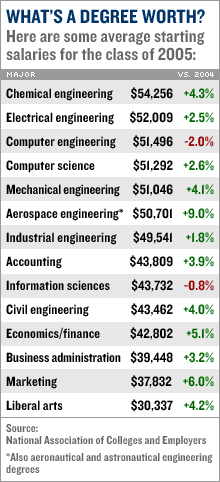
Graphic from the CNN article (April 2005): Average starting salaries for class of ’05 higher — in some cases notably — than last year. 6 of the highest paid starting salaries by major are engineering majors (the other is computer science).

Aerospace and aeronautical engineering majors, for instance, are enjoying a 9 percent increase in starting salaries; marketing majors have seen a 6 percent increase in starting salaries; while economics and finance majors are getting paid 5.1 percent more than last year.

Meanwhile, chemical, mechanical and civil engineers are also seeing paychecks that are at least 4 percent higher.

While such data does not show the health of the entire engineering field it sure is a positive indication for those starting out.

Ken Jarboe:

Let’s put our attention on the total skill development of the S&T workforce – and everyone else, for that matter. That is how we will strengthen our competitive advantage and avoid the skills-person mismatch that seems to plague our S&T labor market

I agree with a focus on a more comprehensive look at education and skill development. A huge amount of education is now done in the workplace. But this transition away from academic learning to employment learning needs to be factored into public policy. We also need to figure out how to incorporate these changes in learning into the hiring process and the economy as a whole. We are making those changes now but in a fairly inefficient way, without much planning and thought. I don’t know what should be done but I do believe this is something in need of improvement.