Category Archives: Economics

Posts exploring the economic impacts of science and engineering. The value of strong science and engineering practice has many benefits to the economy – directly and indirectly. Many countries are focusing their future economic plans on advancing their scientific, engineering and technology communities and creating environments that support scientists and engineers.

China’s Economic Science Experiment

The Great Chinese Experiment, Horace Freeland Judson, MIT Technology Review. China is betting its economic health on becoming a world leader in the sciences. But will it succeed? This long detailed article provides insight into the challenges, practices and potential for China’s economy and scientific innovation going forward.

“The major scientific program running right now in China is this one, called 97-3 Program,” Professor Cao said. “A major huge program to catch up with the scientific development of the whole world. Started in 1997, March. This program is for basic research. According to the needs of the nation.” Technological applications? Or basic science? “Both,” she said with a sharp nod. The goal is split in two? “Yes,” she said. “I think that the major scientific program is the whole-world program. Not just for China. The second is the urgent requirement for our country’s social and economic development.”

The 97-3 Program concentrates research in six areas, agricultural biotechnology, energy, informatics, natural resources and the environment, population and health, and materials science. Cao’s own concern is with population and health. In this area the research is divided into 20 fields. She took me through them with the aid of a 33-page position paper she had put together in anticipation of my visit. The list is diverse, the projects ambitious. Yet even the most basic research — in stem cells, for example — has been defined in terms of immediate applications.

Information on the China 973 basic research program from the Chinese government’s web site:

Stipulation and implementation of the 973 Program is an important decision of our country to carry out the two development strategies of ” Rejuvenating the country through science and technology ” and ” sustainable development”, as well as to further reinforce basic research and science and technology work. It is an important measure of our country to achieve the great objectives of China’s economic, scientific & technology, and social development by 2010-2050 , to upgrade the sustainable S & T innovative capabilities and to meet the challenges of the new century.

While the engineering credentials of China’s leadership is noted often, it is still interesting to note that China’s 9 senior government officials are all engineers. A Technocrat Riding a Wild Tiger:

When China’s leaders meet with Hu each week in Beijing’s government district, Zhongnanhai, they could spend hours discussing cables, switches, tool-making machines and control devices. That’s because every one of them has a degree in engineering. The president himself, the son of a tea merchant from Jiangsu Province, trained to build hydroelectric power stations, while the others hold degrees in electrical engineering, metallurgy and geology.

Science and Engineering Innovation Legislation

Ensign, Lieberman Introduce Major Bipartisan Innovation Legislation – the press release from Senator Lieberman’s office indicates Science and Engineering Fellowships Legislation we mentioned previously, has been introduced:

Our legislation will significantly increase federal support for graduate fellowship and traineeship programs in science, math, and engineering fields in order to attract more students to these fields and to create a more competitive and innovative American workforce.

China and India alone graduate 6.4 million from college each year and over 950,000 engineers. The United States turns out 1.3 million college graduates and 70,000 engineers.

Expands existing educational programs in the physical sciences and engineering by increasing funding for NSF graduate research fellowship programs as well as Department of Defense science and engineering scholarship programs.

The recent report from Duke, explains that the figures on science and engineering graduates used are not accurate (see below). Still, this seems like a good idea. The press release also includes a list of organizations supporting the legislation including: Athena Alliance, Business Roundtable, Council on Competitiveness, Council of Scientific Society Presidents. From the section by section details included on the web site:

The Director of NSF will expand the agency’s Graduate Research Fellowship Program by 250 fellowships per year and extend the length of each fellowship to five years. Program by 250 fellowships per year and extend the length of each fellowship to five years. The bill authorizes $34 million/year for FY 2007- FY 2011 to support these additional fellowships. In addition, funding in the amount of $57 million/year is authorized for a similar expansion of the Integrated Graduate Education and Research Traineeship program by 250 new traineeships per year over five years.
The Tech Talent expansion program encourages American universities to increase the number of graduates with degrees in mathematics and science. The bill authorizes $335 million from Fiscal Year 2007 to Fiscal Year 2010 for continued support of this program.
This section extends the Department of Defense’s Science, Mathematics, and Research for Transformation (SMART) Scholarships program through September 30, 2011, and authorizes $41.3 million/year over 5 years for the SMART program to support additional participants pursuing doctoral degrees and master’s degrees in relevant fields. This section also authorizes $45 million/year over 5 years to be appropriated to the Department of Defense through 2011 to support the expansion of the National Defense Science and Engineering Graduate Fellowship program to additional participants.

Related posts:

Nanotechnology Research

Nanotech’s super salesman by Darin Barney, Globe and Mail (Canada), review of
The Dance of Molecules: How Nanotechnology is Changing Our Lives by Ted Sargent.:

As one might expect, the biggest prizes are medical. Nanoscale “chips that merge computer technologies with cells and genes and proteins” will act as early warning beacons in the detection of cancer and Alzheimer’s disease. Spread of these diseases will be checked at the earliest stages by pharmacies on a chip, implanted in our bodies and programmed remotely by our physician’s cellphone to deliver “a veritable cocktail of drugs.” And if this doesn’t work (or even if we are just overcome by “our unquenchable thirst for self-improvement”), nanoscale tissue engineering will provide a ready supply of replacement parts.

Panel looks at ways to clean up nanotech’s act:

But nanotech may also introduce unwanted side effects that, if not managed effectively, might prompt bans on useful nanomaterials.

Nanotech pioneers can look at asbestos and DDT as examples of materials that solved critical long-standing problems, but caused health and environmental problems so severe as to nullify the materials’ benefits. Nanotechnology is setting out on the same road, promising effective medical treatments and “miracle” consumer products, but also posing threats that must be neutralized if the technology is to be accepted.

Nanotechnology provides great promise. The dangers cannot be ignored, however. Managing those dangers is not an easy task. Those promoting moving forward quickly often ignore potential problems. And given the way the scientific and engineering landscape is changing worldwide, if any country creates to many barriers to research that research will likely move elsewhere, along with many high paying jobs.

Google opens research office near CMU

Google to open new research facility in Pittsburgh:

Google Inc., the leading online search engine company, will open a new engineering and research office in Pittsburgh next year to be headed by a Carnegie Mellon University professor, the company announced Thursday.

The facility will be charged with creating software search tools for Google. It is expected to create as many as 100 new high-tech jobs in the Pittsburgh area over the next few years, said Craig Nevill-Manning, director of Google’s New York engineering office.

This is another specific example how higher education in engineering and science can create jobs. Obviously, there are many cheaper places for Google to start new offices.

Related posts:

Engineers in the Workplace

The engineers are feeling gloomy by Aliza Earnshaw:

Engineers interviewed in depth for the survey went so far as to say they would not recommend that their children follow them into the profession.

“There’s no money in it, there’s nothing but layoffs, and it’s all being outsourced to India,” said one engineer.

“There’s no respect,” comparable to that accorded lawyers or physicians, said another. “Someone with a bachelor’s or master’s in electrical engineering or software, he’s just a flunky.”

It is true some jobs are being moved overseas. But the unemployment rate for engineers is still very low (under 3%). Also the pay for engineering graduates is very high.

The status (respect) accorded to engineers may well indicate a long term trend in the United States to value those who work with money (salesmen, managers, finance…) over those who work on things (engineers, skilled workers, software…). I think this is a significant problem that does require that management improvement. In my view companies that realize that engineers, other knowledge workers, should be the focus of their management (not playing games with quarterly earnings) will outperform those that try to manage companies through financial measures alone.

In a post on our Curious Cat Management Articles blog, Google: Ten Golden Rules, we quoted a Business Week article, Googling for Gold:

The suits inside Google don’t fare much better than the outside pros. Several current and former insiders say there’s a caste system, in which business types are second-class citizens to Google’s valued code jockeys

with engineers and product managers tending to carry more clout than salesmen and dealmakers.

Maybe the suits shouldn’t complain too loudly. They may get others to look at why Google is doing so well and decide it is due to placing more respect on engineers and less on suits (not that suits don’t deserve respect but I question the current balance of respect in most companies). I believe the success of Google will eventually get more “suits” to realize they need to do everything they can to allow the engineers in their companies to innovate. At this time, it is easy for most to see this concept for software engineers but similar potential exists for many engineers.

Here is some data from the United States Bureau of Labor Statistics (which has some great data but the web site could be much better).

Hourly Rates for Engineers in the USA
Field 1997

2000 2004
Aerospace 30.44 33.34 41.15
Chemical 30.65 36.39 37.97
Electrical 29.24 33.94 37.32.15
Petroleum 35.44 36.75 43.26
Other 29.00 33.52 36.59

Some additional data from IEEE, Employment Data Paints a Disturbing Picture:

In the first quarter of 2005, electrical engineers (EE) faced an unemployment rate that by fell to 2.1 percent, just about its historic average. The rate has been declining since 2003 when electrical engineers faced an unemployment rate of 6.3 percent — the highest ever recorded for EEs.

Between 2003 and the first quarter of this year, unemployment fell along with total employment, which declined from 363,000 in 2003 to 335,000 in March of 2005, almost 8 percent. The only way the number of unemployed engineers and the number of employed engineers can both fall at the same time is if a large number of engineers are simply leaving the profession.

While the situation is difficult there are positive and negative trends. We will continue to post on this topic.

Related posts:

Engineers Trained in Lean Manufacturing

14 engineers trained in ‘lean manufacturing’

One North East is investing £9.4m into the North East Productivity Alliance (NEPA) to ensure its acclaimed work with regional companies continues until at least 2009.

The cash will allow 14 new engineers, handpicked from regional firms, to be trained under the NEPA programme, to work with management and shopfloor staff to engrain best practice ‘lean manufacturing’ into companies and raise their productivity.

The funding will also ensure the future of NEPA’s Digital Factory project – which helps firms adopt new technologies to boost productivity.

One NorthEast is a Regional Development Agency helping to create and sustain jobs, prosperity and a higher quality of life. The mission: ‘To transform England through sustainable economic development.’

David Allison, One North East Director of Business and Industry, said: “This further investment by One NorthEast in the NEPA programme is proof positive of the importance the regional development agency attaches to manufacturing.

”The NEPA programme is held up as a shining example nationally of how the public sector can work with private manufacturers to raise productivity and help them compete in a fierce global marketplace.

“Manufacturing continues to be a cornerstone of the North East economy, employing 169,000 people, contributing 25% of its GDP and generating £2.6bn in wages every year.”

The NEPA team is keen to work with regional companies to identify new engineers to work in the project. Employees will gain valuable new qualifications, boosting their worth to their parent companies by bringing best practice technique into the workplace.

More articles on lean manufacturing

Engineering for the Americas Symposium

Engineering for the Americas Symposium:

Engineering education, innovation trends and perspectives on the knowledge-based economy will top the agenda in the four-day Engineering for the Americas Symposium, which opens November 29 in Lima, Peru.

The forum is a joint initiative of the Organization of American States (OAS) Office of Education, Science and Technology, the US Trade and Development Agency, the World Federation of Engineering Organizations, several professional associations, academia, governments and industry, including Hewlett-Packard Company (HP), National Instruments and Microsoft.

Among other objectives, the organizers hope the four-day meeting will produce a clear understanding of the role of engineering education and capacity building in developing countries and a “country roadmap” to that end as well as information on potential funding sources to implement country plans. The organizers also hope to chart a “way forward” for the Engineering for the Americas program.

Shortage of Engineers?

Training Engineers – Continually by Ken Jarboe, quoting a Wall Street Journal article:

Many companies say they’re facing an increasingly severe shortage of engineers. It’s so bad, some executives say, that Congress must act to boost funding for engineering education.

Yet unemployed engineers say there’s actually a big surplus. “No one I know who has looked at the data with an open mind has been able to find any sign of a current shortage,” says demographer Michael Teitelbaum of the Alfred P. Sloan Foundation.

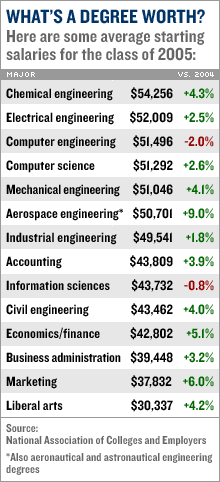
2005 starting salaries I would like to see data to confirm on refute this claim (such as the unemployment rate for engineers over time and pay for engineers over time) but some evidence seems to indicate there is a demand to pay engineers well. That makes me think it is unlikely there is a huge oversupply of engineers (if there was a huge oversupply prices would fall). Granted skill mismatches could account for increasing salaries for engineers while other engineers are unable to find jobs.

Also the marketplace (for any employees, including engineers) is indeed inefficient. But that inefficiency is not complete (so while waste is in the system where employers are not most effectively employing available candidates the system does match the employers and employees). I think it is definitely true the inefficiency of the marketplace hurts companies, potential employees and the economy.

Making the marketplace more efficient would be great but we seem to be making little progress in that area. On a personal level I have long believed the employment marketplace is very inefficient. I think this is true for a variety of complex reasons. I also think companies that figure out how to do so more effectively will gain a competitive advantage. I don’t think their are easy solutions. I believe companies that chose to manage the employee recruitment process using management improvement concepts will gain an advantage over others.

Graphic from the CNN article (April 2005): Average starting salaries for class of ’05 higher — in some cases notably — than last year. 6 of the highest paid starting salaries by major are engineering majors (the other is computer science).

Aerospace and aeronautical engineering majors, for instance, are enjoying a 9 percent increase in starting salaries; marketing majors have seen a 6 percent increase in starting salaries; while economics and finance majors are getting paid 5.1 percent more than last year.

Meanwhile, chemical, mechanical and civil engineers are also seeing paychecks that are at least 4 percent higher.

While such data does not show the health of the entire engineering field it sure is a positive indication for those starting out.

Ken Jarboe:

Let’s put our attention on the total skill development of the S&T workforce – and everyone else, for that matter. That is how we will strengthen our competitive advantage and avoid the skills-person mismatch that seems to plague our S&T labor market

I agree with a focus on a more comprehensive look at education and skill development. A huge amount of education is now done in the workplace. But this transition away from academic learning to employment learning needs to be factored into public policy. We also need to figure out how to incorporate these changes in learning into the hiring process and the economy as a whole. We are making those changes now but in a fairly inefficient way, without much planning and thought. I don’t know what should be done but I do believe this is something in need of improvement.

Companies Not Countries

Companies, Not Countries, Hold The Key to Innovation Leadership by Lester Craft:

But given the overall trend, I would argue that we are quickly heading toward an era where corporations view innovation almost strictly in terms of their own global self-interest rather than in terms of one nation or another. If this is true, then we need to adjust our thinking about America’s role as an innovation leader. When it comes to innovation and intellectual property, it may be that companies are replacing countries as the entities that make the rules.

I agree the impact of countries is declining and companies increasing. Still governments hold a great deal of power to create environments that are supportive or hostile to innovation and thereby influence where it is done.

One, of many reasons, the Untied States succeed in the last half of the 20th century was wise government support of innovation. Now other countries such as India, Singapore, China, Korea… are taking smart action also.

There is still plenty of room for government policy to influence where innovation will take place. As mentioned in my previous posts (see below) being the country that trains doctoral candidates has many benefits. If any country trains 50% of the science and engineering doctoral candidates in 2050 they will have a huge advantage in innovation. Tax policy also has an impact. Intellectual property rights also have an impact. Many factors that governments largely define (and therefore differences exist between countries in how well these factors support innovation and where investors will choose to invest) will play a role in what countries innovation flourishes in going forward: infrastructure, legal system, primary education system, health care system, financial system, funding and encouraging basis research…

I happen to side with those like Lawernce Lessig that believe we are harming the United States economy by having a government policy that too restrictive about intellectual property. I believe countries that have sufficient clout to stand up to the United States, and who have a more sensible IP policy will gain a great advantage if the United States were not to adjust policies based on the ideas of Lessig and others.

The change that I think should be made is to see the role of government as a influencer of what the future will hold rather than a dictator. The actions the United States government takes will be one factor that determines where innovation takes place (and what geographic location gains the largest economic benefit) but other countries, companies and individuals will also make decisions. It will be a much more interdependent system than in the past. And no one player will be able to dictate the action.

Google’s success is not solely due to the fact it was formed in the United States. But there are many reasons why Google, ebay, Amazon, Yahoo… are based in the United States and have lead the way in internet innovation. The challenge for the United States is to keep those comparative advantages as high as possible even though the advantages are declining and will continue to do so, in my opinion.

Related posts:

Article: Is the US Patent System Endangering American Innovation?