Category Archives: Education

MIT International Science and Technology Initiatives

MIT International Science and Technology Initiatives

MIT is providing seed funding to faculty to encourage global research. The seed funds cover a variety of expenses, including exploratory field research, workshop materials and instrument costs. Each proposal is eligible for up to $20,000 in funding. Research and collaboration can take place anywhere in the world on any topic. For all projects, up to $10,000 in additional funding is available for undergraduate and graduate student participation.

MISTI country programs also offer five country-specific seed funds for collaborative research involving France, India, Italy, Japan or Spain.

This is a good use of their huge endowment. So is the Open Courseware initiative. As is their elimination of tuition for those with families earning less than $75,000. Good for MIT.

Related: Global Engineering Education StudyMIT Faculty Study Recommends Significant Undergraduate Education ChangesFunding Medical Research

Best Research University Rankings – 2008

The annual ranking of research Universities are available from Shanghai’s Jiao Tong University. The methodology values publications and faculty awards which provides a better ranking of research (rather than teaching). Results from the 2008 rankings of Top 500 Universities worldwide, country representation of the top schools:

location Top 100 % of World
Population
% of World GDP % of top 500
USA 54     4.6%   27.2%  31.6%
United Kingdom 11  0.9  4.9 8.3
Germany   6  1.3  6.0 8.0
Japan   4  2.0  9.0 6.2
Canada   4  0.5  2.6 4.2
Sweden   4  0.1  0.8 2.2
France   3  0.8  4.6 4.6
Switzerland   3  0.1  0.8 1.6
Australia   3  0.3  1.6 3.0
Netherlands   2  0.2  1.4 2.4
Denmark   2  0.1  0.6 0.8
Finland   1  0.1  0.4 1.2
Norway   1  0.1  0.7 0.8
Israel   1  0.1  0.3 1.2
Russia   1  2.2  2.0 0.4
China  20.5  6.6 6.0
India  17.0  1.9 0.4

There is little change in most of the data from last year, which I think is a good sign, it wouldn’t make much sense to have radical shifts over a year in these rankings. Japan lost 2 schools in the top 100, France lost 1. Denmark (Aarhus University) and Australia (University of Sydney) gained 1. Last year there was a tie so there were 101 schools in the top 100.

The most dramatic data I noticed is China’s number of top 500 schools went from 14 to 30, which made me a bit skeptical of what caused that quick change. Looking more closely last year they reported the China top 500 totals as (China 14, China-Taiwan 6 and China-Hong Kong 5). That still gives them an impressive gain of 5 schools.

Singapore has 1 in the 102-151 range. Taiwan has 1 ranked in the 152-200 range, as do Mexico, Korea and Brazil. China has 9 in the 201-302 range (including 3 in Hong Kong). India has 2 in the 303-401 range.

University of Wisconsin – Madison is 17th again 🙂 My father taught there while I grew up.
Continue reading

Jetsone Jetplane Over English Channel

photo of personal jet wings

We first posted on Yves Rossy’s personal jetpack in 2006. Now he is preparing to fly over the English channel with this jetwings.

The plan is that on or around September 24, Yves will climb into a light aircraft somewhere near Calais with his wing firmly strapped on to his back and a live television crew from the National Geographic Channel filming his every move.

When the plane is at 8,000ft, he will fire up the four little jet engines attached to the underside of the wing and then jump out. In the plane, the wingtips are always folded or Yves would not fit through the door. Once in the open air, he will pull a cord and the two spring-loaded ends will snap open to give him a full wing span of just over eight feet.

He will open up his engines, dive for a few seconds to pick up a speed of around 200mph and then level out at around 5,000ft before flying in a straight line at roughly 115mph to England. As long as the wind is not above 10mph in the opposite direction, he should have enough juice to get him to Kent.

There, he will pull his parachute ripcords and drop safely on to Blighty’s fair shores.

Related: photo from Yves Rossy web siteAlienFly RC Mosquito HelicopterEngineering Quiet, Efficient PlanesMegaflood Created the English Channel

10 Most Beautiful Physics Experiments

Science’s 10 Most Beautiful Experiments by George Johnson

Galileo’s experiment on falling objects

In the late 1500’s, everyone knew that heavy objects fall faster than lighter ones. After all, Aristotle had said so. That an ancient Greek scholar still held such sway was a sign of how far science had declined during the dark ages.

Galileo Galilei, who held a chair in mathematics at the University of Pisa, was impudent enough to question the common knowledge. The story has become part of the folklore of science: he is reputed to have dropped two different weights from the town’s Leaning Tower showing that they landed at the same time. His challenges to Aristotle may have cost Galileo his job, but he had demonstrated the importance of taking nature, not human authority, as the final arbiter in matters of science.

Young’s double-slit experiment applied to the interference of single electrons

Though it is not simply made of particles, neither can it be described purely as a wave. In the first five years of the 20th century, Max Planck and then Albert Einstein showed, respectively, that light is emitted and absorbed in packets — called photons. But other experiments continued to verify that light is also wavelike.

It took quantum theory, developed over the next few decades, to reconcile how both ideas could be true: photons and other subatomic particles — electrons, protons, and so forth — exhibit two complementary qualities; they are, as one physicist put it, ”wavicles.”

Eratosthenes’ measurement of the Earth’s circumference -the librarian at Alexandria in the third century B.C. estimated the circumference of the planet

Assuming the earth is spherical, its circumference spans 360 degrees. So if the two cities are seven degrees apart, that would constitute seven-360ths of the full circle — about one-fiftieth. Estimating from travel time that the towns were 5,000 ”stadia” apart, Eratosthenes concluded that the earth must be 50 times that size — 250,000 stadia in girth.

Related: Book, The Ten Most Beautiful Experiments by George Johnson (not the same experiments) – Home Experiments: Quantum ErasingParticles and Wavestheory of knowledgescientific experiments

Bill Nye the Science Guy, Interview

Bill Nye the Science Guy Makes Green “Stuff Happen”

One of your first “Stuff Happens” episodes is about breakfast. What’s so special about breakfast and the environment?
Are you kidding? It’s the most important meal of the day. It had the iconic story that North American pigs – from where we get bacon – I presume unwillingly are fed feed made with South American anchovies (and herrings and sardines). Farmers say eating fish helps their animals grow to that wonderfully ample size consumers want. Because of this, we’re accidentally destroying an ecosystem. It’s the story of stories.

How so?
We’re seriously depleting the world’s anchovy population and leaving the penguins and South American seabirds with nothing to eat. These birds are dangerously close to starving because the anchovy and sardine populations have been decimated.

What can we do?
Strange as it may seem, you could eat more anchovies. This would raise the price of the fish and make anchovy fish feed more costly and less desirable to pig farmers. Also eat organic bacon from pigs raised on 100% agricultural feed. If you’re looking for the true organic meat products, make sure it’s grass-fed only.

Related: Pigs Instead of PesticidesInterview of Steve WozniakThe Engineer That Made Your Cat a PhotographerInterview with Donald Knuth

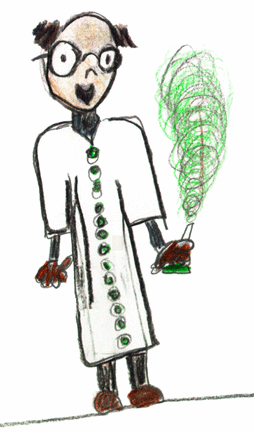
Kids on Scientists: Before and After

Fermilab offers some drawing of scientists by seventh graders before and after a visit to Fermilab. Wonderful visuals.

Before After
I think of a scientist as very dedicated to his work. He is kind of crazy, talking always quickly. He constantly is getting new ideas. He is always asking questions and can be annoying. He listens to others’ ideas and questions them. I know scientists are just normal people with a not so normal job. . . . Scientists lead a normal life outside of being a scientist. They are interested in dancing, pottery, jogging and even racquetball. Being a scientist is just another job which can be much more exciting.
by Amy

This is one of the more extreme ones but there are lots of other great comparisons. Very reminiscent of: Children’s view of Scientists in England.

Related: Scientists and StudentsKids in the Lab: Getting High-Schoolers Hooked on ScienceCurious Cat Science and Engineering SearchSaving FermilabMatter to Anti-Matter 3 Trillion Times a Second

Do Dolphins Sleep?

Do dolphins sleep?, MIT:

Dolphins do sleep, but not quite in the same way that people do. They sleep with one half of the brain at a time and with one eye closed. Dolphins rest this way on and off throughout the day, switching which side of the brain they shut down. During these periods, everything inside the dolphin slows down, and the mammal moves very little.

Related: Why do We Sleep?Energy Efficiency of Digestioninteresting science factsWhy is the Sky Blue?

NASA’s Carl Sagan Fellowships

NASA Exoplanet Science Institute announces the introduction of the Sagan Postdoctoral Fellowship

The NASA Exoplanet Science Institute announces the introduction of the Sagan Postdoctoral Fellowship Program and solicits applications for fellowships to begin in the fall of 2009.

The Sagan Fellowships support outstanding recent postdoctoral scientists to conduct independent research that is broadly related to the science goals of the NASA Exoplanet Exploration area. The primary goal of missions within this program is to discover and characterize planetary systems and Earth-like planets around nearby stars.

The proposed research may be theoretical, observational, or instrumental. This program is open to applicants of any nationality who have earned (or will have earned) their doctoral degrees on or after January 1, 2006, in astronomy, physics, or related disciplines. The fellowships are tenable at U.S. host institutions of the fellows’ choice, subject to a maximum of one new fellow per host institution per year. The duration of the fellowship is up to three years: an initial one-year appointment and two annual renewals contingent on satisfactory performance and availability of NASA funds.

We anticipate awarding 3 – 4 fellowships in 2009. Please note that these are postdoctoral Fellowships only. Previous Michelson Fellowship holders are fully eligible to apply.

Related: Science and Engineering Scholarships and Fellowships DirectoryNSF Graduate Research Fellows 2008