The Toyota iUnit personal transport. Time named it a Best Inventions 2005. I can’t find much new on the progress made since then.
Related: Toyota Partner Robots – Electric Cars

The Toyota iUnit personal transport. Time named it a Best Inventions 2005. I can’t find much new on the progress made since then.
Related: Toyota Partner Robots – Electric Cars
Yale Science and Engineering Association (YSEA), Outreach programs cultivate young scientists:
Related: Science Education sites for students and teachers – science internships – science fairs
MIT neuroengineers’ pulsing light silences overactive neurons:
When neurons are engineered to express the halorhodopsin gene, the researchers can inhibit their activity by shining yellow light on them. Light activates the chloride pumps, which drive chloride ions into the neurons, lowering their voltage and silencing their firing.
…
The group also plans to use the new method to study neural circuits. Last year, Boyden devised a technique to stimulate neurons by shining blue light on them, so with blue and yellow light the researchers can now exert exquisite control over the stimulation and inhibition of individual neurons. Learning more about the neural circuits involved in epilepsy could help scientists develop devices that can predict when a seizure is about to occur, allowing treatment (either shock or light) to be administered only when necessary, Boyden said.
Related: Nanoparticles to Aid Brain Imaging – Feed your Newborn Neurons – Nanofibers Knit Severed Neurons Together
USC innovation institute reinventing itself:
Related: Future of Engineering – Entrepreneurial Engineers – Innovation related blog posts
From the excellent xkcd comic – The Difference:
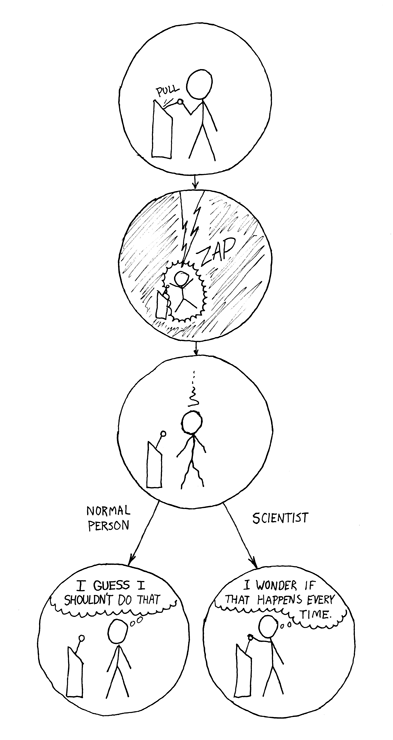
Warning: this comic occasionally contains strong language (which may be unsuitable for children), unusual humor (which may be unsuitable for adults), and advanced mathematics (which may be unsuitable for liberal-arts majors).
Mysterious deaths of the honeybees
At a House Agricultural Subcommittee hearing in Washington, D.C., today, members of various organizations came together to share their concerns about what they have been calling the “Colony Collapse Disorder,” or CCD. Beginning in October 2006, beekeepers from 24 states reported that hundreds of thousands of their bees were dying and their colonies were being devastated.
Related: Bye Bye Bees – Mystery Ailment Strikes Honeybees – Bye Bye British Bees Too
US ‘no longer technology king’:
Despite losing its top position, the US still maintained a strong focus on innovation, driven by one of the world’s best tertiary education systems and its high degree of co-operation with industry, the report said. The country’s efficient market environment, conducive to the availability of venture capital, and the sophistication of financial markets, was also given recognition.
Related: WEF Report – Innovation Economy – USA Still Leads In Innovation – The World’s Best Research Universities – Asia: Rising Stars of Science and Engineering – European Innovation Scoreboard – Aussies Look to Finnish Innovation Model
Schoolgirls rumble Ribena vitamin claims:
But then the girls’ claims were picked up by a TV consumer affairs programme, Fair Go, which suggested they take their findings to the commerce commission, a government watchdog. GSK said the girls had tested the wrong product, and it was concentrated syrup which had four times the vitamin C of oranges. But when the commerce commission investigated, it found that although blackcurrants have more vitamin C than oranges, the same was not true of Ribena. It also said ready-to-drink Ribena contained no detectable level of vitamin C.
GSK is in court in Auckland today facing 15 charges relating to misleading advertising, risking fines of up to NZ$3m (£1.1m). In Australia, GSK has admitted that its claims about Ribena may have misled consumers.
Good job. Related: Science Fair Project on Bacterial Growth on Packaged Salads
Scientists Explore Ways to Lure Viruses to Their Death by Carl Zimmer:
“It occurred to us that if a virus bound to a red blood cell, that was a dead end,” said Dr. Robert W. Finberg, a professor at the University of Massachusetts Medical School.
…
To test the model, the scientists mixed normal bacteria with different levels of mutant traps and then infected them with viruses. After letting the viruses replicate, the scientists took a small sample to start a new colony. They discovered there was indeed a trap threshold above which the virus population could not survive. Above that threshold, the viruses disappeared by the time the scientists started the third round of colonies.
Related: Old Viruses Resurrected Through DNA – Virus population extinction via ecological traps
Science in School is an open access journal focused on science education published quarterly.
The contents include teaching materials; cutting-edge science; education projects; interviews with young scientists and inspiring teachers; European education news; reviews of books and other resources; and European events for teachers.
The latest issue includes: Silky, stretchy and stronger than steel by Giovanna Cicognani and Montserrat Capellas (on spider silk), A fresh look at light: build your own spectrometer by Mark Tiele Westra, Fair enough? Balanced considerations for future science-fair organisers by Eva Amsen and Fusion in the Universe: we are all stardust by Henri Boffin and Douglas Pierce-Price.
Related: Open Access Education Materials – Science Education Web Sites – Open Access Engineering Journals – primary and secondary school science and engineering education post