Category Archives: Life Science

Tardigrades

Tardigrades (commonly known as water bears) have eight legs and are their own phylum on the tree of life. Some can survive temperatures close to absolute zero, temperatures as high as 151 °C (303 °F), 1,000 times more radiation than any other animal, nearly a decade without water, and even the vacuum of space.

Related: Tardigrades, UNC Chapel HillTardigrades In Space (TARDIS)What is an Extremophile?Evolution, Methane, Jobs, Food and More

Fast Fitness Forecast is False, it Takes Time

Fitness Isn’t an Overnight Sensation

“To make a change in how you look, you are talking about a significant period of training,” Dr. Kraemer said. “In our studies it takes six months to a year.” And, he added, that is with regular strength-training workouts, using the appropriate weights and with a carefully designed individualized program. “That is what the reality is,” he said.

And genetic differences among individuals mean some people respond much better to exercise than others

Now, said Mr. Antane, who runs with a group in Princeton on Thursday nights, “everything changed — my outlook on life, who I hung out with, how I felt about myself.”

Our bodies evolved under conditions with much more exercise than we currently get if we sit in an office all day. And we had less food. It is no surprise with more food and less exercise that we gain weight. And given that the benefit of fat was to help us survive when we had little food out bodies don’t change overnight. If they did then our ancestors would have had much more difficulty surviving – the whole point was to provide a resource to tap in bad times. If that resource dissipated quickly it would not have helped much.

Related: Active Amish Avoid ObesityBig Fat LieEat food. Not too much. Mostly plants.Reducing Risk of Diabetes Through Exerciseposts on exercise

Soil Mineral Degrades the Nearly Indestructible Prion

Warped pathogens that lack both DNA and RNA, prions are believed to cause such fatal brain ailments as chronic wasting disease (CWD) in deer and moose, mad cow disease in cattle, scrapie in sheep and Creutzfeldt-Jakob disease in humans. In addition to being perhaps the weirdest infectious agent know to science, the prion is also the most durable. It resists almost every method of destruction from fire and ionizing radiation to chemical disinfectants and autoclaving, which reduce prion infectivity but fail to completely eliminate it.

Other studies have shown that prions can survive in the soil for at least three years, and that soil is a plausible route of transmission for some animals, says Joel Pedersen, a UW-Madison environmental chemist. “We know that environmental contamination occurs in deer and sheep at least,” he notes.

Prion reservoirs in the soil, Pedersen explains, are likely critical links in the chain of infection because the agent does not appear to depend on vectors — intermediate organisms like mosquitoes or ticks — to spread from animal to animal.

That the birnessite family of minerals possessed the capacity to degrade prions was a surprise, Pedersen says. Manganese oxides like birnessite are commonly used in such things as batteries and are among the most potent oxidants occurring naturally in soils, capable of chemically transforming a substance by adding oxygen atoms and stripping away electrons. The mineral is most abundant in soils that are seasonally waterlogged or poorly drained.

full press release

Related: Clues to Prion InfectivityScientists Knock-out Prion Gene in CowsCurious Cat Science and Engineering Search

Moth Jams Bat Sonar

Superloud moth jams bat sonar

A gray moth with orange highlights called Bertholdia trigona “goes berserk,” making lots of noise above the range of human hearing when a hunting bat approaches, says William Conner of Wake Forest University in Winston-Salem, N.C. Bats rely on their natural sonar to locate flying moths in the dark, but in a lab setup, the bats rarely managed to nab a loud moth.

When researchers disabled the moth’s noisemaking organs, though, bats caught the moths in midair with ease, Conner reported at the annual meeting of the Society for Integrative and Comparative Biology.

Conner says the work is “the first example of any prey item that jams biological sonar.” Conference attendee David Yager of the University of Maryland in College Park says Conner’s experimental paradigm is “very strong, and I do think he has documented jamming by a species of moth.”

Insect-hunting bats and their moth prey have become a classic in the study of evolutionary arms races, Conner says. “This is warfare … The first counter-adaptation is that the insects developed ears.”

Jamming isn’t the only possible explanation for moth noises, he said. An explosive clicking sound coming back out of the night might startle a bat just a split-second long enough for the moth to get away.

Related: Vampire Moth DiscoveredMonarch Butterfly MigrationHuman Sonar, EcholocationStill Just a LizardLancelet Genome Provides Answers on Evolution

Rethinking the Food Production System

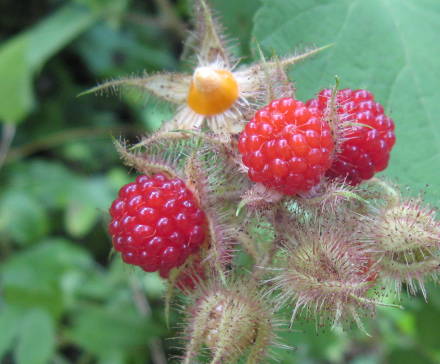
wineberriesphoto by John Hunter of wine-berries from his Garden.

Food needs ‘fundamental rethink’

The new approach needed to address key fundamentals like biodiversity, energy, water and urbanisation, he added.

Water scarcity: “One of the key things that I have been pushing is to get the UK government to start auditing food by water,” Professor Lang said, adding that 50% of the UK’s vegetables are imported, many from water-stressed nations.
Biodiversity: “Biodiversity must not just be protected, it must be replaced and enhanced; but that is going to require a very different way growing food and using the land.”

“In Europe, 30% of the food grown did not appear on the shelves of the retailers because it was a funny shape or odd colour.

“The way that seeds are selected is about immunity to any known disease; they have also got to grow big and fast, and have a fantastic shelf life. “Never mind taste, texture or nutrition, it is all about how it looks.

I agree. The food system is broken. We have moved to mono-culture food production. We have changed our diets to eat food like concoctions. We need to return to healthier and sustainable food production.

Related: Grow Your Own Food and Save MoneyProtecting the Food SupplyEat food. Not too much. Mostly plants.The Science of GardeningPigs Instead of PesticidesObesity Epidemic Explained – Kind Of

Educating the Biologist of the 21st Century

An Introductory Science Curriculum for 21st Century Biologists by David Botstein (webcast)

At Princeton’s new Lewis-Sigler Institute, Botstein is spearheading an innovative effort at interdisciplinary undergraduate education. Students will take advantage of state of the art laboratories and computers capable of crunching vast amounts of data generated by actual research. Professors will “provide essential fundamental concepts as required, using the just-in-time-principle” – no more of the “learn this now, it will be good for you later” approach, which Botstein likens to hazing. Botstein says there is “lots of overhead in teaching historical and traditional origins” so his students will learn instead “with ideas and technologies of today.” He wants to create a new basic language that will enable his biology students to make sense of the fundamental issues of other disciplines.

Very good look at future of biology education.

Related: MIT Faculty Study Recommends Significant Undergraduate Education ChangesThe Importance of Science EducationWebcast: Engineering Education in the 21st CenturyEducating the Engineer of 2020: NAE Report

Making Embryonic Stem Cells

photo of Junying Yuphoto of Junying Yu, an assistant scientist with the University of Wisconsin-Madison by Bryce Richter, 2007.

Holy Grail of stem cell research within reach by Mark Johnson

It was time to test the 14 genes she had selected as the best candidates to reprogram a cell.

Using viruses to deliver the genes, she inserted all 14 at once into human cells. On the morning of July 1, 2006, Yu arrived at the lab and examined the culture dishes. Her eyes focused on a few colonies, each resembling a crowded city viewed from space. They looked like embryonic stem cells.

Cells must pass certain tests. They must multiply for weeks while remaining in their delicate, primitive state. When they are allowed to develop, they must turn into all the other cell types.

Bad things happen. Cells develop too soon. Cells die. There is no “aha!” moment, Thomson has said, only stress. He looked at the colonies and suppressed any excitement. He told Yu, essentially: OK, well get back to me in a couple of weeks.

In the fall of 2006, Yu was preparing to whittle down her list of genes when she fell ill. The pain in her gut was awful. She struggled to eat. Her doctor thought it was a stomach flu. Instead, in late October, Yu’s appendix burst. She was laid up for a month. When she returned to the lab, the problem with the culture medium struck again.

Not until January 2007 was she able to begin narrowing the list of genes. She spent several months testing subsets of them, finally arriving at four. Two, Oct4 and Sox2, were “Yamanaka factors,” the name given to the genes the Japanese scientist had used to reprogram mouse cells. Two, Nanog and Lin28, were not.

Using a virus to deliver the four genes, she reprogrammed a line of fetal cells, then repeated the experiments with more mature cells. Although the process was inefficient, succeeding with only a small fraction of cells, it did work.

Dr. Junying Yu, an American trained scientist who entered the US as a foreign student from China. Which is somewhat ironic given the movement of USA based stem cell researches to China. Great article showing the process of scientific inquiry.

Related: Junying Yu, James Thomson and Shinya Yamanaka (Time people who mattered 2007) – Discovery leaps legal, financial and ethical hurdles facing stem cellsEdinburgh University $115 Million Stem Cell CenterStanford Gets $75 Million for Stem Cell Centerposts relating to Madison, Wisconsin

Octopuses Give Eight Thumbs up to HDTV

Octopuses give eight thumbs up for high-def TV

“Octopuses,” Miss Pronk said, “are very smart. I have seen my octopuses open Vegemite jars by unscrewing the lid. They can find their way through mazes to reach food rewards at the end. “And they can learn simple puzzles”, recognising that symbols, such as squares or circles, mean food is available.

When the crab movie was screened “they jetted straight over to the monitor and tried to attack it”, she said, adding that was strong evidence they knew they were watching food.

When the octopus movie was screened some became aggressive while others changed their skin camouflage or “would go and hide in a corner, moving as far away as possible”.

On viewing the swinging bottle, some puffed themselves up, just in case the object was a threat, while others paid no attention.

But significantly, when the experiment was repeated over several days, she found no consistent response from any octopus. Such random responses implied octopuses have no individual personalities.

She suspected previous efforts to show movies to octopuses failed because their sophisticated eyes were too fast for the 24-frame per second format of standard-definition video.

Related: Octopus Juggling Fellow Aquarium OccupantsRed Octopus in Brine Lake Beneath the SeaRandomization in SportsCurious Cat Science Search

Social Amoeba

Amoebic Morality by Carol Otte

At first their behavior might seem odd; to gather together in the face of starvation surely ought to end in cannibalism or death. Not so, for they are capable of an extraordinary and rare transformation. The amoebas set aside their lives as individuals and join ranks to form a new multicellular entity. Not all the amoebas will survive this cooperative venture, however. Some will sacrifice themselves to help the rest find a new life elsewhere.

These astonishing creatures are Dictyostelium discoideum, and they are a member of the slime mold family. They are also known as social amoebas. Aside from the novelty value of an organism that alternates between unicellular and multicellular existence, D. discoideum is highly useful in several areas of research. Among other things, this organism offers a stellar opportunity to study cell communication, cell differentiation, and the evolution of altruism.

In response to the cAMP distress call, up to one hundred thousand of the amoebas assemble. They first form a tower, which eventually topples over into an oblong blob about two millimeters long. The identical amoebas within this pseudoplasmodium– or slug– begin to differentiate and take on specialized roles.

Another cool example of how life has evolved novel solutions to perpetuate genes.

Related: Thinking Slime MouldsBe Thankful for Marine AlgaeHow Bacteria Nearly Destroyed All Life

1,000 Species Discovered in Greater Mekong in Last Decade

photo of Gumprechts Green PitviperPhotograph of Gumprechts Green Pitviper courtesy Greater Mekong Programme/WWF International

While most species were discovered in the largely unexplored jungles and wetlands, some were first found in the most surprising places. The Laotian rock rat, for example, thought to be extinct 11 million years ago, was first encountered by scientists in a local food market, while the Siamese Peninsula pitviper was found slithering through the rafters of a restaurant in Khao Yai National Park in Thailand.

“This region is like what I read about as a child in the stories of Charles Darwin,” said Dr Thomas Ziegler, Curator at the Cologne Zoo. “It is a great feeling being in an unexplored area and to document its biodiversity for the first time… both enigmatic and beautiful,” he said.

The findings, highlighted in this report, include 519 plants, 279 fish, 88 frogs, 88 spiders, 46 lizards, 22 snakes, 15 mammals, 4 birds, 4 turtles, 2 salamanders and a toad. The region comprises the six countries through which the Mekong River flows including Cambodia, Lao PDR, Myanmar, Thailand, Vietnam and the southern Chinese province of Yunnan. It is estimated thousands of new invertebrate species were also discovered during this period, further highlighting the region’s immense biodiversity.

“It doesn’t get any better than this,” said Stuart Chapman, Director of WWF’s Greater Mekong Programme. “We thought discoveries of this scale were confined to the history books. This reaffirms the Greater Mekong’s place on the world map of conservation priorities.”

The report stresses economic development and environmental protection must go hand-in-hand to provide for livelihoods and alleviate poverty, and ensure the survival of the Greater Mekong’s astonishing array of species and natural habitats.

Full press release. I am a World Wildlife Fund member.

Related: First Contact in the Greater Mekong (8 Mb pdf) – Massive Gorilla Population Found2,000 Species New to Science from One IslandGiant Star Fish and More in AntarcticaHuge Ant NestWhy the Frogs Are Dying