Category Archives: Products

Appropriate Technology Brings a $1.30/month Cell Phone Plan to Remote Village

I love this kind of stuff: smart use of engineering provides cell phone service to remote Mexican village, with 9,000 residents, for $1.30/month (1/13 of the price charge by traditional cell phone service in Mexico City).

The town that Carlos Slim forgot

It’s so remote that there was no cell service. In stepped Rhizomatica, a nonprofit with the goal of increasing “access to mobile telecommunications to the over two billion people without affordable coverage and the 700 million with none at all.”

The U.S. and European experts working with Mexican engineers got the network set up by March of this year. At first, they ruled that phone calls were not to be longer than five minutes each to keep the small network from getting saturated.

By May, local numbers in Mexico City, Los Angeles and Seattle were set up, meaning that Oaxacans in Villa Talea could call relatives in the capital or in California as if it were practically a local call, a few cents a minute.

Given the success they are buying equipment that can handle the volume and will donate the existing equipment to setup a new village (a smaller one, I imagine). This was the first village they setup.

Long-distance is go

After almost two months of fine-tuning, long-distance service is finally ready to launch. This means folks in the town will be able to call out of the coverage area (only around 5-10km) to any phone, anywhere. Likewise we purchased a few DID numbers which allow people to call a Mexico City, Los Angeles or Seattle number and connect right to the village.

This is one of so many great efforts to use appropriate technology to improve people’s lives. It is easy for me to get frustrated at the cash for votes mentality of the USA politicians which creates policies against improvement for society and for protection of obsolete business models (until the bought-and-paid-for politicians make the business models sustainable by legislating against better options). It is great to see these kind of examples for the good work being done outside of the political sphere.

Related: Pay as You Go Solar in IndiaProviding Computer to Remote Students in NepalReducing Poverty Using EntrepreneurshipMonopolies and Oligopolies do not a Free Market Make

White Board Tip

If you can’t erase the ink on your white board (if you leave ink there for a long time this often happens) if you write over the ink with you white board pen again you can erase it easily. If a bit remains just write over it again and erase. I imagine the wet ink has an active chemical makeup that interacts with the dried ink on the board (but I am only guessing).

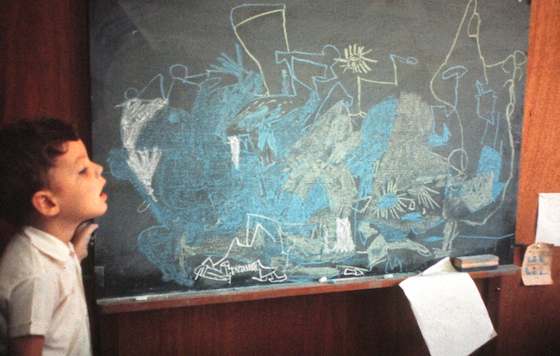
photo of me with a blackboard in my father's office

My drawing on the blackboard in my father’s office, photo by Bill Hunter

Related: Whiteboard Mechanical Simulation SystemMake Your Own Chalkboard PaintLow-Cost Multi-touch Whiteboard Using Wii Remote (2009)

Hyperloop – Fast Transportation Using a Better Engineering Solution Than We Do Now

Elon Musk (the engineer and entrepreneur behind Tesla electric cars and before that he helped create PayPal) has a very cool idea of how to provide fast long distance transportation (faster than a plane). Essentially it is a big version of pneumatic tubes that used to be used to send small packages around a building, as seen in the movie – Brazil 🙂 Details are scheduled to be released August 12th.

This Is How Elon Musk Can Build the Hyperloop for a Tenth the Cost of High-Speed Rail

Having a elevated Hyperloop main line also completely avoids or reduces many of the pitfalls of ground-level right-of-ways, and opens up some new opportunities as well:

  • The crossing of other right-of-ways, like roads and railways, will be a breeze.
  • Rivers and other terrain obstacles will only be a 10th the problem of rail construction.
  • Hyperloop can avoid tunnels completely by having more flexible choices of right-of-way.
  • An elevated right-of-way opens up new route options, like leasing farmer’s fields using contracts similar to what wind-power companies sign.
  • That could be paid for by leasing Hyperloop’s right-of-way to communications companies for fiber optic cables, cell phone towers, etc.
  • …and let’s not forget the solar power that a couple of square miles of surface area can generate!

Hype Builds Before Elon Musk’s August Alpha Plan for Hyperloop

The Hyperloop would transport passengers from San Francisco to Los Angeles in about 30 minutes and at about twice the average speed of a commercial jet. The system would be on-demand, cheaper than current alternatives, impossible to crash, and potentially, run entirely on solar power.

Travelers ride in pods magnetically accelerated and decelerated into the main tube (like a rail gun) where the air circulates at speed. The air between pods acts as a cushion, preventing crashes, while more air injected through perforations in the tube levitates the pods and reduces friction, much as it might on an air hockey table.

Elon Musk has some very good ideas but what really sets him apart is turning them into functioning enterprises. Great ideas are wonderful but a huge number never go anywhere. Those people that can actually get ideas into the marketplace are the people that provide a much greater standard of living for all of us. And many of them are engineers.

Update: link to his blog post announcement.

More examples of cool extreme engineering: Monitor-Merrimac Memorial Bridge-TunnelTransferring Train Passengers Without Stoppingtransatlantic tunnelWebcast on Machine That Bores Subway Tunnels

3d Printers Can Already Save Consumers Money

I first wrote about 3d printing at home here, on the Curious Cat Engineering blog, in 2007. Revolutionary technology normally takes quite a while to actually gain mainstream viability. I am impressed how quickly 3d printing has moved and am getting more convinced we are underestimating the impact. The quality of the printing is improving amazingly quickly.

3d printed objects

As is so often the case these day, our broken patent system is delaying innovation in our society. For 3d printing there is a good argument the delays due to the innovation crippling way that system is operating today will be avoided as critical 3d patents expire in 2014. Patents can aid society but the current system is not, instead it is causing society great harm and delaying us being able to use new innovations.

“For the average American consumer, 3D printing is ready for showtime,” said Associate Professor Joshua Pearce, Michigan Technological University.

3D printers deposit multiple layers of plastic or other materials to make almost anything, from toys to tools to kitchen gadgets. Free designs that direct the printers are available by the tens of thousands on websites like Thingiverse (a wonderful site). Visitors can download designs to make their own products using open-source 3D printers, like the RepRap, which you build yourself from printed parts, or those that come in a box ready to print, from companies like Type-A Machines.

3D printers have been the purview of a relative few aficionados, but that is changing fast, Pearce said. The reason is financial: the typical family can already save a great deal of money by making things with a 3D printer instead of buying them off the shelf.

In the study, Pearce and his team chose 20 common household items listed on Thingiverse. Then they used Google Shopping to determine the maximum and minimum cost of buying those 20 items online, shipping charges not included.

Next, they calculated the cost of making them with 3D printers. The conclusion: it would cost the typical consumer from $312 to $1,944 to buy those 20 things compared to $18 to make them in a weekend.

Open-source 3D printers for home use have price tags ranging from about $350 to $2,000. Making the very conservative assumption a family would only make 20 items a year, Pearce’s group calculated that the printers would pay for themselves quickly, in a few months to a few years.

The group chose relatively inexpensive items for their study: cellphone accessories, a garlic press, a showerhead, a spoon holder, and the like. 3D printers can save consumers even more money on high-end items like customized orthotics and photographic equipment.

Continue reading

Loon – Balloon Enabled Internet

Project Loon, from Google:

The Internet is one of the most transformative technologies of our lifetimes. But for 2 out of every 3 people on earth, a fast, affordable Internet connection is still out of reach.

We believe that it might actually be possible to build a ring of balloons, flying around the globe on the stratospheric winds, that provides Internet access to the earth below. It’s very early days, but we’ve built a system that uses balloons, carried by the wind at altitudes twice as high as commercial planes, to beam Internet access to the ground at speeds similar to today’s 3G networks or faster. As a result, we hope balloons could become an option for connecting rural, remote, and underserved areas, and for helping with communications after natural disasters.

Google testing out this system now in New Zealand. If they can get it to work they plan to use ballons to provide wireless internet access to hundreds of millions, or even billions, of people that don’t have access now. These ballons would float about 20 km above earth in the stratosphere (so well above where commercial airline traffic) and they are really working somewhat like to satellites.

Though ballons are much cheaper to put in place than satellites they also offer significant problems as they get blow around by wind (which is why they haven’t been used before and why Google is going to experiment to see if they can get it to work). The ballons will use solar power and be controlled by a mission control to move into different wind zones to position themselves.


Continue reading

Appropriate Technology Health Care Solution Could Save 72,000 Lives a Year

We need more medical solutions that serve the majority of humanity instead of just the rich. Some medical research is innately costly and therefore require large costs to pay back the investment. But too little concern is shown for solutions that help people (with so much focus only on solutions that will make organizations rich).

Cheap vinegar test cut cervical cancer deaths in India; could help many poor countries

This low-tech visual exam cut the cervical cancer death rate by 31 percent, the study found. It could prevent 22,000 deaths in India and 72,600 worldwide each year, researchers estimate.

More progress against cervical cancer may come from last month’s announcement that two companies will drastically lower prices on HPV vaccines for poor countries. Pilot projects will begin in Asia and Africa; the campaign aims to vaccinate more than 30 million girls in more than 40 countries by 2020.

India continues to invest in medical research for solutions that are affordable to a majority of the world. The rich health care companies largely neglect the majority to focus on the most wealthy.

Related: Using Available Technology (Cellphone) as a MicroscopeDangerous Drug-Resistant Strains of TB are a Growing Threat‘Refrigerator’ Without Electricity

Clay Water Filters for Ghana

Pure Home Water, Ghana manufactures and distributes AfriClay Filters in an effort to bring clean water to 1 million people. So far they have delivered filters to provide 100,000 people clean water.

The process is simple. Water is placed in a clay filter and gravity pulls the water through the pores left in the clay during firing.

Sediment and bacteria are filtered out in several ways:

  • Physical straining: the particles are too large to fit through the pores in the clay
  • Sedimentation or adsorption: particles come to rest on or stick to the clay
  • Inertia: friction in the pores keeps the particles from passing through

Bacteria are also killed by a coating of colloidal silver (a disinfectant), which we apply to all filters that pass our quality control tests. While sediment and bacteria are filtered out, the molecules of water are small enough to pass through the pores in the clay.

The filters are sold to those who will use them. The effort has shown a willingness to pay by villagers in remote Northern Ghana (those earning < US$1/day). I imagine (I am just guessing) the prices are subsidized; in the last decade more (most?) appropriate technology solutions will have those benefiting pay something for the benefits they receive. My nephews are working on a similar effort in India, using bio sand filters, I plan to post more on that later. There is current a campaign to help fund the delivery of water filters to Indian villages.

Related: Solar Powered Water Jug to Purify Drinking WaterElectric WindStudent Invents Solar-Powered FridgeReducing Poverty

Building A Better Bed Bug Trap Using Bean Leaves

Building A Better Bed Bug Trap

An old folk remedy involving hairy bean leaves strewn around the bedroom may have a new life as a modern bed bug trap, according to new research from the University of California, Irvine and the University of Kentucky.

Although its mechanisms weren’t known at the time, the tactic dates back to at least 1678, when the English philosopher John Locke wrote of placing kidney bean leaves under the pillow or around the bed to keep bed bugs from biting as he traveled through Europe.

In the early twentieth century, the approach was also common throughout the Balkans, according to a 1927 report from the Imperial and Royal Austro-Hungarian Army. That report suggested the leaves stunned the bloodsucking bugs as they traveled from hiding places to their sleeping hosts during the night; in the morning, the bug-covered leaves were removed and burned.

“The inconvenience of bean leaves is that not everyone wants them scattered around their bed room.” Synthetics mimicking the surface of the bean leaf, however, could be placed “as a ring around the bed legs, a floor mat at the door, a strip on the bed board, it could be something one put’s in one’s suitcase,”

Very cool. The chemical assault on bed buds is failing all over the world. A new vector to assist in the fight against bed bugs will be most welcome. It is interesting to learn the scientific reasons that explain why some folk remedies work.

Related: Bed Bugs, Science and the MediaAntibiotics Breed Superbugs Faster Than ExpectedPigs Instead of Pesticides

Introduction Video on 3D Printing

3D printing is an amazing technology that opens up great opportunities for us to enjoy life. The future is great. It is exciting to see how quickly advances are being made in this area. I think the ability to print replacement parts is a huge benefit. And the creative uses people will put these printers too will be a joy to see.

Related: A Pen That Prints in 3D While You DrawOpen Source 3-D Printing (2007)Great 3D Printing Presentation by a kid (2011)3D Printing is Here (2009)A plane You Can Print (2006)

Solar Powered Water Jug to Purify Drinking Water

Deepika Kurup, a 14-year-old New York student, won the Discovery Education 3M Young Scientist Challenge for her invention of a solar-powered water jug that changes dirty water into purified drinking water. She won the top prize of $25,000.

During “the 5 minutes of my presentation 15 children have died from lack of clean drinking water.”

I am thankful we have kids like this to create solutions for us that will make the world a better place. We rely on hundreds of thousands of such people to use science and engineering methods to benefit society.

Related: Strawjet: Invention of the YearCheap Drinking Water From SeawaterWater and Electricity for AllThanksgiving, Appropriately (power of capitalism and people to provide long term increases in standards of living)