Category Archives: Research

The Politics of Anti-Science

In the 1960’s the USA had an unrealistic view of how much studying and learning about science and engineering could do. Investing is science and engineering is an extremely wise economic (and cultural) endeavor but it isn’t going to solve all the problems that exist. Somehow today we find ourselves with a large number of politically powerful people we take strong anti-science positions. These tactics reduce funding and support for beneficial research and are short sited approaches to public administration. This is an unfortunate turn of events that is damaging the American economy and will have huge damages going forward.

Thankfully other countries have seen how wise investing in science and engineering is and have more than taken up the slack created by the anti-science community. Two favorite tactics of the anti-science leaders is to try and create confusion where there is none and to turn the focus away from serious matters and instead playing silly political games. The silly games will draw donors and voters so if they care about those things more than the country and the future of the country it is a sound tactic. The damage it causes the country however I would hope would limit the use of such tactics however that has not been the case recently.

‘Shrimp On A Treadmill’: The Politics Of ‘Silly’ Studies

Take the case of the “shrimp on a treadmill.” Burnett says the senator’s report linked that work to a half-million-dollar research grant. But that money actually went to a lot of different research that he and his colleagues did on this economically important seafood species.

The treadmills were just a small part of it, a way to measure how shrimp respond to changes in water quality. Burnett says the first treadmill was built by a colleague from scraps and was basically free, and the second was fancier and cost about $1,000. The senator’s report was misleading, says Burnett, “and it suggests that much money was spent on seeing how long a shrimp can run on a treadmill, which was totally out of context.”

John Hart, a Coburn spokesperson, said in an email that “our report never claimed all the money was spent on shrimp on a treadmill. The scientists doth protest too much. Receiving federal funds is a privilege, not a right. If they don’t want their funding scrutinized, don’t ask.”

What the politicians are doing is exactly what this spokesperson suggests – they are withdrawing from the anti-science culture created by some in Washington: they are moving their research to countries that support rather than attack science. That is a very bad thing for the USA. There are a number of very bad economic policies a government can take. Driving scientists and engineers into the arms of other countries is one of the worst.
Continue reading

New Life Form Found at South African Truck Stop

Man discovers a new life-form at a South African truck stop

An order is one of the big categories of life, a big branch on evolution’s tree. Animal species are named every day, but finding another new order would be equivalent to discovering bats having not previously known they existed. Bats constitute their own order, as do primates, beetles, flies and rodents.

The Mantophasmatodes look, inescepably, larval (they lack wings, for example, and have no ocelli) and so Picker like others mistook them for immature versions of some known creature, perhaps some weird kind of cricket. When more than three quarters of all species of animals are not yet named, it is hard to know which ones to get excited about finding. Picker went through his collections looking for specimens of Mantophasmatodes. Within weeks, he had found twenty-nine individual Mantophasmatodes. Thirteen living species of Mantophasmatodea have now been named and placed in 10 genera and three different families.

In other words, Zompro has done something more amazing than finding a rare new order of animals. He has discovered a common order of animals that everyone else had missed, a discovery in plain view.

Mantaphasmatodes are not a far away species confined to some remote hunk of rock. They are a whole suite of species, some of which live places as mundane as backyards. They are also a kind of a living extended metaphor for what lurks around us unnoticed all the time.

I was always told as a child that I shouldn’t question so much and just accept what adults have decided. I am sure I was very annoying questioning everything. Especially how amazingly boring they make school. I love learning stuff. In general I did not love school. But questioning that school really should do a better job of making it fun to learn was seen as being a bothersome kid. I should just accept this is how school is and learn. I still think I was right. School is horribly designed to nurture the innate curiosity of people. Rather than seeing the kids that point this out as troublemakers we should see those that perpetuate the current system as troublemakers.

I still remember my sophomore year in high school I was taught by a biology teacher that new very little. They had been a 2nd grade teacher for like 15 years and due to seniority (they didn’t need as many 2nd grade teachers I guess) she bumped the biology teacher from the year before and we were stuck learning from her. In fact, any decently interesting question was more likely to be answered by a student (Peter – who then went to Princeton and then to play for the National Symphony) after the teacher said she didn’t know.

I found biology horrible. And it probably took a decade or more for me to finally notcie how amazingly cool biology. Fantastically cool. The amount of just super interesting biology is so vast that I have huge amounts of great stuff I get to look forward to learning. My teacher made it even worse, but frankly the way it is taught (I would imagine) is pretty bad even if the teacher is good. My high school was populated largely by the kids of Professors and compared to other schools in the USA I was told many times was fantastic (and the data seemed to support that – I believe we have more national merit scholars the year I graduated than all but 1 other public school in the country).

We need to do a much better job of harnessing the native desire to learn people have instead of killing it (which we do far to often). It really is a tragedy. It isn’t noticed because you can get by alright without loving learning. But it reduces the lives people have when they have their love of learning crushed. I didn’t have mine crushed but when I look around at many adults they seem to have done so to a large extent (sometimes it pokes through in a hobby or with their kids). And of course many adults kept a strong love of learning (all those geeks for example – and don’t forget the biologists).

Related: Photos of Rare Saharan Cheetah, Sand Cat and More WildlifeThe Only Known Cancerless AnimalWhat Kids can Learn, if We Give Them a ChanceIt took me a lot longer than most kids to stop asking why?, why?, why?Teaching Through Tinkering

Insightful Problem Solving in an Asian Elephant

Another example of very cool animal behavior. This Asian Elephant, seemed to consider the problem, devise a solution and then go get a stool to reach food that could not be reached without a tool.

Insightful Problem Solving in an Asian Elephant

The “aha” moment or the sudden arrival of the solution to a problem is a common human experience. Spontaneous problem solving without evident trial and error behavior in humans and other animals has been referred to as insight. Surprisingly, elephants, thought to be highly intelligent, have failed to exhibit insightful problem solving in previous cognitive studies. We tested whether three Asian elephants (Elephas maximus) would use sticks or other objects to obtain food items placed out-of-reach and overhead. Without prior trial and error behavior, a 7-year-old male Asian elephant showed spontaneous problem solving by moving a large plastic cube, on which he then stood, to acquire the food. In further testing he showed behavioral flexibility, using this technique to reach other items and retrieving the cube from various locations to use as a tool to acquire food. In the cube’s absence, he generalized this tool utilization technique to other objects and, when given smaller objects, stacked them in an attempt to reach the food. The elephant’s overall behavior was consistent with the definition of insightful problem solving. Previous failures to demonstrate this ability in elephants may have resulted not from a lack of cognitive ability but from the presentation of tasks requiring trunk-held sticks as potential tools, thereby interfering with the trunk’s use as a sensory organ to locate the targeted food.

Further inspired by Köhler’s chimpanzee studies, in experiment 4 we conducted 8 additional sessions to investigate whether Kandula would stack items to reach food. For these sessions, the baited branches were hung at a height that could be reached by stacking three butcher block cutting boards or by the use of other objects. In addition, the elephant was given sticks and other enrichment items. Kandula first touched several items and then moved two items, a plastic disk and a block under the suspended branches, placing one front foot on each in an unsuccessful attempt to reach for the branch. He solved the problem in an unexpected novel manner, moving and standing on the object closest in size to the absent cube, a large ball. Standing on unstable platforms such as this had not been previously observed. He repeated this behavior 9 times during this session. During the session’s last minutes, Kandula picked up a block ~2 m from the food and placed it directly on top of a block that he placed under the food in a previous attempt. He stood on the stacked blocks and attempted to reach the food but was unsuccessful. He stacked two blocks again in the second and sixth sessions but each time his trunk was several inches from the food.

This is very cool research. I do wonder why they didn’t provide more videos (and in a more user-friendly format than .mov files). I made them available via YouTube.

It seems like a very interesting area to have more experiments with more elephants (and continuing to work with Kandula: he seems to be very curious elephant, good for him).

Related: Orangutan Attempts to Hunt Fish with SpearBird Using Bait to Catch FishCrows Transferring Their Understanding to Novel ProblemCapuchin Monkeys Using Stone ToolsFighting Elephant Poaching With SciencePhoto of Fish Using a Rock to Open a Clam
Continue reading

MIT Scientists Find New Drug That Could Cure Nearly Any Viral Infection

New drug could cure nearly any viral infection

The drug works by targeting a type of RNA produced only in cells that have been infected by viruses. “In theory, it should work against all viruses,” says Todd Rider, a senior staff scientist in Lincoln Laboratory‘s Chemical, Biological, and Nanoscale Technologies Group who invented the new technology.

There are a handful of drugs that combat specific viruses, such as the protease inhibitors used to control HIV infection, but these are relatively few in number and susceptible to viral resistance.

Rider drew inspiration for his therapeutic agents, dubbed DRACOs (Double-stranded RNA Activated Caspase Oligomerizers), from living cells’ own defense systems. When viruses infect a cell, they take over its cellular machinery for their own purpose — that is, creating more copies of the virus. During this process, the viruses create long strings of double-stranded RNA (dsRNA), which is not found in human or other animal cells.

As part of their natural defenses against viral infection, human cells have proteins that latch onto dsRNA, setting off a cascade of reactions that prevents the virus from replicating itself. However, many viruses can outsmart that system by blocking one of the steps further down the cascade.

Rider had the idea to combine a dsRNA-binding protein with another protein that induces cells to undergo apoptosis (programmed cell suicide) — launched, for example, when a cell determines it is en route to becoming cancerous. Therefore, when one end of the DRACO binds to dsRNA, it signals the other end of the DRACO to initiate cell suicide.

Combining those two elements is a “great idea” and a very novel approach, says Karla Kirkegaard, professor of microbiology and immunology at Stanford University. “Viruses are pretty good at developing resistance to things we try against them, but in this case, it’s hard to think of a simple path pathway to drug resistance,” she says.

Each DRACO also includes a “delivery tag,” taken from naturally occurring proteins, that allows it to cross cell membranes and enter any human or animal cell. However, if no dsRNA is present, DRACO leaves the cell unharmed.

Very cool stuff and potentially hugely beneficial. Just a reminder: this works against viruses – not bacteria (just as antibiotics do not work against viruses).

image showing the results of cultures treated with DRACO v. those not treated

Related: Science Explained: RNA Interference8 Percent of the Human Genome is Old Virus GenesVirus Engineered To Kill Deadly Brain Tumors
Continue reading

Quantum Information Theory Postulated As Source of Emergent Theory of Gravity

I love the advances we have made using our understanding of science and engineering, like the internet, air conditioning and antibiotics. I also love the discussion of research where we really have only educated guesses about what the scientific inquiry process is telling us about the way things are. This research from the University of York is very interesting.

Escaping gravity’s clutches: the black hole breakout

Professor Braunstein says: “Our results didn’t need the details of a black hole’s curved space geometry. That lends support to recent proposals that space, time and even gravity itself may be emergent properties within a deeper theory. Our work subtly changes those proposals, by identifying quantum information theory as the likely candidate for the source of an emergent theory of gravity.”

Dr Patra adds: “We cannot claim to have proven that escape from a black hole is truly possible, but that is the most straight-forward interpretation of our results. Indeed, our results suggest that quantum information theory will play a key role in a future theory combining quantum mechanics and gravity.”

It is too bad the University of York supports closed science and allows work to be withheld from the public to support outdated publishers business models. Luckily scientists often support open science and publish material openly – I have provided a link for those interested in science instead of the link the University of York gives to a publishers closed system.

Black Hole Evaporation Rates without Spacetime

Verlinde recently suggested that gravity, inertia, and even spacetime may be emergent properties of an underlying thermodynamic theory. This vision was motivated in part by Jacobson’s 1995 surprise result that the Einstein equations of gravity follow from the thermodynamic properties of event horizons. Taking a first tentative step in such a program, we derive the evaporation rate (or radiation spectrum) from black hole event horizons in a spacetime-free manner. Our result relies on a Hilbert space description of black hole evaporation, symmetries therein which follow from the inherent high dimensionality of black holes, global conservation of the no-hair quantities, and the existence of Penrose processes. Our analysis is not wedded to standard general relativity and so should apply to extended gravity theories where we find that the black hole area must be replaced by some other property in any generalized area theorem.

Related: Gravity and the Scientific MethodGravity May Emerge from Quantum InformationDoes Time ExistWebcast of Astronaut Testing Gravity on the Moonsupport open science

Biologists Identified a New Way in Which Bacteria Hijack Healthy Cells

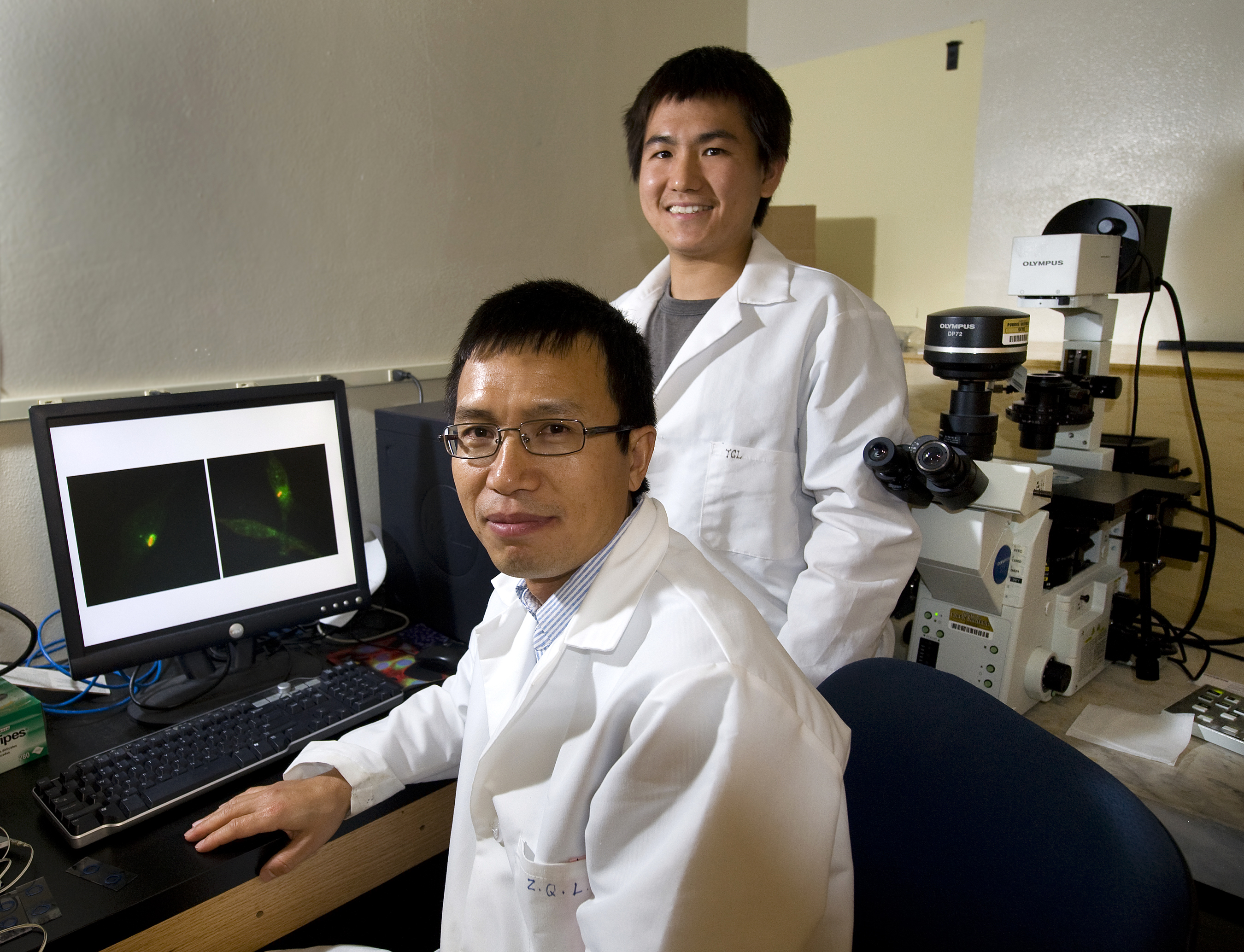
photo of Zhao-Qing Luo and Yunhao Tan

Associate professor of biological sciences Zhao-Qing Luo, foreground, and graduate student Yunhao Tan identified a new way in which bacteria modify healthy cells during infection. Shown on the computer screen are cells infected with a mutant strain of the bacteria Legionella pneumophila used in their research.

Purdue University biologists identified a new way in which bacteria hijack healthy cells during infection, which could provide a target for new antibiotics. Zhao-Qing Luo, the associate professor of biological sciences who led the study, said the team discovered a new enzyme used by the bacterium Legionella pneumophila – which causes Legionnaires’ disease – to control its host cell in order to take up residence.

“Legionnaires’ disease is a severe form of pneumonia, and this finding could lead to the design of a new therapy that saves lives,” Luo said. “At the same time it also provides great insight into a general mechanism of both bacterial infection and cell signaling events in higher organisms including humans.”

Successful infection by Legionella pneumophila requires the delivery of hundreds of proteins into the host cells that alter various functions to turn the naturally hostile environment into one tailor-made for bacterial replication. These proteins tap into existing communication processes within the cells in which an external signal, such as a hormone, triggers a cascade of slight modifications to proteins that eventually turns on a gene that changes the cell’s behavior, he said.

“Pathogens are successful because they know how information in our cells is relayed and they amplify some signals and block others in order to evade the immune system and keep the cell from defending itself,” Luo said. “Despite our understanding of this, we do not know much about how the proteins delivered by the bacteria accomplish this – how they work. This time we were able to pinpoint an enzyme and see how it disrupted and manipulated a specific signaling pathway in order to create a better environment for itself.”

The signaling pathway involved was only recently identified, and the discovery by Luo and graduate student Yunhao Tan also provides a key insight into its process. The signaling pathway involves a new form of protein modification called AMPylation in order to relay instructions to change cell behavior and has been found to be used by almost all organisms, Luo said.

The bacterium affects the host cell’s functions differently during different phases of the infection process, tapping into signaling pathways to turn on and off certain natural cellular activities. SidD stops the AMPylation process four hours after the start of infection in order to reverse an earlier modification that would be detrimental to the cell if left in place, he said.

Read the full press release.

Related: Using Bacteria to Carry Nanoparticles Into CellsDisrupting Bacterial Communication to Thwart ThemScientists Target Bacteria Where They LiveAre you ready for a world without antibiotics?

NASA’s Mars Curiosity Rover

Curiosity is the name of the new rover from NASA. It will be launched to continue the exploration of Mars so successfully done by Spirit and Opportunity (2 previous Mars rovers that did some amazing work and laster years longer than expected). The rover is NASA’s Mars Science Laboratory, a mobile robot for investigating Mars’ past or present ability to sustain microbial life.

photo of NASA's Mars Rover: Curiosity

Once on the surface, the rover will be able to roll over obstacles up to 75 centimeters (29 inches) high and travel up to 90 meters per hour. On average, the rover is expected to travel about 30 meters per hour, based on power levels, slippage, steepness of the terrain, visibility, and other variables.

The rover is about the size of a small SUV — 10 feet long (not including the arm), 9 feet wide and 7 feet tall. It weighs 900 kilograms (2,000 pounds)

The rover will carry a radioisotope power system that generates electricity from the heat of plutonium’s radioactive decay. This power source gives the mission an operating lifespan on Mars’ surface of a full martian year (687 Earth days) or more, while also providing significantly greater mobility and operational flexibility, enhanced science payload capability, and exploration of a much larger range of latitudes and altitudes than was possible on previous missions to Mars.

Related: Mars Rover Continues ExplorationMars Rovers Getting Ready for Another Adventure (2007)Sunset on Mars

More Dark Matter Experiment Results

A dark-matter experiment deep in the Soudan mine of Minnesota now has detected a seasonal signal variation similar to one an Italian experiment has been reporting for more than a decade.

The new seasonal variation, recorded by the Coherent Germanium Neutrino Technology (CoGeNT) experiment, is exactly what theoreticians had predicted if dark matter turned out to be what physicists call Weakly Interacting Massive Particles (WIMPs).

“We cannot call this a WIMP signal. It’s just what you might expect from it,” said Juan Collar, associate professor in physics at the University of Chicago. Collar and John Orrell of Pacific Northwest National Laboratory, who lead the CoGeNT collaboration, are submitting their results in two papers to Physical Review Letters.

WIMPS might have caused the signal variation, but it also might be a random fluctuation, a false reading sparked by the experimental apparatus itself or even some exotic new phenomenon in atomic physics, Collar said.

Dark matter accounts for nearly 90 percent of all matter in the universe, yet its identity remains one of the biggest mysteries of modern science. Although dark matter is invisible to telescopes, astronomers know it is there from the gravitational influence it exerts over galaxies.

Theorists had predicted that dark matter experiments would detect an annual modulation because of the relative motion of the Earth and sun with respect to the plane of the Milky Way galaxy.
Continue reading

H-index Rank for Countries: for Science Publications

The SCImago Journal and Country Rank provides journal and country scientific indicators. As stated in previous posts, these types of rankings have limitations but they are also interesting. The table shows the top 6 countries by h-index and then some others I chose to list (the top 6 repeat from my post in 2008 – Country H-index Rank for Science Publications). The h-index provides a numeric indication of scientific production and significance (by looking at the citations given papers by other papers). Read more about the h-index (Hirsh index).

Country h-index h-index (2007) % of World
Population
total Cites
USA

1,139 793     4.5% 87,296,701
United Kingdom

689 465     .9% 21,030,171
Germany

607 408     1.2% 17,576,464
France

554 376     1.0% 12,168,898
Canada

536 370     .5% 10,375,245
Japan

527 372     1.8% 14,341,252
Additional countries of interest
18) China

279 161 19.4% 5,614,294
21) South Korea

258 161     .7% 2,710,566
22) Brazil

239 148  2.8% 1,970,704
25) India

227 146 17.5% 2,590,791
31) Singapore

196 .01% 871,512

Related: Top Countries for Science and Math Education: Finland, Hong Kong and KoreaWorldwide Science and Engineering Doctoral Degree Data Top 15 Manufacturing Countries in 2009Science and Engineering Doctoral Degrees WorldwideRanking Universities Worldwide (2008)Government Debt as Percentage of GDP 1990-2009: USA, Japan, Germany, China…

Evolution of Altruism in Robots

The webcast explores robots evolving cooperative behavior. A Quantitative Test of Hamilton’s Rule for the Evolution of Altruism (open access paper)

One of the enduring puzzles in biology and the social sciences is the origin and persistence of altruism, whereby a behavior benefiting another individual incurs a direct cost for the individual performing the altruistic action. This apparent paradox was resolved by Hamilton’s theory, known as kin selection, which states that individuals can transmit copies of their own genes not only directly through their own reproduction but also indirectly by favoring the reproduction of kin, such as siblings or cousins. While many studies have provided qualitative support for kin selection theory, quantitative tests have not yet been possible due to the difficulty of quantifying the costs and benefits of helping acts. In this study, we conduct simulations with the help of a simulated system of foraging robots to manipulate the costs and benefits of altruism and determine the conditions under which altruism evolves.

By conducting experimental evolution over hundreds of generations of selection in populations with different costs and benefits of altruistic behavior, we show that kin selection theory always accurately predicts the minimum relatedness necessary for altruism to evolve. This high accuracy is remarkable given the presence of pleiotropic and epistatic effects, as well as mutations with strong effects on behavior and fitness. In addition to providing a quantitative test of kin selection theory in a system with a complex mapping between genotype and phenotype, this study reveals that a fundamental principle of natural selection also applies to synthetic organisms when these have heritable properties.

Related: Robots That Start as Babies Master Walking Faster Than Those That Start as AdultsFriday Fun: Robocup 2010, Robot FootballToyota Develops Thought-controlled Wheelchair
Continue reading