Category Archives: Science

Importance of TAs to Science Education

TA’s as the Key to Science Teaching via Confessions of a Science Librarian:

In 1997, Elaine Seymour was one of the authors of Talking About Leaving: Why Undergraduates Leave the Sciences. She found that a reason cited by student after student — at a range of institutions — was poor teaching. And at many institutions, teaching assistants were a major part of the problem.

What should colleges be doing to help teaching assistants? Seymour offers several strategies that are discussed in her book:

  • Creating semester-length courses that teach pedagogy. “You have to show them how to do it.”
  • Involving science faculty members demonstrating techniques of teaching so that the pedagogy is not just theoretical.
  • Scheduling regular meetings — at least once a week — for teaching assistants to talk about how their sections are going and the issues that are coming up. “You have to troubleshoot,” she says.
  • Providing support for teaching, so that TA’s dissertation committees and advisers know that their teaching duties should be taken seriously.

These ideas are very important.

Also see, Teaching Quality Improvement by Quality Improvement in Teaching by Ian Hau. This paper describes how students and the instructor worked as a team to improve the quality of teaching in a class.

New book by Elaine Seymour due out in January- Partners in Innovation: Teaching Assistants in College Science Courses.

2004 Medal of Science Winners

Presidential Medal of Science - USA

President Announces 2004 Medal of Science Winners

Winners included:

  • Biological Sciences, Regarded as the “Father of the Green Revolution,” Norman Borlaug, won the Nobel Peace Prize in 1970 for his efforts to feed the world’s hungry through improved farming techniques
  • Engineering, Edwin N. Lightfoot is Hilldale Professor (emeritus) at the University of Wisconsin, Madison. He was one of the first biochemical engineering professors in the United States and a forerunner in biomedical engineering. He is awarded the Medal of Science for vigorous and sustained leadership in developing the fields of biochemical and biomedical engineering, particularly in the areas of blood oxygenation, oxygen diffusion into tissue, mathematical modeling of biological pathways, bioseparations and studies of diabetic responses
  • Chemistry, Stephen J. Lippard is the Arthur Amos Noyes Professor of Chemistry at the Massachusetts Institute of Technology. An expert in the interactions between metal ions and biological molecules, Lippard is considered the leader in inorganic chemistry in living systems. He revealed the mechanism by which the anti-cancer drug cisplatnin binds to DNA and inhibits growth in cancer cells and is currently applying that knowledge along with other chemical and gene-therapy strategies to develop better platinum-based molecules and protocols for cancer chemotherapy.
  • Behavioral or Social Sciences, Kenneth J. Arrow professor of economics (emeritus) at Stanford University. He made groundbreaking contributions to the pure theory of economics

Shortage of Engineers?

Training Engineers – Continually by Ken Jarboe, quoting a Wall Street Journal article:

Many companies say they’re facing an increasingly severe shortage of engineers. It’s so bad, some executives say, that Congress must act to boost funding for engineering education.

Yet unemployed engineers say there’s actually a big surplus. “No one I know who has looked at the data with an open mind has been able to find any sign of a current shortage,” says demographer Michael Teitelbaum of the Alfred P. Sloan Foundation.

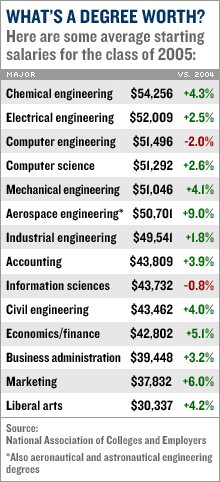
2005 starting salaries I would like to see data to confirm on refute this claim (such as the unemployment rate for engineers over time and pay for engineers over time) but some evidence seems to indicate there is a demand to pay engineers well. That makes me think it is unlikely there is a huge oversupply of engineers (if there was a huge oversupply prices would fall). Granted skill mismatches could account for increasing salaries for engineers while other engineers are unable to find jobs.

Also the marketplace (for any employees, including engineers) is indeed inefficient. But that inefficiency is not complete (so while waste is in the system where employers are not most effectively employing available candidates the system does match the employers and employees). I think it is definitely true the inefficiency of the marketplace hurts companies, potential employees and the economy.

Making the marketplace more efficient would be great but we seem to be making little progress in that area. On a personal level I have long believed the employment marketplace is very inefficient. I think this is true for a variety of complex reasons. I also think companies that figure out how to do so more effectively will gain a competitive advantage. I don’t think their are easy solutions. I believe companies that chose to manage the employee recruitment process using management improvement concepts will gain an advantage over others.

Graphic from the CNN article (April 2005): Average starting salaries for class of ’05 higher — in some cases notably — than last year. 6 of the highest paid starting salaries by major are engineering majors (the other is computer science).

Aerospace and aeronautical engineering majors, for instance, are enjoying a 9 percent increase in starting salaries; marketing majors have seen a 6 percent increase in starting salaries; while economics and finance majors are getting paid 5.1 percent more than last year.

Meanwhile, chemical, mechanical and civil engineers are also seeing paychecks that are at least 4 percent higher.

While such data does not show the health of the entire engineering field it sure is a positive indication for those starting out.

Ken Jarboe:

Let’s put our attention on the total skill development of the S&T workforce – and everyone else, for that matter. That is how we will strengthen our competitive advantage and avoid the skills-person mismatch that seems to plague our S&T labor market

I agree with a focus on a more comprehensive look at education and skill development. A huge amount of education is now done in the workplace. But this transition away from academic learning to employment learning needs to be factored into public policy. We also need to figure out how to incorporate these changes in learning into the hiring process and the economy as a whole. We are making those changes now but in a fairly inefficient way, without much planning and thought. I don’t know what should be done but I do believe this is something in need of improvement.

Companies Not Countries

Companies, Not Countries, Hold The Key to Innovation Leadership by Lester Craft:

But given the overall trend, I would argue that we are quickly heading toward an era where corporations view innovation almost strictly in terms of their own global self-interest rather than in terms of one nation or another. If this is true, then we need to adjust our thinking about America’s role as an innovation leader. When it comes to innovation and intellectual property, it may be that companies are replacing countries as the entities that make the rules.

I agree the impact of countries is declining and companies increasing. Still governments hold a great deal of power to create environments that are supportive or hostile to innovation and thereby influence where it is done.

One, of many reasons, the Untied States succeed in the last half of the 20th century was wise government support of innovation. Now other countries such as India, Singapore, China, Korea… are taking smart action also.

There is still plenty of room for government policy to influence where innovation will take place. As mentioned in my previous posts (see below) being the country that trains doctoral candidates has many benefits. If any country trains 50% of the science and engineering doctoral candidates in 2050 they will have a huge advantage in innovation. Tax policy also has an impact. Intellectual property rights also have an impact. Many factors that governments largely define (and therefore differences exist between countries in how well these factors support innovation and where investors will choose to invest) will play a role in what countries innovation flourishes in going forward: infrastructure, legal system, primary education system, health care system, financial system, funding and encouraging basis research…

I happen to side with those like Lawernce Lessig that believe we are harming the United States economy by having a government policy that too restrictive about intellectual property. I believe countries that have sufficient clout to stand up to the United States, and who have a more sensible IP policy will gain a great advantage if the United States were not to adjust policies based on the ideas of Lessig and others.

The change that I think should be made is to see the role of government as a influencer of what the future will hold rather than a dictator. The actions the United States government takes will be one factor that determines where innovation takes place (and what geographic location gains the largest economic benefit) but other countries, companies and individuals will also make decisions. It will be a much more interdependent system than in the past. And no one player will be able to dictate the action.

Google’s success is not solely due to the fact it was formed in the United States. But there are many reasons why Google, ebay, Amazon, Yahoo… are based in the United States and have lead the way in internet innovation. The challenge for the United States is to keep those comparative advantages as high as possible even though the advantages are declining and will continue to do so, in my opinion.

Related posts:

Article: Is the US Patent System Endangering American Innovation?

Scientific American 50 Award

Scientific American 50 Award:

first annual celebration of visionaries from the worlds of research, industry and politics whose recent accomplishments point toward a brighter technological future for everyone.

Awardees include:

  • Alice H. Amsden, Massachusetts Institute of Technology, Identified strategies for economic development that could be of singular value to non-Western countries on the rise.
  • Ken Deering, Wind Turbine Company, designed new wind turbines that are more efficient and produce more power.
  • Lawrence Lessig, Stanford University Law School, argued against interpretations of copyright that could stifle innovation and discourse online.

Colored Bubbles

photo of blue bubble

The 11-Year Quest to Create Disappearing Colored Bubbles by Mike Haney, Popular Science.

Colored soap bubbles! Of course! Everyone loves blowing bubbles. It seemed such a simple and perfect idea, the kind that would leave other inventors slapping their foreheads and saying Why didn’t I think of that? Kehoe says, “I remember walking down to the store thinking, ‘This is so easy. I’m going to be rich!’ “

Well, rich maybe, but not so easy.

The long years of desk jobs and desperate late-night experiments were finally over. He had done what the toy companies had told him to, and now it didn’t matter what they thought. He had his own well-financed company and a washable bubble. It was time to tell the world.

Photo gallery and movie of the colored bubbles.


Popular Science Grand Award for General Innovation

Red Blood Cell’s Amazing Flexibility

Images of red blood cells

Scientists Discover Secret Behind Human Red Blood Cell’s Amazing Flexibility:

The human red blood cell membrane skeleton is a network of roughly 33,000 protein hexagons that looks like a microscopic geodesic dome.

a team of UCSD researchers describe a mathematical model that explains how a mesh-like protein skeleton gives a healthy human red blood cell both its rubbery ability to stretch without breaking, and a potential mechanism to facilitate diffusion of oxygen across its membrane. “Red cells are one of the few kinds of cells in the body with no nucleus and only a thin layer of protein skeleton under their membrane: they are living bags of hemoglobin,” said Amy Sung, a professor of bioengineering at UCSD’s Jacobs School of Engineering

Seeing Cellular Machinery

kinetochore rings are visibly bound to the microtubules. An electron microscope image generated by the Nogales Lab, where kinetochore rings are visibly bound to the microtubules, from Seeing Cellular Machinery article from the always interesting ScienceMatters@Berkeley.

A cell is perhaps the most complex factory in the world. The basic structural and functional unit of all life, cells convert nutrients to energy, perform highly specialized tasks based on instructions stored in their DNA, and reproduce themselves. How are these feats accomplished though? UC Berkeley biologist Eva Nogales is using electron microscopy to watch some of these cellular mechanisms in action.

Worldwide Science and Engineering Doctoral Degree Data

graph showing doctoral degrees awarded by region The graph shows doctoral degrees awarded by region in science and engineering (graph from the United States National Science Foundation Science and Engineering Indicators 2004 report). The data used to make the chart is included in this spreadsheet on the NSF site.

It seems to me the claims of the NY Times article discussed in our previous post are wrong. I would trust this NSF data to be fairly accurate. The full report includes a great deal of related data and is worth looking at.

The data from the NSF 2004 report (the data is from 2000 and 2001 [the most recent data they have access to]) show a total of 24,409 science and engineering doctoral degrees granted in all of Asia. How many in the USA? 25,509.

International Mobility of Doctoral Recipients from U.S. Universities by Jean M. Johnson, NSF, 2000, provides some good discussion of related issues. For example, the paper explores country of origin of the students as well as where the students go to work once they receive the degrees.

The percentage of foreign doctoral recipients planning to stay in the United States may
return to the lower 50 percent level that existed until 1992. The 60-70 percent stay rates of the 1993-99 period may have been driven by the expanding U.S. economy and employment opportunities.

In any discussion of the impact of the United States failing behind in science and engineering graduation, and the resulting economic decline, it is critical to understand where the graduates go to work. There are real changes going on:

For example, in the last 5 years, Chinese and Korean students earned more doctoral S&E degrees in their respective countries than in U.S. universities. And in 1999, Taiwanese students, for the first time, earned more doctoral S&E degrees within Taiwanese universities than from U.S. universities.

This is important information. It is also important to see that it was just 1998 when more doctoral degrees were granted in the US than in Taiwan to Taiwanese students.

It seems there are at least two critical issues that people are considering when quoting figures (or related statements about the decline of US science and engineering status). One is getting scientific and engineering workers working in the economy. Another is the actual education of students, which relates directly to the first issue and has many “spin-off” benefits.

One measure used to look at creating future science and engineering workers is the number of those earning degrees (undergraduate and graduate degrees). That is a sensible thing to look at, though it should be noted that such a measure provides a limited view (it is an input measure and not an outcome measure, which would be preferable).

I believe the graduate measure is used as a way to project into the future by many of the future health of the science and engineering success of countries. It seems a sensible measure to pay attention to: we cannot measure today the number of high wages scientists and engineers employed in specific countries 20 years from now (or the jobs those scientists and engineers create for others in the economy or the useful patents written, scientific discoveries made, engineering breakthroughs achieved…).

The number of graduates has some value in trying to predict that outcome years from now but it is only a proxy measure and not at all definitive. The United States has been remarkably effective at getting those who graduate with advanced science and engineering degrees in the United States to say (and even in getting those granted degrees elsewhere to move here during their careers and gaining tremendous benefits to the United States economy). Where students receive degrees (and where they grew up), I believe is correlated to where a person ends up working during their career, but that correlation is not perfect. And that correlation may change in the future – in fact I believe it will do so significantly.

I believe the correlation will decrease – movement will increase and much of this may not even make sense as work flows without much regard for national boundaries (while physical location is one factor if essentially workers in Singapore, India, Mexico and Germany all our working on the same project for a company based in Japan and owned 40% by Canadians… how all this is analyzed gets very confusing).

Looking at where they work immediately after graduation is a sensible thing to do, however we should also look at where they work 10 or 20 years in the later if we are interested in long term impact.

The actual education of the students is also seen as critical to many, and I agree. One reason this is important is you have many good jobs educating the students. But there are many other benefits. The students often do research which if they are in you country is much more likely to benefit your economy than if they are earning there degree elsewhere and supporting research elsewhere.

Also the leading educational hubs create a climate for technological innovation (proximity to the leading experts in the world often provides benefits in tapping that knowledge for purposes that often have economic advantages). If the students are educated elsewhere it is likely those hubs of technological innovation will move also (or at least the lure of the local hub will loose some to another hub that grows in importance). So measuring the number of graduate, post graduate and doctoral degrees granted in your country makes sense (again it is not a perfect measure but a valuable one).

While there is a great deal of worry about the importance of improving science and engineering education to capture economic benefit I think the understanding of the actual situation is lacking. I think we need to have a clearer idea of what the data actual shows. Then I think we can start looking at where we would like to improve. I am to explore related issues with this blog.

Engineering Education and Innovation

Are U.S. Innovators Losing Their Competitive Edge? by Timothy L. O’Brien, New York Times:

He fears that corporate and public nurturing of inventors and scientific research is faltering and that America will pay a serious economic and intellectual penalty for this lapse.

See previous post, Leverage Universities to Transform State Economy.

The Industrial Research Institute, an organization in Arlington, Va., that represents some of the nation’s largest corporations, is also concerned that the academic and financial support for scientific innovation is lagging in the United States. The group’s most recent data indicate that from 1986 to 2001, China, Taiwan, South Korea and Japan all awarded more doctoral degrees in science and engineering than did the United States. Between 1991 and 2003, research and development spending in America trailed that of China, Singapore, South Korea and Taiwan – in China’s case by billions of dollars.

In a previous post, Science and Engineering Doctoral Degrees Worldwide, I mentioned that I thought the United States was not in fact leading (and if they still were it would not last for more than a few years) in doctoral degrees in science and engineering though I could not find supporting data. I still can’t, but the NY Times claims IRI does have the data (though I can’t find any such data on their web site).

And I find the claim questionable without the data. Do they mean on a percentage of population basis, that seems unlikely with China? On an absolute basis it seems unlikely for South Korea and Taiwan (at least, if not all countries) especially from 1986-2001. On an absolute basis crediting the degree earned to the nationality of the student (so Taiwanese students in American graduate schools count for Taiwan not the US)? The last version seems the most likely basis of the data to me, though even then I find it questionable. And it is not what I think most readers would believe the statement in the article means (instead believing that doctoral degrees granted by American schools were lower than those granted by schools in Taiwan… from 1986-2001).

I find it hard to believe that the United States trailed Singapore on R&D spending on an absolute basis so I would guess the data the NY Times is quoting on a percentage basis (at least for R&D) though that seems unlikely for China, so I am a bit confused about the claims in the article. They really should state what the data says specifically not just that the United States trails on some undefined measure. And they also really should provide the data that backs up their claim.