Category Archives: Science

The Sun is a Miasma of Incandescent Plasma

They Might be Giants once again provide an enjoyable view into the wonders of science. Previously they published the video, The Sun is a Mass of Incandescent Gas. They published an updated video, a couple years ago, which captures the best current understanding based on the scientific inquiry process: Why Does the Sun Really Shine? (The Sun is a Miasma of Incandescent Plasma).

I really do love, They Might be Giants. Even before their focus on science I enjoyed their music. But they have done wonders with all their recent work. Go Giants. Get their DVD: Here Comes Science.

Related: How Science is Unmasking the Secrets of the Sun (Science magazine, 1974)The problem with hot gas = Test it Out, Experiment by They Might Be GiantsHere Comes Science by They Might Be Giants

Their previous video, The Sun is a Mass of Incandescent Gas, Continue reading

Wesley the Owl: Love Story of an Owl and His Girl

This story begins on Valentine’s Day in 1985 when biologist Stacey O’Brien meets a four-day-old baby barn owl in a fateful encounter that would turn into an astonishing 19-year saga. With nerve damage in one wing, the owlet’s ability to fly was forever compromised and he had no hope of surviving on his own in the wild. A young assistant in the owl laboratory at Caltech, O’Brien promised to care for the helpless owlet and give him a permanent home. O’Brien’s heartfelt memoir of life with this wild bird, Wesley the Owl: The Remarkable Love Story of an Owl and His Girl recounts their dramatic, and often humorous, life together.

For almost two decades, O’Brien studied Wesley and his strange habits intensively and providing a mice-only diet. With a heart-shaped face and outsized personality that belied his 18-inch stature, the gorgeous white-and-gold Wesley fascinated everyone he met, and touched many lives. Stacey and Wesley’s bond was especially deep; O’Brien discovered that owls are highly sentient beings with individual personalities, subtle emotions, and a playful nature that can also turn fiercely loyal and protective.

Cool fact: “While we hear in two dimensions, owls hear in three.” Owls can detect a mouse heartbeat under three feet of snow.
Related: Friday Fun: Cat and Owl PlayingBird Brain (smart crows)Using Barn Owls for Bilogical Pest Control in Israel
Continue reading

Evolution in New York City Wildlife

Evolution Right Under Our Noses by Carl Zimmer

White-footed mice, stranded on isolated urban islands, are evolving to adapt to urban stress. Fish in the Hudson have evolved to cope with poisons in the water. Native ants find refuge in the median strips on Broadway. And more familiar urban organisms, like bedbugs, rats and bacteria, also mutate and change in response to the pressures of the metropolis. In short, the process of evolution is responding to New York and other cities the way it has responded to countless environmental changes over the past few billion years. Life adapts.

Dr. Wirgin and his colleagues were intrigued to discover that the Hudson’s population of tomcod, a bottom-dwelling fish, turned out to be resistant to PCBs. “There was no effect on them at all,” Dr. Wirgin said, “and we wanted to know why.”

In March, he and his colleagues reported that almost all the tomcod in the Hudson share the same mutation in a gene called AHR2. PCBs must first bind to the protein encoded by AHR2 to cause damage. The Hudson River mutation makes it difficult for PCBs to grab onto the receptor, shielding the fish from the chemical’s harm.

The AHR2 mutation is entirely missing from tomcod that live in northern New England and Canada. A small percentage of tomcod in Long Island and Connecticut carry the mutation. Dr. Wirgin and his colleagues concluded that once PCBs entered the Hudson, the mutant gene spread quickly.

Carl Zimmer again does a good job of explaining science in an engaging way. It is interesting to learn about science and evolution in urban environments. Lots of life manages to survive the challenges of urban life and it is interesting to learn what scientists are finding about that life.

Related: Trying to Find Pest Solutions While Hoping Evolution Doesn’t Exist Doesn’t WorkMicrocosm by Carl ZimmerNew Yorkers Help Robot Find Its Way in the Big CityParasite RexBackyard Wildlife: Great Spreadwing Damselfly

How Algorithms Shape our World

Our modern world is influenced greatly by algorithms. As computing power allowed incredibly complex calculation we have taken advantage of that and used algorithms to find solutions to our desires. Great things are done but we also find ourselves getting into trouble occasionally as we develop these algorithm.

Related: Algorithmic Self-AssemblyComputer Science RevolutionGoogle’s Answer to Filling Jobs Is an AlgorithmWhat are Genetic Algorithms?Google Prediction API

Great Projects From First Google Science Fair Finalists

15 finalists (from 3 different age groups – 13-14 years old, 15-16 and 17-18) were selected. 11 finalists were from the USA and 1 each from Singapore, Canada, India and South Africa. These examples of what can be done with imagination, effort and a scientific mindset is great.

The grand prize winner, Shree Boseer’s project:

Each year, over 21,000 women are diagnosed with ovariancancer – the 5th leading cause of cancer-related deaths in women in the United States. One of the most common drugs usedin ovarian cancer chemotherapy is cisplatin, a platinum-based chemotherapy treatment. While the drug affects ordinary cells, the significantly higher replication frequency of cancer cells causes cisplatin to have a greater impact in malignant cells. However, cancer cells often develop resistance to cisplatin, rendering the treatment ineffective. To improve the efficiency of cisplatin treatment, this research sought to determine whether AMP kinase, an energy protein of cell, plays a role in the development of cisplatin resistance. Studies with various techniques showed a significant difference on cell death caused by cisplatin insensitive and resistant ovarian cancer cells when AMPK was inhibited,suggesting that AMPK plays a role in the development of resistance. This work,in addition to offering a new treatment regime, also furthers our understanding of ovarian cancer and cancers in general.

This is a great project and the experience for the students is wonderful. Still I do think the prizes should be much larger given all the large corporations involved. Get involved with the next Google Science fair.

Google Science Fair 2011 Projects semi finalistsIntel Science and Engineering Fair 2009 WebcastsHats off to the winners of the inaugural Google Science FairPresident Obama Speaks on Getting Students Excited About Science and Engineering
Continue reading

Biologists Identified a New Way in Which Bacteria Hijack Healthy Cells

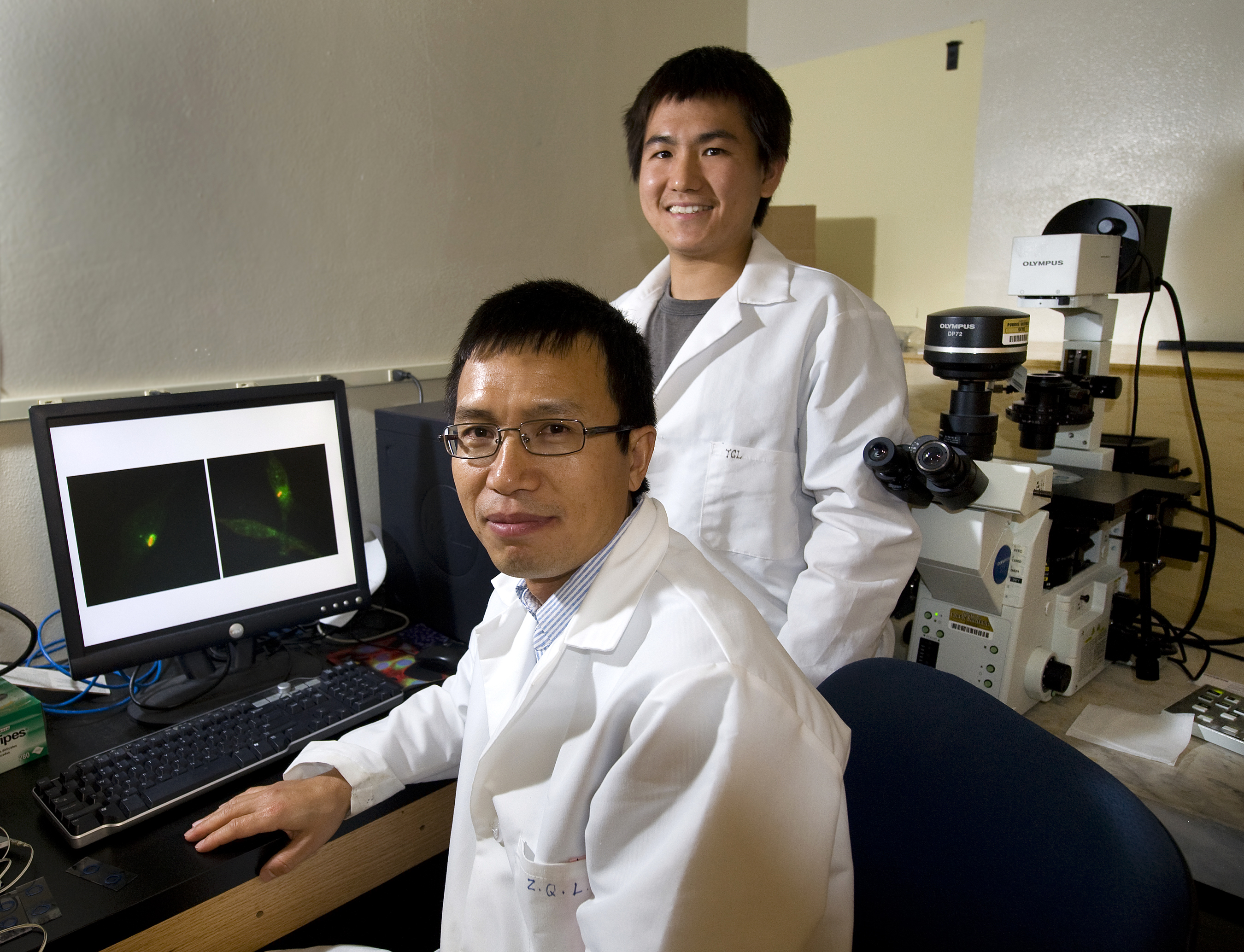
photo of Zhao-Qing Luo and Yunhao Tan

Associate professor of biological sciences Zhao-Qing Luo, foreground, and graduate student Yunhao Tan identified a new way in which bacteria modify healthy cells during infection. Shown on the computer screen are cells infected with a mutant strain of the bacteria Legionella pneumophila used in their research.

Purdue University biologists identified a new way in which bacteria hijack healthy cells during infection, which could provide a target for new antibiotics. Zhao-Qing Luo, the associate professor of biological sciences who led the study, said the team discovered a new enzyme used by the bacterium Legionella pneumophila – which causes Legionnaires’ disease – to control its host cell in order to take up residence.

“Legionnaires’ disease is a severe form of pneumonia, and this finding could lead to the design of a new therapy that saves lives,” Luo said. “At the same time it also provides great insight into a general mechanism of both bacterial infection and cell signaling events in higher organisms including humans.”

Successful infection by Legionella pneumophila requires the delivery of hundreds of proteins into the host cells that alter various functions to turn the naturally hostile environment into one tailor-made for bacterial replication. These proteins tap into existing communication processes within the cells in which an external signal, such as a hormone, triggers a cascade of slight modifications to proteins that eventually turns on a gene that changes the cell’s behavior, he said.

“Pathogens are successful because they know how information in our cells is relayed and they amplify some signals and block others in order to evade the immune system and keep the cell from defending itself,” Luo said. “Despite our understanding of this, we do not know much about how the proteins delivered by the bacteria accomplish this – how they work. This time we were able to pinpoint an enzyme and see how it disrupted and manipulated a specific signaling pathway in order to create a better environment for itself.”

The signaling pathway involved was only recently identified, and the discovery by Luo and graduate student Yunhao Tan also provides a key insight into its process. The signaling pathway involves a new form of protein modification called AMPylation in order to relay instructions to change cell behavior and has been found to be used by almost all organisms, Luo said.

The bacterium affects the host cell’s functions differently during different phases of the infection process, tapping into signaling pathways to turn on and off certain natural cellular activities. SidD stops the AMPylation process four hours after the start of infection in order to reverse an earlier modification that would be detrimental to the cell if left in place, he said.

Read the full press release.

Related: Using Bacteria to Carry Nanoparticles Into CellsDisrupting Bacterial Communication to Thwart ThemScientists Target Bacteria Where They LiveAre you ready for a world without antibiotics?

Photo of Fish Using a Rock to Open a Clam

photo of a blackspot tuskfish using a rock to crack open a clam

Blackspot tuskfish using a rock to crack open a clam. Photo by Scott Gardner

Diver Snaps First Photo of Fish Using Tools

While exploring Australia’s Great Barrier Reef, professional diver Scott Gardner heard an odd cracking sound and swam over to investigate. What he found was a footlong blackspot tuskfish (Choerodon schoenleinii) holding a clam in its mouth and whacking it against a rock. Soon the shell gave way, and the fish gobbled up the bivalve, spat out the shell fragments, and swam off. Fortunately, Gardner had a camera handy and snapped what seem to be the first photographs of a wild fish using a tool.

Tool use, once thought to be the distinctive hallmark of human intelligence, has been identified in a wide variety of animals in recent decades…

There have also been a handful of reports of fish cracking open hard-shelled prey, such as bivalves and sea urchins, by banging them on rocks or coral, but there’s no photo or video evidence to back it up, according to Culum Brown, a behavioral ecologist at Macquarie University in Sydney, Australia, and a co-author of the present paper, to be published in a forthcoming issue of Coral Reefs.

The more we learn about animals the more tool use we find. It is continually interesting to see the wide variety of behavior documented.

Related: Bird Using Bait to FishDolphins Using Tools to HuntOrangutan Attempts to Fish with SpearAncient Chimps Used Stone “Hammers”

The State of the Oceans

World’s oceans in ‘shocking’ decline

In a new report, [an expert panel of scientists] warn that ocean life is “at high risk of entering a phase of extinction of marine species unprecedented in human history”. They conclude that issues such as over-fishing, pollution and climate change are acting together in ways that have not previously been recognised.

ocean acidification, warming, local pollution and overfishing are acting together to increase the threat to coral reefs – so much so that three-quarters of the world’s reefs are at risk of severe decline.

The report also notes that previous mass extinction events have been associated with trends being observed now – disturbances of the carbon cycle, and acidification and hypoxia (depletion of oxygen) of seawater.

Levels of CO2 being absorbed by the oceans are already far greater than during the great extinction of marine species 55 million years ago (during the Paleocene-Eocene Thermal Maximum), it concludes.

The overfishing of our oceans has been a problem for over 100 years and a known problem, that we continue to give too little attention to. Adding to that impacts of climate change and the state of ocean life is in trouble. The decision of our population to not deal with the causes of climate change will have very bad consequences. It is a shame we have so little caring about the consequences of our decisions. And even sadder that our “leaders” do such an appalling job of leading – instead they pander to selfish immediate gratification.

Related: Altered Oceans: the Crisis at Sea (2006)Unless We Take Decisive Action, Climate Change Will Ravage Our PlanetArctic System on Trajectory to New, Seasonally Ice-Free State (2005)

NASA’s Mars Curiosity Rover

Curiosity is the name of the new rover from NASA. It will be launched to continue the exploration of Mars so successfully done by Spirit and Opportunity (2 previous Mars rovers that did some amazing work and laster years longer than expected). The rover is NASA’s Mars Science Laboratory, a mobile robot for investigating Mars’ past or present ability to sustain microbial life.

photo of NASA's Mars Rover: Curiosity

Once on the surface, the rover will be able to roll over obstacles up to 75 centimeters (29 inches) high and travel up to 90 meters per hour. On average, the rover is expected to travel about 30 meters per hour, based on power levels, slippage, steepness of the terrain, visibility, and other variables.

The rover is about the size of a small SUV — 10 feet long (not including the arm), 9 feet wide and 7 feet tall. It weighs 900 kilograms (2,000 pounds)

The rover will carry a radioisotope power system that generates electricity from the heat of plutonium’s radioactive decay. This power source gives the mission an operating lifespan on Mars’ surface of a full martian year (687 Earth days) or more, while also providing significantly greater mobility and operational flexibility, enhanced science payload capability, and exploration of a much larger range of latitudes and altitudes than was possible on previous missions to Mars.

Related: Mars Rover Continues ExplorationMars Rovers Getting Ready for Another Adventure (2007)Sunset on Mars

More Dark Matter Experiment Results

A dark-matter experiment deep in the Soudan mine of Minnesota now has detected a seasonal signal variation similar to one an Italian experiment has been reporting for more than a decade.

The new seasonal variation, recorded by the Coherent Germanium Neutrino Technology (CoGeNT) experiment, is exactly what theoreticians had predicted if dark matter turned out to be what physicists call Weakly Interacting Massive Particles (WIMPs).

“We cannot call this a WIMP signal. It’s just what you might expect from it,” said Juan Collar, associate professor in physics at the University of Chicago. Collar and John Orrell of Pacific Northwest National Laboratory, who lead the CoGeNT collaboration, are submitting their results in two papers to Physical Review Letters.

WIMPS might have caused the signal variation, but it also might be a random fluctuation, a false reading sparked by the experimental apparatus itself or even some exotic new phenomenon in atomic physics, Collar said.

Dark matter accounts for nearly 90 percent of all matter in the universe, yet its identity remains one of the biggest mysteries of modern science. Although dark matter is invisible to telescopes, astronomers know it is there from the gravitational influence it exerts over galaxies.

Theorists had predicted that dark matter experiments would detect an annual modulation because of the relative motion of the Earth and sun with respect to the plane of the Milky Way galaxy.
Continue reading