Category Archives: Science

Best Research University Rankings – 2008

The annual ranking of research Universities are available from Shanghai’s Jiao Tong University. The methodology values publications and faculty awards which provides a better ranking of research (rather than teaching). Results from the 2008 rankings of Top 500 Universities worldwide, country representation of the top schools:

location Top 100 % of World
Population
% of World GDP % of top 500
USA 54     4.6%   27.2%  31.6%
United Kingdom 11  0.9  4.9 8.3
Germany   6  1.3  6.0 8.0
Japan   4  2.0  9.0 6.2
Canada   4  0.5  2.6 4.2
Sweden   4  0.1  0.8 2.2
France   3  0.8  4.6 4.6
Switzerland   3  0.1  0.8 1.6
Australia   3  0.3  1.6 3.0
Netherlands   2  0.2  1.4 2.4
Denmark   2  0.1  0.6 0.8
Finland   1  0.1  0.4 1.2
Norway   1  0.1  0.7 0.8
Israel   1  0.1  0.3 1.2
Russia   1  2.2  2.0 0.4
China  20.5  6.6 6.0
India  17.0  1.9 0.4

There is little change in most of the data from last year, which I think is a good sign, it wouldn’t make much sense to have radical shifts over a year in these rankings. Japan lost 2 schools in the top 100, France lost 1. Denmark (Aarhus University) and Australia (University of Sydney) gained 1. Last year there was a tie so there were 101 schools in the top 100.

The most dramatic data I noticed is China’s number of top 500 schools went from 14 to 30, which made me a bit skeptical of what caused that quick change. Looking more closely last year they reported the China top 500 totals as (China 14, China-Taiwan 6 and China-Hong Kong 5). That still gives them an impressive gain of 5 schools.

Singapore has 1 in the 102-151 range. Taiwan has 1 ranked in the 152-200 range, as do Mexico, Korea and Brazil. China has 9 in the 201-302 range (including 3 in Hong Kong). India has 2 in the 303-401 range.

University of Wisconsin – Madison is 17th again 🙂 My father taught there while I grew up.
Continue reading

10 Most Beautiful Physics Experiments

Science’s 10 Most Beautiful Experiments by George Johnson

Galileo’s experiment on falling objects

In the late 1500’s, everyone knew that heavy objects fall faster than lighter ones. After all, Aristotle had said so. That an ancient Greek scholar still held such sway was a sign of how far science had declined during the dark ages.

Galileo Galilei, who held a chair in mathematics at the University of Pisa, was impudent enough to question the common knowledge. The story has become part of the folklore of science: he is reputed to have dropped two different weights from the town’s Leaning Tower showing that they landed at the same time. His challenges to Aristotle may have cost Galileo his job, but he had demonstrated the importance of taking nature, not human authority, as the final arbiter in matters of science.

Young’s double-slit experiment applied to the interference of single electrons

Though it is not simply made of particles, neither can it be described purely as a wave. In the first five years of the 20th century, Max Planck and then Albert Einstein showed, respectively, that light is emitted and absorbed in packets — called photons. But other experiments continued to verify that light is also wavelike.

It took quantum theory, developed over the next few decades, to reconcile how both ideas could be true: photons and other subatomic particles — electrons, protons, and so forth — exhibit two complementary qualities; they are, as one physicist put it, ”wavicles.”

Eratosthenes’ measurement of the Earth’s circumference -the librarian at Alexandria in the third century B.C. estimated the circumference of the planet

Assuming the earth is spherical, its circumference spans 360 degrees. So if the two cities are seven degrees apart, that would constitute seven-360ths of the full circle — about one-fiftieth. Estimating from travel time that the towns were 5,000 ”stadia” apart, Eratosthenes concluded that the earth must be 50 times that size — 250,000 stadia in girth.

Related: Book, The Ten Most Beautiful Experiments by George Johnson (not the same experiments) – Home Experiments: Quantum ErasingParticles and Wavestheory of knowledgescientific experiments

Kids on Scientists: Before and After

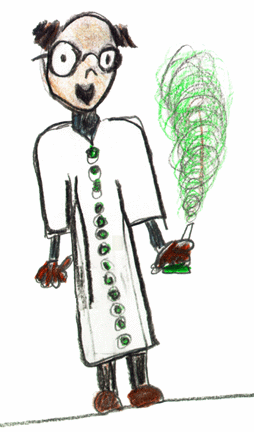
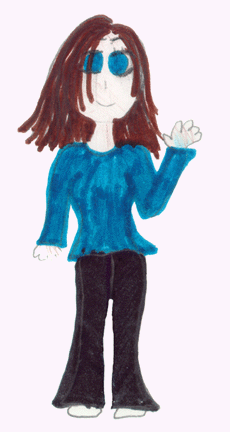
Fermilab offers some drawing of scientists by seventh graders before and after a visit to Fermilab. Wonderful visuals.

Before After
I think of a scientist as very dedicated to his work. He is kind of crazy, talking always quickly. He constantly is getting new ideas. He is always asking questions and can be annoying. He listens to others’ ideas and questions them. I know scientists are just normal people with a not so normal job. . . . Scientists lead a normal life outside of being a scientist. They are interested in dancing, pottery, jogging and even racquetball. Being a scientist is just another job which can be much more exciting.
by Amy

This is one of the more extreme ones but there are lots of other great comparisons. Very reminiscent of: Children’s view of Scientists in England.

Related: Scientists and StudentsKids in the Lab: Getting High-Schoolers Hooked on ScienceCurious Cat Science and Engineering SearchSaving FermilabMatter to Anti-Matter 3 Trillion Times a Second

NASA’s Carl Sagan Fellowships

NASA Exoplanet Science Institute announces the introduction of the Sagan Postdoctoral Fellowship

The NASA Exoplanet Science Institute announces the introduction of the Sagan Postdoctoral Fellowship Program and solicits applications for fellowships to begin in the fall of 2009.

The Sagan Fellowships support outstanding recent postdoctoral scientists to conduct independent research that is broadly related to the science goals of the NASA Exoplanet Exploration area. The primary goal of missions within this program is to discover and characterize planetary systems and Earth-like planets around nearby stars.

The proposed research may be theoretical, observational, or instrumental. This program is open to applicants of any nationality who have earned (or will have earned) their doctoral degrees on or after January 1, 2006, in astronomy, physics, or related disciplines. The fellowships are tenable at U.S. host institutions of the fellows’ choice, subject to a maximum of one new fellow per host institution per year. The duration of the fellowship is up to three years: an initial one-year appointment and two annual renewals contingent on satisfactory performance and availability of NASA funds.

We anticipate awarding 3 – 4 fellowships in 2009. Please note that these are postdoctoral Fellowships only. Previous Michelson Fellowship holders are fully eligible to apply.

Related: Science and Engineering Scholarships and Fellowships DirectoryNSF Graduate Research Fellows 2008

MythBuster: 3 Ways to Fix USA Science Education

MythBuster Adam Savage: 3 Ways to Fix U.S. Science Education

Let students get their hands dirty.
It’s really difficult to absorb things just by being told about them—I know I don’t learn well that way. If students could get their hands dirty in science class they’d be more likely to internalize information. You can lecture about the surface tension of water, but it’s not as effective as conducting an experiment with a needle and a single beam balance. Jamie and I are in touch with a lot of teachers from industrial engineering programs, and one of them told us he thinks our show has helped shift the emphasis from the strictly theoretical to a more hands-on approach.

2. Yes, spend more money on science.

3. Celebrate mistakes.
A good scientist will tell you that being wrong can be just as interesting as being right. The same holds for our show. We love hearing from fans who challenge our conclusions—especially kids.

Related: Report on K-12 Science Education in USA (2006)posts on science educationThe Economic Consequences of Investing in Science EducationMiddle School EngineersLego LearningThe Importance of Science Education – Science Toys You Can Make With Your Kids

Alumni Return to Redesign High School Engineering Classes

Prince George’s County High School Alumni Return to Redesign Classes

Cressman joined nine fellow graduates of the elite science and technology magnet program every day for six weeks to create top-flight engineering courses for high school students. The class at the Greenbelt, Maryland, school will teach the latest in computer programming and drafting with software used by college professors and professional engineers. And since engineering teachers can be hard to find, the curriculum is designed to be taught by a non-expert.

All freshman in the science and technology magnet program are already required to take two introductory engineering classes, but the curricula for those classes were originally designed in 1976. “There has been some revamping through the years, but we knew we needed a major overhaul. Things have changed so much,” explains Jane Hemelt, coordinator of the science and technology program, which serves about 900 of the school’s 2,700 students. The problem was that there wasn’t an easy way to get the expertise to fix it.

Hemelt talked about the problem with Rocco Mennella, a mathematics professor at Prince George’s Community College and Catholic University who teaches science and math at Roosevelt. For several years, Mennella had been recruiting Roosevelt graduates as tutors for his summer precalculus class, and he told Hemelt that his recruits—who were science, math, and engineering majors—might serve double duty by redesigning the engineering curriculum.

Mennella’s college recruits came from Caltech, MIT, Brown, Johns Hopkins, Georgia Tech, and the University of Maryland, where they have been exposed to some of the best science and engineering teachers in the country. In addition, Cressman contacted about 80 engineering professors at universities and colleges around the country to find out what they would like their incoming students to know; almost 50 responded.

For example, all agreed that the classes should focus on the practical aspects of engineering, including computer-aided design and computer programming, while exposing the high school students to electrical, civil, and mechanical engineering. But the curriculum designers also wanted their younger peers to have fun while learning, so they put in many hours on computers creating lessons that would challenge students to redesign the Taj Mahal, build an SUV, or guide a robot.

Eleanor Roosevelt High School will test some of the modules as part of other classes this fall, which will reach 30 students or more, and the team hopes to roll out the other classes full time in coming years. The Prince George’s school district’s other two science magnet schools, Oxon Hill and Charles Flowers, also plan to use the curriculum. But Mennella and Hemelt hope it will spread even wider, including to schools that don’t specialize in science and math. Those schools might just use parts of the curriculum, or spread a semester-long class out over a year. “Who knows, this could become a model for the state and maybe a model for the country,” Hemelt says.

I am looking into how people can see the curricula, and any other material that may be available.

Related: Center for Engineering Educational OutreachKids in the Lab: Getting High-Schoolers Hooked on ScienceMiddle School EngineersTechnology and Fun in the ClassroomEducation Resources for Science and Engineering

General Biology Berkeley Course Webcast

General Biology Course at University of California – Berkeley, Fall 2007. Instructors John Forte, R Fischer and R Malkin. “General introduction to cell structure and function, molecular and organism genetics, animal development, form and function. Intended for biological sciences majors, but open to all qualified students.” A great service from Berkeley with video and audio… Topics include: Macromolecules structure and function, How cells function-an introduction to cellular metabolism and biological catalysts, Microbes – Viruses, Bacteria, Plasmids, Transposons and Homeostasis: The body’s defenses.

Related: Science and Engineering Webcast DirectoryHarvard Course: Understanding Computers and the InternetBerkeley and MIT courses onlineArizona State Science Studio PodcastsGoogle Tech Talks

Wireless Power

   
An end to spaghetti power cables by Maggie Shiels, BBC News

Mr Rattner envisaged a scenario where a laptop’s battery could be recharged when the machine gets within several feet of a transmit resonator which could be embedded in tables, work surfaces, picture frames and even behind walls.

Intel’s technology relies on an idea called magnetic induction. It is a principle similar to the way a trained singer can shatter a glass using their voice; the glass absorbs acoustic energy at its natural frequency. At the wall socket, power is put into magnetic fields at a transmitting resonator – basically an antenna. The receiving resonator is tuned to efficiently absorb energy from the magnetic field, whereas nearby objects do not.

Intel’s demonstration has built on work done originally by Marin Soljacic, a physicist at Massachusetts Institute of Technology (MIT). At the Intel Developer Forum in San Francisco, researcher Alanson Sample showed how to make a 60-watt light bulb glow from an energy source three feet away. This was achieved with relatively high efficiency, only losing a quarter of the energy it started with.

Don’t expect to see this available commercially this year, they estimate it is at least 5 years away. Though this is not university and business collaboration in the sense they are working together, it is in the sense that Intel is building upon the work MIT did. See other posts on university and business collaboration.

Related: Water From AirEngineers Save EnergyMicrochip Cooling Innovation

Patent Gridlock is Blocking Developing Lifesaving Drugs

How patent gridlock is blocking the development of lifesaving drugs by Michael Heller, Forbes

Since a 1980 Supreme Court decision allowing patents on living organisms, 40,000 dna-related patents have been granted. Now picture a drug developer walking into an auditorium filled with dozens of owners of the biotech patents needed to create a potential lifesaving cure. Unless the drugmaker can strike a deal with every person in the room, the new drug won’t be developed.

Nicholas Naclerio, who used to head the BioChip Division at Motorola , told Scientific American, “If we want to make a medical diagnostic with 40 genes on it, and 20 companies hold patents on those genes, we may have a big problem.”

And it’s not just drugs we’re losing. Today anything high tech–banking, semiconductors, software, telecom–demands the assembly of innumerable patents. Innovation has moved on, but we’re stuck with old-style ownership that’s easy to fragment and hard to put together. This debacle’s only upside is that assembling fragmented property is one of the great entrepreneurial and political opportunities of our era.

This is a critical problem I have written about before. The broken patent system is a serious problem that needs to be fixed.

Related: The Effects of Patenting on SciencePatent Policy Harming USA, and the worldPatenting Life is a Bad IdeaThe Differences Between Culture and CodeInnovation and Creative CommonsThe Value of the Public DomainThe Patent System Needs to be Significantly ImprovedAre Software Patents Evil?

Very Long-Term Backup

Very Long-Term Backup by Kevin Kelly

This graphic side of the disk is pure titanium. A black oxide coating has been added to the surface. The text is etched into that, revealing the whiter titanium. This bold sign board is needed because the pages of genesis which are etched on the mirror-like opposite side of the disk are nearly invisible.

This business side of the disk is pure nickel. Picking it up you would not be aware there were 13,500 pages of linguistic gold hiding on it. The nickel is deposited on an etched silicon disk. In effect the Rosetta disk is a nickel cast of a micro-etch silicon mold. When the disk is held at the right angle the grid array of the pages form a slight diffraction rainbow. You need a 750-power optical microscope to read the pages.

The Rosetta disk is not digital. The pages are analog “human-readable” scans of scripts, text, and diagrams. Among the 13,500 scanned pages are 1,500 different language versions of Genesis 1-3, a universal list of the words common for each language, pronunciation guides and so on. Some of the key indexing meta-data for each language section (such as the standard linguistic code number for that language) are displayed in a machine-readable font (OCRb) so that a smart microscope could guide you through this analog trove.

Our hope is that at least one of the eight headline languages can be recovered in 1,000 years. But even without reading, a person might guess there are small things to see in this disk.

This is another project of an organization I like very much: The Long Now Foundation.

Related: The Future of ScienceEngineering at Home1,000 True Fans