Bill Nye the Science Guy, Interview

Bill Nye the Science Guy Makes Green “Stuff Happen”

One of your first “Stuff Happens” episodes is about breakfast. What’s so special about breakfast and the environment?
Are you kidding? It’s the most important meal of the day. It had the iconic story that North American pigs – from where we get bacon – I presume unwillingly are fed feed made with South American anchovies (and herrings and sardines). Farmers say eating fish helps their animals grow to that wonderfully ample size consumers want. Because of this, we’re accidentally destroying an ecosystem. It’s the story of stories.

How so?
We’re seriously depleting the world’s anchovy population and leaving the penguins and South American seabirds with nothing to eat. These birds are dangerously close to starving because the anchovy and sardine populations have been decimated.

What can we do?
Strange as it may seem, you could eat more anchovies. This would raise the price of the fish and make anchovy fish feed more costly and less desirable to pig farmers. Also eat organic bacon from pigs raised on 100% agricultural feed. If you’re looking for the true organic meat products, make sure it’s grass-fed only.

Related: Pigs Instead of PesticidesInterview of Steve WozniakThe Engineer That Made Your Cat a PhotographerInterview with Donald Knuth

What is an Engineer?

Guest post: What is an engineer? by Chris Gammell

I’ve been having what some would call an identity crisis. How, you ask? I’ve been working on digital electronics.

*GASP*!

I found out that in the early 90s and even earlier, analog engineers routinely switched from working in the analog domain to the digital domain…because it was paying really great. Not only that, most analog engineers had the expertise to do what most early digital engineers were doing (basically stringing together a lot of digital gates in DIP packages). It wasn’t until later that digital engineers started acting more as programmers and VHDL/Verilog experts.

So why do I bring this up? Because I’ve been thinking about the versatility required from engineers in general, not just analog or digital engineers. Routinely engineers are asked to switch modes or tasks or careers in order to get a job done. It’s not that other professions are never asked this; it’s just that the chameleon-like requirement placed on engineers seems to define the profession. Allow me to explain.

What is an engineer?

An engineer puts theories into practice using available devices and elements. They create new products and pass on knowledge through design iterations and trial and error. Their work should be directly applicable to the real world (sometimes in the form of an end-product, sometimes not) and hopefully able to be reproduced successfully in the same form for multiple parties (mass manufacturing). Engineers are often rooted in math and science but require a wide range of skill-sets in order to properly construct an end product.

I think it is important to note that an engineer is different from a scientist, although the line can often be blurred (especially when looking back at the inventors of the early 20th century). In modern times a scientist is usually tasked with pushing the barrier and finding new theories and concepts. This means that the concept will not necessarily be available in product form right away (although this is not always the case), as the product form must be iterated upon and improved for production.
Continue reading

Kids on Scientists: Before and After

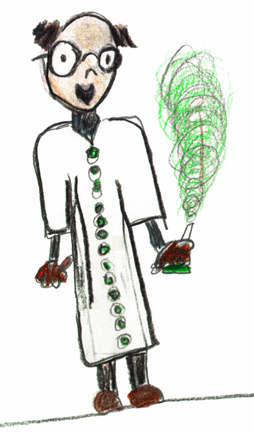
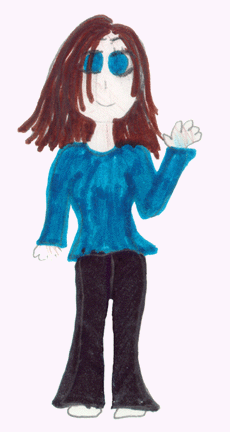
Fermilab offers some drawing of scientists [updated to archive.org link since the USA government purged this content from their website] by seventh graders before and after a visit to Fermilab. Wonderful visuals.

Before After
drawing of a male scientist in a lab coat
drawing of a scientist (women in blue blouse)
I think of a scientist as very dedicated to his work. He is kind of crazy, talking always quickly. He constantly is getting new ideas. He is always asking questions and can be annoying. He listens to others’ ideas and questions them. I know scientists are just normal people with a not so normal job. . . . Scientists lead a normal life outside of being a scientist. They are interested in dancing, pottery, jogging and even racquetball. Being a scientist is just another job which can be much more exciting.
by Amy

This is one of the more extreme ones but there are lots of other great comparisons. Very reminiscent of: Children’s view of Scientists in England.

Related: Scientists and StudentsKids in the Lab: Getting High-Schoolers Hooked on ScienceCurious Cat Science and Engineering SearchSaving FermilabMatter to Anti-Matter 3 Trillion Times a Second

Do Dolphins Sleep?

Do dolphins sleep?, MIT:

Dolphins do sleep, but not quite in the same way that people do. They sleep with one half of the brain at a time and with one eye closed. Dolphins rest this way on and off throughout the day, switching which side of the brain they shut down. During these periods, everything inside the dolphin slows down, and the mammal moves very little.

Related: Why do We Sleep?Energy Efficiency of Digestioninteresting science factsWhy is the Sky Blue?

NASA’s Carl Sagan Fellowships

NASA Exoplanet Science Institute announces the introduction of the Sagan Postdoctoral Fellowship

The NASA Exoplanet Science Institute announces the introduction of the Sagan Postdoctoral Fellowship Program and solicits applications for fellowships to begin in the fall of 2009.

The Sagan Fellowships support outstanding recent postdoctoral scientists to conduct independent research that is broadly related to the science goals of the NASA Exoplanet Exploration area. The primary goal of missions within this program is to discover and characterize planetary systems and Earth-like planets around nearby stars.

The proposed research may be theoretical, observational, or instrumental. This program is open to applicants of any nationality who have earned (or will have earned) their doctoral degrees on or after January 1, 2006, in astronomy, physics, or related disciplines. The fellowships are tenable at U.S. host institutions of the fellows’ choice, subject to a maximum of one new fellow per host institution per year. The duration of the fellowship is up to three years: an initial one-year appointment and two annual renewals contingent on satisfactory performance and availability of NASA funds.

We anticipate awarding 3 – 4 fellowships in 2009. Please note that these are postdoctoral Fellowships only. Previous Michelson Fellowship holders are fully eligible to apply.

Related: Science and Engineering Scholarships and Fellowships DirectoryNSF Graduate Research Fellows 2008

Study Finds No Measurable Benefit to Flu Shots

Do Flu Shots For The Elderly Save Lives? Just Washing Hands Works Better, Says Study

The widely-held perception that the influenza vaccination reduces overall mortality risk in the elderly does not withstand careful scrutiny, according to researchers in Alberta. The vaccine does confer protection against specific strains of influenza, but its overall benefit appears to have been exaggerated by a number of observational studies that found a very large reduction in all-cause mortality among elderly patients who had been vaccinated.

The study included more than 700 matched elderly subjects, half of whom had taken the vaccine and half of whom had not. After controlling for a wealth of variables that were largely not considered or simply not available in previous studies that reported the mortality benefit, the researchers concluded that any such benefit “if present at all, was very small and statistically non-significant and may simply be a healthy-user artifact that they were unable to identify.”

“Over the last two decades in the United Sates, even while vaccination rates among the elderly have increased from 15 to 65 percent, there has been no commensurate decrease in hospital admissions or all-cause mortality

Related: New and Old Ways to Make Flu VaccinesStudy Shows Why the Flu Likes WinterOver-reliance on Prescription Drugs to Aid Children’s Sleep?

Algorithmic Self-Assembly

Paul Rothemund, scientist at Cal Tech, provides a interesting look at DNA folding and DNA based algorithmic self-assembly. In the talk he shows the promise ahead for using biological building blocks using DNA origami — to create tiny machines that assemble themselves from a set of instructions.

Algorithmic Self-Assembly of DNA Sierpinski Triangles, PLoS paper.

I posted a few months ago about how you can participate in the protein folding, with the Protein Folding Game.

Related: Viruses and What is LifeDNA Seen Through the Eyes of a CoderSynthesizing a Genome from ScratchEvidence of Short DNA Segment Self AssemblyScientists discover new class of RNA