MIT Engineering Design Workshop for Boston High School Students

This summer, a few dozen Boston-area high school students chose to spend their mornings toiling away with a variety of materials to create working marvels of engineering in the Engineering Design Workshop, a month-long program that gives teenagers a hands-on experience with the joys and challenges of engineering.

None of the activities are prescribed; instead, students take part in brainstorming sessions on the first day, and things develop from there. Typically, the “counselors” — a mix of undergraduate and graduate students from MIT and other local universities — present a few ideas, and the high school students decide which projects they’d most like to work on. I really like the idea of involving the college students.

This year, the 22 students divided themselves into five projects: a modified Razor scooter, equipped with a motor and brakes; a sound system of giant tower speakers; remote-controlled “anything” (which ended up including cars, fish, birds and even a flying turtle); a mosaic tiger meticulously assembled from pieces of stained glass; and an electric cello.

Each student is allotted $100 to spend on materials for his or her group’s project; this way, projects that attract more students have a larger budget to work with. Counselors help them purchase supplies online and work with them on the construction from the ground up.

There are probably thousands of similar type activities throughout the year to help engage students in engineering. I think it is great, but we need to do more. We need to let young students know what they are missing. If people know the wonders of engineering and choose something else for their career path, that is fine. It is a shame when people don’t get to decide, because they never experience what engineering has to offer.

Read the full press release.

Related: Infinity Project: Engineering Education for Today’s ClassroomRutgers Initiative to Help Disadvantaged ChildrenInspirational EngineerWhat Kids can Learn on Their Own

Science is at its best when curious people are just trying to find things out

Brian Cox has a new television show, Wonders Of The Universe (a co-production of the BBC, the Discovery Channel, and the Science Channel), that looks like it will be wonderful. I would love more great shows on science. BBC has done some great stuff, so has PBS and the Discovery channel. I’ll be exploring what kind of access those channels have provided over the internet in the next year. I hope it is good. I was going to link to the web site for the show but the first 2 videos I tried to click on to view they wouldn’t show, so I don’t see the point in linking – hopefully eventually people that care about promoting science will make decisions to use the internet sensibly).

Interview of Professor Brian Cox

That’s a very important point about scientific discovery in general. Most scientists are interested in just looking at the universe, looking at nature. I don’t think there are many great discoveries that you can point to that were the result of someone wanting to find the answer to a particular question. If you look back at Einstein or Newton, you find that people are fascinated often by the smallest things, actually. In terms of Einstein, cosmology—which is a real part of the way the universe evolved, the way the universe began, the Big Bang—all that stuff came from Einstein really just being interested in the speed of light. He was just interested. It was a question he’d always asked. He’d always wondered about how light travels. It’s a useful lesson, in general, not only to the theories, but that science is at its best when curious people are just trying to find things out.

There’s a very famous quote from [Alexander] Fleming, when he discovered penicillin, he said something like, “On September something 1928, I didn’t expect to wake up and revolutionize medicine.” He woke up playing around with little bits of mold in his kitchen, basically. He was just interested in moldy things. [Laughs.] And he revolutionized everybody’s life. Everybody. Virtually everybody who is over the age of about 40 or 50 is alive today because of antibiotics. Virtually everybody would have died if it hadn’t been for that. And it wasn’t someone trying to discover antibiotics that did it. It was someone exploring nature. So, the argument, “Couldn’t we just spend our money making everybody’s lives better?” We are doing that. That’s what exploration actually does.

Related: Why Do People Invest Large Amounts of Time and Money? (Neil deGrasse Tyson)Brian Cox Particle Physics WebcastScience and Engineering WebcastsScientifically Literate See a Different WorldScience and the Excitement, the Mystery and the Awe of a Flower

The Sun is a Miasma of Incandescent Plasma

They Might be Giants once again provide an enjoyable view into the wonders of science. Previously they published the video, The Sun is a Mass of Incandescent Gas. They published an updated video, a couple years ago, which captures the best current understanding based on the scientific inquiry process: Why Does the Sun Really Shine? (The Sun is a Miasma of Incandescent Plasma).

I really do love, They Might be Giants. Even before their focus on science I enjoyed their music. But they have done wonders with all their recent work. Go Giants. Get their DVD: Here Comes Science.

Related: How Science is Unmasking the Secrets of the Sun (Science magazine, 1974)The problem with hot gas = Test it Out, Experiment by They Might Be GiantsHere Comes Science by They Might Be Giants

Their previous video, The Sun is a Mass of Incandescent Gas, Continue reading

Wesley the Owl: Love Story of an Owl and His Girl

This story begins on Valentine’s Day in 1985 when biologist Stacey O’Brien meets a four-day-old baby barn owl in a fateful encounter that would turn into an astonishing 19-year saga. With nerve damage in one wing, the owlet’s ability to fly was forever compromised and he had no hope of surviving on his own in the wild. A young assistant in the owl laboratory at Caltech, O’Brien promised to care for the helpless owlet and give him a permanent home. O’Brien’s heartfelt memoir of life with this wild bird, Wesley the Owl: The Remarkable Love Story of an Owl and His Girl recounts their dramatic, and often humorous, life together.

For almost two decades, O’Brien studied Wesley and his strange habits intensively and providing a mice-only diet. With a heart-shaped face and outsized personality that belied his 18-inch stature, the gorgeous white-and-gold Wesley fascinated everyone he met, and touched many lives. Stacey and Wesley’s bond was especially deep; O’Brien discovered that owls are highly sentient beings with individual personalities, subtle emotions, and a playful nature that can also turn fiercely loyal and protective.

Cool fact: “While we hear in two dimensions, owls hear in three.” Owls can detect a mouse heartbeat under three feet of snow.
Related: Friday Fun: Cat and Owl PlayingBird Brain (smart crows)Using Barn Owls for Bilogical Pest Control in Israel
Continue reading

Evolution in New York City Wildlife

Evolution Right Under Our Noses by Carl Zimmer

White-footed mice, stranded on isolated urban islands, are evolving to adapt to urban stress. Fish in the Hudson have evolved to cope with poisons in the water. Native ants find refuge in the median strips on Broadway. And more familiar urban organisms, like bedbugs, rats and bacteria, also mutate and change in response to the pressures of the metropolis. In short, the process of evolution is responding to New York and other cities the way it has responded to countless environmental changes over the past few billion years. Life adapts.

Dr. Wirgin and his colleagues were intrigued to discover that the Hudson’s population of tomcod, a bottom-dwelling fish, turned out to be resistant to PCBs. “There was no effect on them at all,” Dr. Wirgin said, “and we wanted to know why.”

In March, he and his colleagues reported that almost all the tomcod in the Hudson share the same mutation in a gene called AHR2. PCBs must first bind to the protein encoded by AHR2 to cause damage. The Hudson River mutation makes it difficult for PCBs to grab onto the receptor, shielding the fish from the chemical’s harm.

The AHR2 mutation is entirely missing from tomcod that live in northern New England and Canada. A small percentage of tomcod in Long Island and Connecticut carry the mutation. Dr. Wirgin and his colleagues concluded that once PCBs entered the Hudson, the mutant gene spread quickly.

Carl Zimmer again does a good job of explaining science in an engaging way. It is interesting to learn about science and evolution in urban environments. Lots of life manages to survive the challenges of urban life and it is interesting to learn what scientists are finding about that life.

Related: Trying to Find Pest Solutions While Hoping Evolution Doesn’t Exist Doesn’t WorkMicrocosm by Carl ZimmerNew Yorkers Help Robot Find Its Way in the Big CityParasite RexBackyard Wildlife: Great Spreadwing Damselfly

How Algorithms Shape our World

Our modern world is influenced greatly by algorithms. As computing power allowed incredibly complex calculation we have taken advantage of that and used algorithms to find solutions to our desires. Great things are done but we also find ourselves getting into trouble occasionally as we develop these algorithm.

Related: Algorithmic Self-AssemblyComputer Science RevolutionGoogle’s Answer to Filling Jobs Is an AlgorithmWhat are Genetic Algorithms?Google Prediction API

EZ-Builder Robot Control Software

You can get EZ-Builder Robot Control Software and try this out yourself.

Not a programmer? No problem! The EZ-Builder application allows non-programmers to easily build robots using advanced functions of the EZ-B Robot Controller. It is a Microsoft Windows application that gives you remote and scripting control of your custom robot design. Within the application, you add Controls that mimic your robot’s configuration. There are many controls for speakers, iRobot Roomba, HBridge, Servos, Cameras, Voice Recognition, Joysticks and more! There is even an easy scripting language so you may create short animations, interactions or initialization routines for your robot.

Using a Dremel, hot glue gun, screw drivers and various other tools, you can begin modifying the toy shell to fit your servos. For wheels or mobility, use continuous rotation modified servos. For arms and neck, use a standard servo. To allow your robot to see for object detection, use a Sharp IR Distance Sensor or a HC-SR04 Ultrasonic Ping Sensor.

Related: Arduino: Open Source Programmable HardwareRobots That Start as Babies Master Walking Faster Than Those That Start as AdultsRobot Built Largely From Old TV Parts

Great Projects From First Google Science Fair Finalists

15 finalists (from 3 different age groups – 13-14 years old, 15-16 and 17-18) were selected. 11 finalists were from the USA and 1 each from Singapore, Canada, India and South Africa. These examples of what can be done with imagination, effort and a scientific mindset is great.

The grand prize winner, Shree Boseer’s project:

Each year, over 21,000 women are diagnosed with ovariancancer – the 5th leading cause of cancer-related deaths in women in the United States. One of the most common drugs usedin ovarian cancer chemotherapy is cisplatin, a platinum-based chemotherapy treatment. While the drug affects ordinary cells, the significantly higher replication frequency of cancer cells causes cisplatin to have a greater impact in malignant cells. However, cancer cells often develop resistance to cisplatin, rendering the treatment ineffective. To improve the efficiency of cisplatin treatment, this research sought to determine whether AMP kinase, an energy protein of cell, plays a role in the development of cisplatin resistance. Studies with various techniques showed a significant difference on cell death caused by cisplatin insensitive and resistant ovarian cancer cells when AMPK was inhibited,suggesting that AMPK plays a role in the development of resistance. This work,in addition to offering a new treatment regime, also furthers our understanding of ovarian cancer and cancers in general.

This is a great project and the experience for the students is wonderful. Still I do think the prizes should be much larger given all the large corporations involved. Get involved with the next Google Science fair.

Google Science Fair 2011 Projects semi finalistsIntel Science and Engineering Fair 2009 WebcastsHats off to the winners of the inaugural Google Science FairPresident Obama Speaks on Getting Students Excited About Science and Engineering
Continue reading

Cambrian Explosion Song

via Smithsonian’s Surprising Science:

What does a music teacher do when he ends up teaching science? He teaches about evolution and the geologic timeline with music, of course, and that’s what Canadian elementary school teacher John Palmer did. He originally played “Cambrian Explosion” as a rock/hip hop creation in class but has since recorded an acoustic version. (The trio is called Brighter Lights, Thicker Glasses and consists of Palmer on the guitar/vocals, Michael Dunn on the dobro and Brian Samuels [from UBC civil engineering department] on the cello.)

The video was filmed in the Beaty Biodiversity Museum (Canada) atrium with the blue whale exhibit in the background.

Related: Test it Out, Experiment by They Might Be GiantsHere Comes Science by They Might Be GiantsLobopodians from China a Few Million Years AgoGoogle Art Project: View Art from the Hermitage, the Met, etc.

Biologists Identified a New Way in Which Bacteria Hijack Healthy Cells

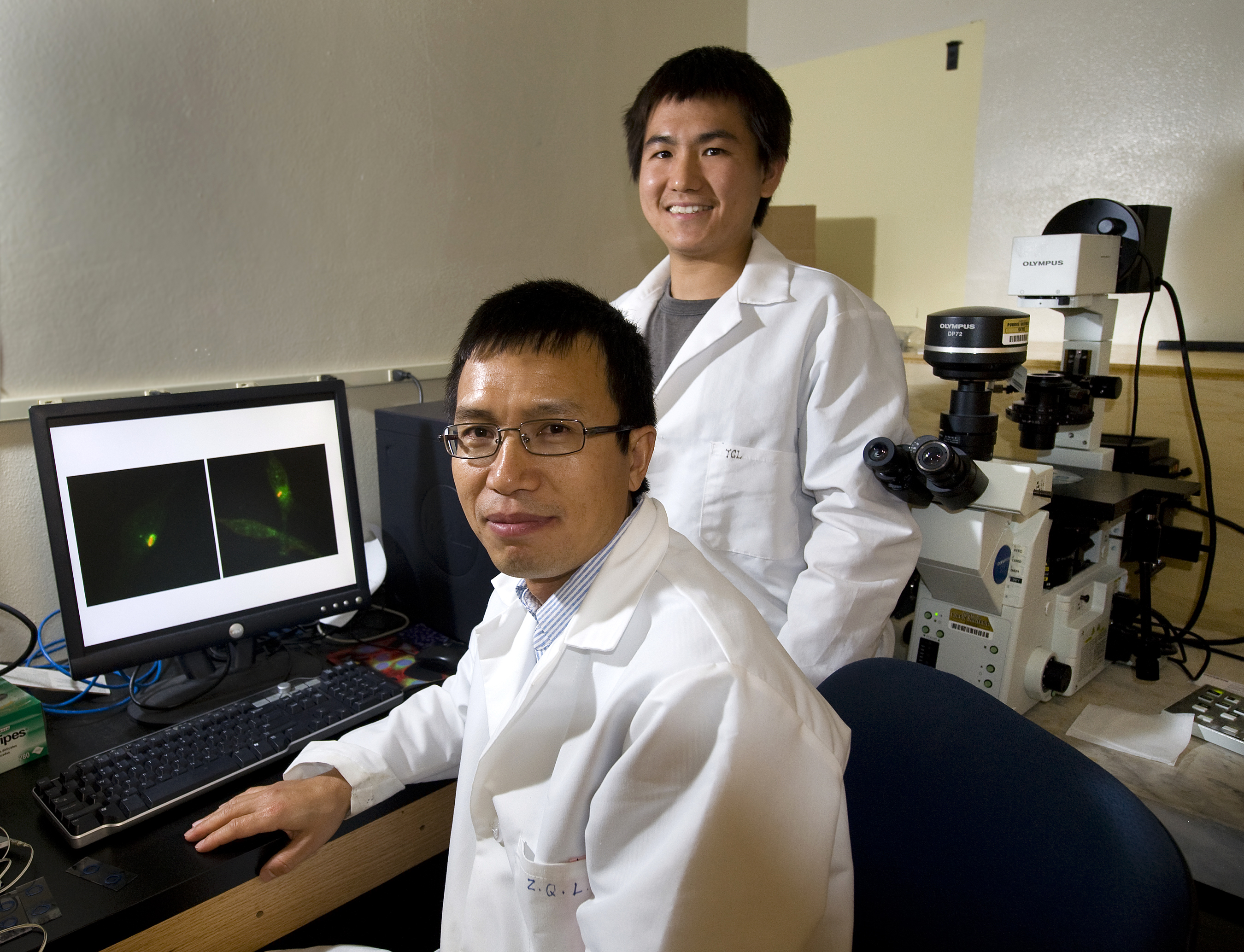
photo of Zhao-Qing Luo and Yunhao Tan

Associate professor of biological sciences Zhao-Qing Luo, foreground, and graduate student Yunhao Tan identified a new way in which bacteria modify healthy cells during infection. Shown on the computer screen are cells infected with a mutant strain of the bacteria Legionella pneumophila used in their research.

Purdue University biologists identified a new way in which bacteria hijack healthy cells during infection, which could provide a target for new antibiotics. Zhao-Qing Luo, the associate professor of biological sciences who led the study, said the team discovered a new enzyme used by the bacterium Legionella pneumophila – which causes Legionnaires’ disease – to control its host cell in order to take up residence.

“Legionnaires’ disease is a severe form of pneumonia, and this finding could lead to the design of a new therapy that saves lives,” Luo said. “At the same time it also provides great insight into a general mechanism of both bacterial infection and cell signaling events in higher organisms including humans.”

Successful infection by Legionella pneumophila requires the delivery of hundreds of proteins into the host cells that alter various functions to turn the naturally hostile environment into one tailor-made for bacterial replication. These proteins tap into existing communication processes within the cells in which an external signal, such as a hormone, triggers a cascade of slight modifications to proteins that eventually turns on a gene that changes the cell’s behavior, he said.

“Pathogens are successful because they know how information in our cells is relayed and they amplify some signals and block others in order to evade the immune system and keep the cell from defending itself,” Luo said. “Despite our understanding of this, we do not know much about how the proteins delivered by the bacteria accomplish this – how they work. This time we were able to pinpoint an enzyme and see how it disrupted and manipulated a specific signaling pathway in order to create a better environment for itself.”

The signaling pathway involved was only recently identified, and the discovery by Luo and graduate student Yunhao Tan also provides a key insight into its process. The signaling pathway involves a new form of protein modification called AMPylation in order to relay instructions to change cell behavior and has been found to be used by almost all organisms, Luo said.

The bacterium affects the host cell’s functions differently during different phases of the infection process, tapping into signaling pathways to turn on and off certain natural cellular activities. SidD stops the AMPylation process four hours after the start of infection in order to reverse an earlier modification that would be detrimental to the cell if left in place, he said.

Read the full press release.

Related: Using Bacteria to Carry Nanoparticles Into CellsDisrupting Bacterial Communication to Thwart ThemScientists Target Bacteria Where They LiveAre you ready for a world without antibiotics?