Tag Archives: appropriate technology

Engineering: Cellphone Microscope

UCLA Professor Aydogan Ozcan‘s invention (LUCAS) enables rapid counting and imaging of cells without using any lenses even within a working cell phone device. He placed cells directly on the imaging sensor of a cell phone. The imaging sensor captures a holographic image of the cells containing more information than a conventional microscope. The CelloPhone received a Wireless Innovations Award from Vodafone

a wireless health monitoring technology that runs on a regular cell-phone would significantly impact the global fight against infectious diseases in resource poor settings such as in Africa, parts of India, South-East Asia and South America.

The CelloPhone Project aims to develop a transformative solution to these global challenges by providing a revolutionary optical imaging platform that will be used to specifically analyze bodily fluids within a regular cell phone. Through wide-spread use of this innovative technology, the health care services in the developing countries will significantly be improved making a real impact in the life quality and life expectancy of millions.

For most bio-medical imaging applications, directly seeing the structure of the object is of paramount importance. This conventional way of thinking has been the driving motivation for the last few decades to build better microscopes with more powerful lenses or other advanced imaging apparatus. However, for imaging and monitoring of discrete particles such as cells or bacteria, there is a much better way of imaging that relies on detection of their shadow signatures. Technically, the shadow of a micro-object can be thought as a hologram that is based on interference of diffracted beams interacting with each cell. Quite contrary to the dark shadows that we are used to seeing in the macro-world (such as our own shadow on the wall), micro-scale shadows (or transmission holograms) contain an extremely rich source of quantified information regarding the spatial features of the micro-object of interest.

By making use of this new way of thinking, unlike conventional lens based imaging approaches, LUCAS does not utilize any lenses, microscope-objectives or other bulk optical components, and it can immediately monitor an ultra-large field of view by detecting the holographic shadow of cells or bacteria of interest on a chip. The holographic diffraction pattern of each cell, when imaged under special conditions, is extremely rich in terms of spatial information related to the state of the cell or bacteria. Through advanced signal processing tools that are running at a central computer station, the unique texture of these cell/bacteria holograms will enable highly specific and accurate medical diagnostics to be performed even in resource poor settings by utilizing the existing wireless networks.

This is another great example of engineers creating technologically appropriate solutions.

Related: Better health through your cell phoneMobile Phone-based Vehicle Anti-theft SystemAppropriate Technology: Self Adjusting GlassesEngineering a Better World: Bike Corn-ShellerThe Engineer That Made Your Cat a PhotographerFreeware Wi-Fi app turns iPod into a Phone

Engineer Tried to Save His Sister and Invented a Breakthrough Medical Device

Here is another remarkable example of the great benefit engineers provide society.

How a software engineer tried to save his sister and invented a breakthrough medical device

I wanted to help my sister as much as I could. I went to Medline, where there are hundreds of thousands of documents describing clinical studies, to see what I could find.

There are billions of dollars spent every year on clinical studies. I was surprised to discover that there were sometimes clinical studies of treatments for which there were no clinical applications. The trials would show successful results but no clinical applications.

I found a 1987 Italian funded set of clinical studies that showed successful treatment of tumors by the application of chemotherapy directly into the tumors. But I could find nothing since then.

It took us two years to do the engineering. And it has taken the FDA seven years and two months to approve the product for sale. We were able to shorten the FDA process a little by saying that it was similar to other devices that had already been approved.

Great stuff.

Related: Cardiac Cath Lab: Innovation on SiteSurgeon-engineer advances high-tech healingHome Engineering: Dialysis machineStoryCorps: Passion for Mechanical EngineeringEngineers Should Follow Their Hearts

Appropriate Technology: Solar Water in Poor Cairo Neighborhoods

Cairo Slums Get Energy Makeover

Since 2003 the nonprofit Solar CITIES project has installed 34 solar-powered hot water systems and 5 biogas reactors in Cairo’s poor Coptic Christian and Islamic neighborhoods.

Solar CITIES’ hot water systems are constructed from recycled materials and are uniquely tailored to the parts of a city where water and electricity availability are often sporadic. “The problem with professional solar hot water systems is that they’re made for cities with continuous water,” Culhane said. By contrast, Solar CITIES’s water heaters use a city’s water when it’s available but draw from a backup storage tank when it’s not.

The setup consists of an insulated rectangular box covered in clear glass or plastic on one side. Inside the box are copper tubes wrapped in sheets of aluminum, which are painted black. Sunlight striking the darkened aluminum is converted to heat, which is then used to warm water flowing through the pipes. The glass sheet on top of the box prevents the heat from being carried away by wind.

Solar CITIES also installs biogas reactors, which are based on designs Culhane saw while working in India. The reactors use microbes harvested from animal guts to break down food wastes into flammable gas that can be used for cooking and heating. If necessary, the reactors can draw hot water from the solar water heaters to maintain the warm temperatures the bacteria need to survive.

By attaching a simple plastic tube to the reactors, gas can be piped down several stories for residents to use. “In 24 hours, you’ve got 2 hours of cooking gas from yesterday’s cooking garbage,” Culhane said. The biogas reactors provide a more reliable supply of cooking gas than most residents currently have.

Awesome, I love to see people using engineering to make life better for those that can truly use help.

Related: Engineering Appropriate Technology SolutionsWater Pump Merry-go-RoundReducing Poverty15 Photovoltaics Solar Power InnovationsCurious Cat Egypt Travelogue

Searching for More Effective Tuberculosis Drugs

In India: A Search for More Effective Tuberculosis Drugs

The multi-drug regimen is a major problem for several reasons. It requires TB patients to manage taking four drugs exactly as prescribed over six to nine months. If patients don’t take the full course of the medicines, the TB bacteria may develop resistance to the drugs and become even more difficult to treat. To reduce that risk, many countries require that patients go to a clinic so a healthcare professional can watch them take the medication and ensure they are complying with their drug-treatment regimen. This is both expensive and time consuming. Gokhale said that a single drug that targets multiple pathways could save time and money by eliminating the need to take so many drugs over such a long period of time.

To create their new compound, Gokhale and his colleagues exploited an evolutionary quirk in the way Mycobacterium tuberculosis builds the lipid layer that coats its surface. Unlike other organisms, M. tuberculosis displays a suite of complex lipids on its outer membrane. Some scientists have suggested that these long lipid molecules contribute to the bacteria’s ability to maintain long-term infections by confusing the host’s immune system.

Related: Fighting TuberculosisTB Pandemic ThreatExtensively Drug-resistant Tuberculosis (XDR TB)Virtually untreatable TB found

Student Invents Solar-Powered Fridge

solar powered refrigerator illustration

Student Invents Solar-Powered Fridge for Developing Countries

21-year-old student/inventor/entrepreneur Emily Cummins has designed a brilliant portable solar-powered refrigerator that works based upon the principle of evaporation. Employing a combination of conduction and convection, the refrigerator requires no electricity and can be made from commonly available materials like cardboard, sand, and recycled metal.

Simply place perishable foods or temperature-sensitive medications in the solar refrigerator’s interior metal chamber and seal it. In-between the inner and outer chamber, organic material like sand, wool or soil is then saturated with water. As the sun warms the organic material, water evaporates, reducing the temperature of the inner chamber to a cool, 6 ºC [43 ºF] for days at a time!

After winning £5,000 from York Merchant Adventurers for her idea, Emily delayed going to college for a year to take her refrigerator to Africa for further development.

At 16 Emily won a regional Young Engineer for Britain Award for creating a toothpaste squeezer for people with arthritis, and the next year went on to win a Sustainable Design Award for a water-carrier made from wood and rubber tubing. In 2007 Emily was named the British Female Innovator of the Year, and last year was short-listed for Cosmopolitan’s 2008 Ultimate Women of the Year Competition.

Update: some readers seem confused by what related means below. Those links show previous post to related items and include previous similar designs to keep things cool, including “Refrigerator Without Electricity” which is a clay pot design by Mohammed Bah Abba of Nigeria for the Pot in Pot Cooling System that received the 2000 Rolex award.

Related: Refrigerator Without ElectricityCompressor-free Refrigeratorposts on appropriate engineeringUK Young Engineers CompetitionsWinter Air RefrigerationThe Glove, Engineering Coolness

Providing Computer to Remote Students in Nepal

photo of students using computers in Nepal

Pupils conquer fear of computers

“I was really scared when I saw the computer,” he says. “I didn’t go near it. I was worried it might explode and kill me. “It was only when the teacher called me saying it was harmless that I went into the room, but I still hesitated.” Things have changed now, he adds.

“I’m feeling much better. The E-library has helped with my studies. “We can see the periodic table of science, and also maps and other geography things in a pictorial way that is easy to understand. It’s not only that – we can also play games and have fun.”

Kamal says his parents were very excited when he told them about the computer and came to watch the very next day. It was not only Kamal. His computer teacher, Shankar Prajapati, says all the pupils were afraid. “They all worried they would catch some virus and fall ill or even die. But now they are familiar with computers,” he says.

“Even we teachers are gaining knowledge from the E-library. It’s really helpful for us, too. “The students can see science experiments carried out on screen and search for whatever they want in the encyclopaedia.

This is a free and open-source (accessible to everyone) package which connects one powerful central server in the school, using the Linux operating system, to a number of diskless low-end computers. When linked to the server, each computer receives a full Linux desktop.

Read more about the Help Nepal Network’s eLibrary program. Photos from this web site shows students in Nepal using computers.

In the face of rapidly changing technological advancement and the exorbitant cost of proprietary hardware and software solutions, which had stymied Nepal in attempting to participate in ICT for development, the use for Free and Open Source Software (FOSS) is emerging as a solution.

Linux Terminal Server Project (LTSP) can be a low cost solution for deprived communities who cannot afford a bigger volume financial expense.

LTSP, a system that works with only one central high end server and other diskless low-end thin client computers, allows to run Linux on a server, and then use thin clients (almost any computer will do) to connect to the server and receive a full-blown Linux desktop.

I believe strongly in the ability of kids to learn if they are just provided some tools that help them do so. See a great post on Hole in the Wall computers.

Related: A Child’s View of the OLPC LaptopFixing the World on $2 a DayOpen Source: The Scientific Model Applied to ProgrammingWhat Business Can Learn from Open Source

Open Source Abandoned by OLPC

Not Free at Any Price by Richard M. Stallman

When the OLPC appeared, it fell one step short of full freedom: the highly publicized wireless mesh network device, which allows OLPCs to connect to the Internet through nearby OLPCs, required a non-free program. This piece of non-free code prevented me from fully endorsing the OLPC. But that would not stop me from using one: I would just have to delete the non-free code and do without the internal wireless device.

The OLPC had practical inconveniences, too: no internal hard disk, a small screen, and a tiny keyboard. In December 2007 I test-drove the OLPC with an external keyboard, and concluded I could use it with an external disk despite the small screen. I decided to switch.

If you want to support a venture to distribute low-priced laptops to children, wait a few months, then choose one that donates MIPS-based machines that run entirely free software. That way you can be sure to give the gift of freedom.

He is more anti-microsoft than I am but I agree with this contention that what we should support is a open source solution to provide laptops to children around the world. It is a shame, I really liked the potential for OLPC. I still wish them success I just am not interesting in directly supporting that effort but instead would like an alternative open source solution.

The Sylvania Netbook is available from Amazon now with the Ubuntu operating system (linux version). I use Ubuntu and it is excellent.

Related: Will Desktop Linux Take Off?Lemote (fully open source laptop)13 Things For Ubuntuposts on UbuntuGreat FreewareOne Laptop Per Child – Give One Get OneOLPC’s Open Source Rift Deepens

Appropriate Technology: Self Adjusting Glasses

Self Adjusting Glasses for 1 billion of the world’s poorest see better

What if it were possible, he thought, to make a pair of glasses which, instead of requiring an optician, could be “tuned” by the wearer to correct his or her own vision? Might it be possible to bring affordable spectacles to millions who would never otherwise have them?

More than two decades after posing that question, Josh Silver [a physics professor at Oxford] now feels he has the answer. The British inventor has embarked on a quest that is breathtakingly ambitious, but which he insists is achievable – to offer glasses to a billion of the world’s poorest people by 2020.

Some 30,000 pairs of his spectacles have already been distributed in 15 countries, but to Silver that is very small beer. Within the next year the now-retired professor and his team plan to launch a trial in India which will, they hope, distribute 1 million pairs of glasses. The target, within a few years, is 100 million pairs annually.

Silver has devised a pair of glasses which rely on the principle that the fatter a lens the more powerful it becomes. Inside the device’s tough plastic lenses are two clear circular sacs filled with fluid, each of which is connected to a small syringe attached to either arm of the spectacles.

The wearer adjusts a dial on the syringe to add or reduce amount of fluid in the membrane, thus changing the power of the lens. When the wearer is happy with the strength of each lens the membrane is sealed by twisting a small screw, and the syringes removed. The principle is so simple, the team has discovered, that with very little guidance people are perfectly capable of creating glasses to their own prescription.

Oxford University, at his instigation, has agreed to host a Centre for Vision in the Developing World, which is about to begin working on a World Bank-funded project with scientists from the US, China, Hong Kong and South Africa. “Things are never simple. But I will solve this problem if I can. And I won’t really let people stand in my way.”

Cool. A couple points I would like to make:

1) this professor is making a much bigger difference in the “real world” than most people ever will. The idea that professors are all lost in insignificant “ivory towers” is a very inaccurate view of what really happens.
2) Spending money on this kind of thing seems much more important for the human race than spending trillions to bail out poor moves by bankers, financiers… It sure seems odd that we can’t find a few billion to help out people across the globe that are without basic necessities yet we can find trillions to bail out the actions of few thousand bad actors.

Related: Adaptive EyecareBringing Eye Care to Thousands in IndiaRiver Blindness Worm Develops Resistance to DrugsStrawjet: Invention of the Year (2006)Fixing the World on $2 a DayAppropriate Technology

High School Inventor Teams @ MIT

Sadly MIT deleted the video after having it live for several years.

Lemelson-MIT InvenTeams is a national grants initiative of the Lemelson-MIT Program to foster inventiveness among high school students. The webcast above shows a high school team presenting a project they completed to create a solution to provide clean water. This stuff is great. I love appropriate technology. I love seeing kids think and create effective solutions to real problems. This is how you get kids to learn – not boring classes (at least kids like me).

The students are passing on the project to students at their school to continue to work on. (MIT TechTV used to have many more presentation by other InvenTeams – not anymore 🙁 ) InvenTeams and MIT deserve a great deal of credit for creating such great learning opportunities and great solutions for the world.

InvenTeams composed of high school students, teachers and mentors are asked to collaboratively identify a problem that they want to solve, research the problem, and then develop a prototype invention as an in-class or extracurricular project. Grants of up to $10,000 support each team’s efforts. InvenTeams are encouraged to work with community partners, specifically the potential beneficiaries of their invention.

Related: Water and Electricity for AllWater Pump Merry-go-RoundEngineering a Better World: Bike Corn-ShellerInspiring a New Generation of InventorsKids in the Lab: Getting High-Schoolers Hooked on Science

Thanksgiving, Appropriately

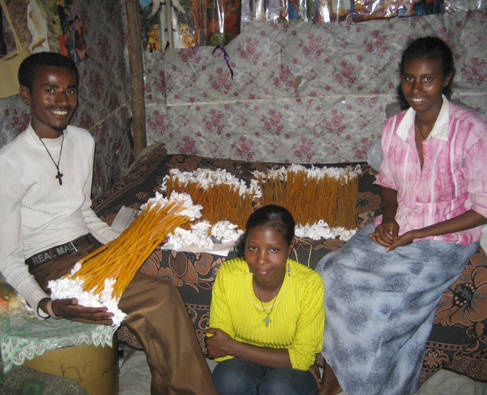
photo of Frew Wube in Ethiopia

This is a post from my Curious Cat Investing and Economics Blog: Financial Thanksgiving. I have tweaked a bit to tie into appropriate technology since that is the related area to me on this blog.

For me, giving back to others is part of my personal financial plan. As I have said most people that are actually able to read this are financially much better off than billions of other people today. At least they have the potential to be if they don’t chose to live beyond their means. Here are some of the ways I give back to others.

Kiva is a wonderful organization and particularly well suited to discuss because they do a great job of using the internet to make the experience rewarding for people looking to help – as I have mentioned before: Reducing Poverty. One of my goals for this blog is to increase the number of readers participating in Kiva – see current Curious Cat Kivans. I have also created a lending team on Kiva. Kiva added a feature that allows people to connect online. When you make a loan you may link you loan to a group.

I actually give more to Trickle Up, I have been giving to them for a long time. They appeal to my same desire to help people help themselves. I believe in the power of capitalism and people to provide long term increases in standards of living. I love the idea of providing support that grows over time. I like investing and reaping the rewards myself later (with investment I make for myself). But I also like to do that with my gifts. I would like to be able to provide opportunities to many people and have many of them take advantage of that to build a better life for themselves, their families and their children.

The photo shows Frew Wube, Haimanot and Melkan (brother and two sisters), an entrepreneur that received a grant from Trickle up. Trickle Up provides grants to entrepreneur, similar to micro loans, except the entrepreneur does not have to pay back the grant. They are able to use the full funds to invest in their business and use all the income they are able to generate to increase their standard of living and re-invest in the business.
Continue reading