Tag Archives: appropriate technology

Reducing Poverty

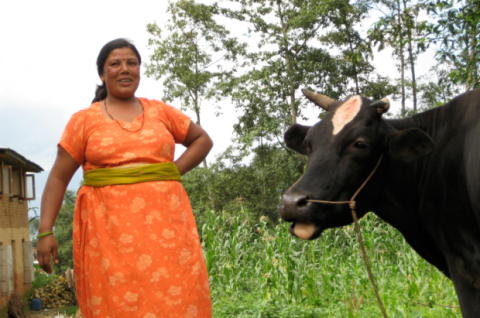
photo of Rita Bashnet

Today is blog action day, which this year is focused on poverty. We have highlighted various uses of appropriate technology, many of which help those in poverty improve their lives. Such as: Water Pump Merry-go-Round and Smokeless Stove Uses 80% Less Fuel.

I am also very interested in using micro loans to help entrepreneur improve their lives – I have written about Kiva before. Kiva fellows are funded by Kiva (fellows are unpaid) to go to spend time in the countries Kiva facilitates loans for working with the local partners. This post is about Rita Bashnet (in photo) an entrepreneur from Nepal:

Field visits are by far the best part about being a Kiva Fellow. You’re given the opportunity to hop on a motorbike, hike up a village trail, and actually see the impact of a Kiva loan firsthand.

Five years ago, Ms. Rita took her first loan of NRs. 10,000 (USD $150) and purchased some extra seed and fertilizer in the hopes of expanding her small vegetable patch. With the profits from this initial investment and a second loan from Patan Business and Professional Women (they offer a graduated loan program), she then purchased her first dairy cow.

After hearing about a program that subsidized the installation of methane gas storage tanks, Ms. Rita took another loan and applied for the program. With this new system, she is now able to capture the valuable gas released from her cow’s waste in a simple controlled-release storage tank. Today she no longer purchases gas from the city and can even sell some during times of shortage.

Ms. Rita exemplifies the potential of microfinance. A combination of access to capital and strategic investment has allowed her and her family to drastically improve their economic situation in a short five years.

Great story, and exactly my hope for using capitalism to improve the standard of living for people around the globe.

If you haven’t loaned money through Kiva, please consider it now. If you do (or already have a Kiva page), send me your Kiva lender link and I will add it to Curious Cat Kivans. I would love to add more of our readers to that page.

Related: Using Capitalism to Make a Better WorldAppropriate TechnologyFixing the World on $2 a DayTrickle Up

Engineering a Better World: Bike Corn-Sheller

photo of bike maize sheller

More appropriate technology from MIT’s D-Lab.

D-Lab-developed device makes corn processing more efficient

Jodie Wu, an MIT senior in mechanical engineering, spent the summer traveling from village to village in Tanzania to introduce a new system for processing the corn: A simple attachment for a bicycle that makes it possible to remove the kernels quickly and efficiently using pedal power. The device makes processing up to 30 times faster and allows one person to complete the job alone in one day.

The basic concept for the maize-sheller was first developed in Guatemala by an NGO called MayaPedal, and then refined by Wu last semester as a class project in D-Lab: Design, a class taught by Department of Mechanical Engineering Senior Lecturer Amy Smith. Now, thanks to Wu’s efforts, the technology is beginning to make its way around the world.

Thus, the owner of a bicycle, with a small extra investment, can travel from village to village to carry out a variety of useful tasks. A simple bike thereby becomes an ongoing source of income.

Wu refined the corn-sheller system, which was originally designed as a permanent installation that required a bicycle dedicated solely to that purpose, to make it an add-on, like Kiwia’s tools, that could be easily bolted onto an ordinary bike and removed easily.

Photo shows the prototype of the attachment. Engineering that makes a significant difference in people’s lives (especially those that need it the most) is even cooler than the latest high tech gizmos in my opinion. And those new gizmos are cool.

Related: Design for the Unwealthiest 90 PercentAppropriate Technology postsWater Pump Merry-go-RoundNepalese Entrepreneur Success – Tumaini Cycles blog (by

Engineer Uses Gravity

Now Diving: Sir Isaac Newton

On TV, a diver walks out onto a platform. The camera fixes on him. He waits. He leaps. And then — somehow — the camera stays with him as he plunges. In the instant it takes him to break the water’s surface, the picture suddenly cuts to an underwater shot — and we watch in disbelief as the dive culminates in a burst of bubbles.

How do they do it?

Well, there’s a rope. There’s a pulley. And the rope and the pulley work a contraption made out of a pipe. The whole gizmo is based on the brilliant insight that objects fall at the same rate regardless of mass. A Tuscan by the name of Galileo came up with it about 400 years ago; if he were alive, he’d call it cutting edge. And there’s the beauty of it: It’s sophisticated, yes, but only because it’s simple.

Garrett Brown revolutionized the movie business 38 years ago when he invented the Steadicam, a mechanical arm for cameramen that smooths away the jerkiness of hand-held shots. Much later, he came up with the Skycam, which rides a web of wires above the heads of football players. In between, Mr. Brown, 66 years old, got his one-line brief from NBC: “They wanted a camera,” he says, “that stayed with divers, including going underwater with them.”

The falling camera rides a rail on the inside of the pipe. A glass strip runs along the pipe’s full length; the camera takes its picture through the glass. From the diving platform to the water line, the glass is smoky. Below the line, it’s clear, so the camera need not adjust its exposure as it streaks into underwater darkness.

The pipe is caulked. The camera drops through air. “It doesn’t splash into the water,” Mr. Brown said. “That would look horrible.”

The appropriate use of technology is great to see. Applying knowledge well is a key to good engineering.

Related: Using Cameras Monitoring To Aid Conservation EffortsHow Do Wii Game Controllers Work?Bigger Impact: 15 to 18 mpg or 50 to 100 mpg?Awesome Cat Cam

Very Long-Term Backup

Very Long-Term Backup by Kevin Kelly

This graphic side of the disk is pure titanium. A black oxide coating has been added to the surface. The text is etched into that, revealing the whiter titanium. This bold sign board is needed because the pages of genesis which are etched on the mirror-like opposite side of the disk are nearly invisible.

This business side of the disk is pure nickel. Picking it up you would not be aware there were 13,500 pages of linguistic gold hiding on it. The nickel is deposited on an etched silicon disk. In effect the Rosetta disk is a nickel cast of a micro-etch silicon mold. When the disk is held at the right angle the grid array of the pages form a slight diffraction rainbow. You need a 750-power optical microscope to read the pages.

The Rosetta disk is not digital. The pages are analog “human-readable” scans of scripts, text, and diagrams. Among the 13,500 scanned pages are 1,500 different language versions of Genesis 1-3, a universal list of the words common for each language, pronunciation guides and so on. Some of the key indexing meta-data for each language section (such as the standard linguistic code number for that language) are displayed in a machine-readable font (OCRb) so that a smart microscope could guide you through this analog trove.

Our hope is that at least one of the eight headline languages can be recovered in 1,000 years. But even without reading, a person might guess there are small things to see in this disk.

This is another project of an organization I like very much: The Long Now Foundation.

Related: The Future of ScienceEngineering at Home1,000 True Fans

Fixing the World on $2 a Day

MIT’s Guru of Low-Tech Engineering Fixes the World on $2 a Day

The charcoal project is the responsibility of Mary Hong, a 19-year-old branching out beyond her aerospace major this semester. She and the other students, coincidentally all women, are enrolled in Smith’s D-Lab, a course that is becoming quietly famous beyond the MIT campus in Cambridge, Mass. The D is for development, design and dissemination; last fall, more than 100 students applied for about 30 slots. To prepare for their field work, D-Lab students live for a week in Cambridge on $2 per day. (Smith joins in.) Right now, eight more D-Lab teams are plying jungle rivers, hiking goat trails and hailing chicken buses in seven additional countries—Brazil, Honduras, Ghana, Tanzania, Zambia, India and China. In Smith’s view, even harsh aspects of Third World travel have their benefits. “If you get a good bout of diarrhea from a waterborne disease,” she says, “you really understand what it means to have access to clean drinking water.”

Despite their simplicity, Smith’s creations made her a minor celebrity at MIT, and in 2000 she became the first woman to win the $30,000 Lemelson-MIT Student Prize. The same year, she began teaching full time at the university. It was nearly 30 years since German economist E.F. Schumacher had published Small is Beautiful: Economics as if People Mattered, the book credited with launching the appropriate technology movement. Schumacher argued that many of the infrastructure projects funded by the World Bank and other organizations hadn’t improved lives on the village level. “He rightly and aptly pointed out that big solutions don’t fit for villages. You have to make it small,”

Related: Smokeless Stove Uses 80% Less Fuelappropriate technology postsEngineering a Better WorldBill Hunter

Refrigeration Without Electricity

Lack of electricity is a serious problem for vaccines and medicines that need to be cooled. It is hard to imagine that this is a problem, living in the USA, but this is still a problem today. As readers of this blog notice I really like appropriate technology solutions that provide real quality of life enhancements for hundreds of millions of people (which undoubtedly is influence by my father).

Related: Cooling with Clay Pots, Sand and Waterappropriate technology postsWater and Electricity for AllInspirational Engineer Technology, Entertainment, Design (TED) posts (great webcasts)

Engineers Without Borders

Engineering as diplomacy

You cannot look into the eyes of a child who is dying from a disease caused by drinking dirty water — something that rarely, if ever, happens in the United States — and not feel changed. You cannot stand before her parents without thinking, “I’m an engineer. There must be something I can do.”

A year later, I returned with 10 engineering students from the University of Colorado. We devised a rudimentary pumping system, bringing water to the people of San Pablo. Today, the village’s young girls go to school and are healthier.

That trip was a transforming experience, not just for the villagers, but also for me. Intuitively, we engineers like things big — expansive bridges, colossal dams, massive tunnels. My experience taught me that small-scale engineering can have the most impact on people’s lives.

When I returned to Boulder, I began building something else: Engineers Without Borders — USA. The organization was formed out of the conviction that engineers have a leadership role to play in addressing some of the world’s most serious problems: contaminated water, poor sanitation systems, expensive or harmful energy sources.

In a world focused on bigger and newer, there is growing recognition that small-scale engineering can play a major role in helping end the cycle of poverty that persists among almost half the world’s population. Studies by the World Bank and United Nations suggest the most basic technology is critical to bringing more than 3 billion people out of poverty.

Today EWB-USA counts more than 11,000 student and professional engineers as members and works in 43 countries on 300 projects involving water, sanitation, energy and shelter. Whether it’s combining sustainable technologies with advanced construction techniques to bring affordable housing to pockets of the world, drilling drinking water wells in Kenya, constructing fog collectors in the Himalayas to harvest fresh water or installing solar panels to provide energy for a remote hospital in Rwanda, we are healing communities throughout the globe, giving people dignity and hope for better lives.

Engineers without Borders is another vivid example of the benefits engineering brings to society.

Related: Engineering a Better WorldScientists and Engineers Without BordersKick Start Appropriate Technology

‘Refrigerator’ Without Electricity

photo of pot in pot

2000 Rolex award to Mohammed Bah Abba of Nigeria for the Pot in Pot Cooling System:

Ingenious technique that requires no external energy supply to preserve fruit, vegetables and other perishables in hot, arid climates. The pot-in-pot cooling system, a kind of “desert refrigerator”, helps subsistence farmers by reducing food spoilage and waste and thus increasing their income and limiting the health hazards of decaying foods. Abba says he developed the pot-in-pot “to help the rural poor in a cost-effective, participatory and sustainable way”.

The pot-in-pot consists of two earthenware pots of different diameters, one placed inside the other. The space between the two pots is filled with wet sand that is kept constantly moist, thereby keeping both pots damp. Fruit, vegetables and other items such as soft drinks are put in the smaller inner pot, which is covered with a damp cloth. The phenomenon that occurs is based on a simple principle of physics: the water contained in the sand between the two pots evaporates towards the outer surface of the larger pot where the drier outside air is circulating. By virtue of the laws of thermodynamics, the evaporation process automatically causes a drop in temperature of several degrees, cooling the inner container, destroying harmful micro-organisms and preserving the perishable foods inside.

He also received the 2001 Shell Award for Sustainable Development. Great stuff:

Born in 1964 into a family of pot makers and raised in the rural north, Mohammed Bah Abba was familiar from an early age with the various practical and symbolic uses of traditional clay pots, and learned as a child the rudiments of pottery. Subsequently studying biology, chemistry and geology at school, he unravelled the technical puzzle that led him years later to develop the “pot-in-pot preservation/cooling system”.

Related: Appropriate Technology (Kick Start)appropriate technology tagged postsSmokeless Stove Uses 80% Less FuelWater and Electricity for AllThe Importance of Science EducationEngineering a Better World

Water Pump Merry-go-Round

I wrote about PlayPumps in 2006: Safe Water Through Play. This video by National Geographic gives more detail on PlayPumps and water needs in general. Some facts from KnowH2O

  • A child dies every 15 seconds from diseases related to unsafe water, inadequate sanitation and poor hygiene.
  • 1.1 billion people worldwide lack access to safe drinking water.
  • 40 billion hours each year are spent collecting water in sub-Saharan Africa, equal to over 19 million full-time employees.
  • Every $1 invested in water yields an economic return worth $8 in saved time, increased productivity and reduced healthcare costs. (UNDP)
  • In many areas of sub-Saharan Africa women and girls often walk an average of five miles to the nearest water source every day. If a woman only had to carry water for one hour a day, she could earn an additional US $100 a year.
  • Related: Water and Electricity for AllMicrofinancing Entrepreneurs

    Make the World Better

    Three ways to make the world better. First, Kiva is lets you loan money directly to an entrepreneur of your choice. Kiva provides loans through partners (operating in the countries) to the entrepreneurs. Those partners do charge the entrepreneurs interest (to fund the operations of the lending partner). Kiva pays the principle back to you but does not pay interest. And if the entrepreneur defaults then you do not get your capital paid back (in other words you lose the money you loaned). See my post: Helping Capitalism Make the World Better (if you donate to Kiva I have a Curious Cat Kivan – comment to have you link added).

    Second, donate using the widget displayed in this post: to William Kamkwamba who built his own windmill in Malawi to get electricity for his home. The donations go to help him with his education and engineering projects. He is a young student and engineer. I have donated $50, I would love to see readers donate – do so and send me a link to your personal blog or personal home page and I will update this post with a link (only to a site obviously associated with you – I reserve the right to link or not link to whoever I want). [the campaign is over so I removed the widget – $943 was raised, the goal was $2,000]. A recent post to his blog: My sisters and cousins with their first books:

    Some well-wishers sent many children’s books that are written or take place in countries around Africa in addition to English and American classics such as Where the Wild Things Are. All the children in my neighborhood, most of whom are cousins or sisters share these new books.

    Third, create a Kiva like setup for donations that could be used to provide a source for finding remarkable people that have plans for possible donated funds. The potential is huge.

    Related: Children’s booksAppropriate TechnologyWhat Kids can LearnLesson on Life$100 Laptop UpdateMillennium Development Goals