Tag Archives: Awards

2012 Nobel Prize in Chemistry to Robert Lefkowitz and Brian Kobilka

The Royal Swedish Academy of Sciences has decided to award the Nobel Prize in Chemistry for 2012 to

  • Robert J. Lefkowitz, Howard Hughes Medical Institute and Duke University Medical Center, Durham, NC, USA
  • and Brian K. Kobilka, Stanford University School of Medicine, Stanford, CA, USA

for studies of G-protein–coupled receptors.

Your body is a fine-tuned system of interactions between billions of cells. Each cell has tiny receptors that enable it to sense its environment, so it can adapt to new situtations. Robert Lefkowitz and Brian Kobilka are awarded the 2012 Nobel Prize in Chemistry for groundbreaking discoveries that reveal the inner workings of an important family of such receptors: G-protein–coupled receptors.

For a long time, it remained a mystery how cells could sense their environment. Scientists knew that hormones such as adrenalin had powerful effects: increasing blood pressure and making the heart beat faster. They suspected that cell surfaces contained some kind of recipient for hormones. But what these receptors actually consisted of and how they worked remained obscured for most of the 20th Century.

Lefkowitz started to use radioactivity in 1968 in order to trace cells’ receptors. He attached an iodine isotope to various hormones, and thanks to the radiation, he managed to unveil several receptors, among those a receptor for adrenalin: β-adrenergic receptor. His team of researchers extracted the receptor from its hiding place in the cell wall and gained an initial understanding of how it works.

The team achieved its next big step during the 1980s. The newly recruited Kobilka accepted the challenge to isolate the gene that codes for the β-adrenergic receptor from the gigantic human genome. His creative approach allowed him to attain his goal. When the researchers analyzed the gene, they discovered that the receptor was similar to one in the eye that captures light. They realized that there is a whole family of receptors that look alike and function in the same manner.

Today this family is referred to as G-protein–coupled receptors. About a thousand genes code for such receptors, for example, for light, flavour, odour, adrenalin, histamine, dopamine and serotonin. About half of all medications achieve their effect through G-protein–coupled receptors.

The studies by Lefkowitz and Kobilka are crucial for understanding how G-protein–coupled receptors function. Furthermore, in 2011, Kobilka achieved another break-through; he and his research team captured an image of the β-adrenergic receptor at the exact moment that it is activated by a hormone and sends a signal into the cell. This image is a molecular masterpiece – the result of decades of research.

Related: More details on the research2011 Nobel Prize in Chemistry2009 Nobel Prize in Chemistry: the Structure and Function of the RibosomeThe Nobel Prize in Chemistry 2008

2011 MacArthur Fellows

2011 MacArthur Fellows

Elodie Ghedin (in video) is a biomedical researcher who is harnessing the power of genomic sequencing techniques to generate critical insights about human pathogens. A major focus of her work has been parasites that cause diseases endemic to tropical climates, such as leishmaniasis, sleeping sickness, Chagas disease, elephantiasis, and river blindness.

More scientists given the $500,000 award: Markus Greiner, Condensed Matter Physicist, Harvard University; Sarah Otto, Evolutionary Geneticist, University of British Columbia; Shwetak Patel, Sensor Technologist & Computer Scientist, University of Washington; Kevin Guskiewicz, Department of Exercise & Sport Science, University of North Carolina; Melanie Sanford, Organometallic Chemist, University of Michigan; Matthew Nock, Clinical Psychologist, Harvard University; Yukiko Yamashita, Developmental Biologist, University of Michigan; William Seeley, Neurologist, University of California, San Francisco.

Related: 2008 MacArthur FellowsPresidential Early Career Awards for Scientists and EngineersNew Physics Prize Gives 9 Physicists $3 million Each2011 Nobel Prize in Chemistry

New Physics Prize Gives 9 Physicists $3 million Each

A new physics prize created by Russian billionaire who started a PhD in physics before switching to an MBA and getting rich (investing in Facebook, Twitter, Zynga and Groupon) has announced the first 9 winners. The award includes awards worth $3 million; the Nobel prize paid $1.1 million last year.

Yuri Milner awards make nine fundamental physics pioneers rich

The nine will now form a committee to select a winner, or winners, for next year. The prize will be given in the first quarter of each year

According to Milner, the new prizes are not intended to compete with the Nobels, and differ in crucial ways. They can go to younger researchers because experimental verification of theoretical breakthroughs is not required. And, unlike a Nobel prize, which can be shared by three scientists at most, the Milner prize imposes no limit.

Alongside the main prize, Milner’s foundation will give two further awards, the first being an annual New Horizons in Physics prize for promising junior researchers, and a special ad-hoc fundamental physics prize that can be awarded at any time, forgoing the usual nomination process. Milner said the latter prize might, for example, recognise experimental results that are clearly and immediately groundbreaking.

Milner, 50, left Moscow State University in 1985 with an advanced degree in theoretical physics. He later abandoned a PhD at the Russian Academy of Sciences for an MBA at the Wharton School of Business at the University of Pennsylvania.

winners:
Nima Arkani-Hamed, Institute for Advanced Study, Princeton. For original approaches to outstanding problems in particle physics, including the proposal of large extra dimensions, new theories for the Higgs boson, novel realisations of supersymmetry, theories for dark matter, and the exploration of new mathematical structures in gauge theory scattering amplitudes.

Ashoke Sen, Harish-Chandra Research Institute, Allahabad. For uncovering striking evidence of strong-weak duality in certain supersymmetric string theories and gauge theories, opening the path to the realisation that all string theories are different limits of the same underlying theory.

7 of the 9 winners are currently working in the USA (1 in India and 1 in France). 4 are at Princeton and 1 each at MIT, Cal Tech and Stanford.

Related: 2011 Nobel Prize in PhysicsShaw Laureates 20082008 USA Medals of Science and National Medals of Technology and Innovation

High School Student Creates: Test That is Much More Accurate and 26,000 Times Cheaper Than Existing Pancreatic Cancer Tests

Seeing what these kids come up with is so refreshing after being so disappointed by the actions fo our leaders (politicians, business leaders, financiers, law enforcement [spying on citizens because they feel electronic privacy is fine to invade, taking away liberty…], health care in the USA [twice as expensive as elsewhere with no better results, 10 of millions without coverage]…). These kids make me feel hopeful, unfortunately the actions of the powerful leave me less hopeful.

Jack Andraka created a new paper based test for diagnosing pancreatic cancer that is 50% more accurate, 400 times more sensitive, and 26,000 times less expensive than existing methods. His method uses carbon nanotubes and can catch the disease in very early stages which is critical to treatment success. The test also covers other forms of cancer very effectively (he concentrated on the results for pancreatic cancer given the low survival rates for that cancer). Jack Andraka: “I actually love single-walled carbon nanotubes; they’re like the superheroes of material science.”

His results are great. Often initial results can be difficult to actually turn into such positive results in the real world. But this is a great step and it is great to see what young minds can do. The claims for how much better, cheaper etc. are wildly different in various places on the International Science and Engineering Fair (ISEF) site.

Jack Andraka was awarded $75,000 for his development of a new method to detect pancreatic cancer as the winner of the top prize at the Intel ISEF (I believe it is new this year to call the winner the Gordon E. Moore Award).

Related: 2009 Intel Science and Engineering Fair WebcastsIntel International Science and Engineering Fair 2007Intel Science Talent Search 2012 AwardeesGoogle Science Fair 2011 Projects

A Novel Paper Sensor for the Detection of Pancreatic Cancer by Jack Andraka
North County High School, Glen Burnie, MD

Continue reading

Wonderful Views of Life Using Micro-photography

The Olympus BioScapes 2011 Winners Gallery is full of great photos and videos of micro bioscapes.

Floschularia Ringerns Rotifer

Floschularia Ringerns Rotifer feeding by Charles Crebs

Winning photo by Mr. Charles Krebs, Issaquah, Washington, USA
Specimen: Rotifer Floscularia ringens feeding. Its rapidly beating cilia (hair-like structures) bring water containing food to the rotifer
Technique: Differential interference contrast microscopy

The photo shows the microscopic animal’s self-made reddish tube-shaped home, with a building block in the process of being formed inside the rotifer’s body.

Related: 2006 Nikon Small World Photos50 Species of DiatomsArt of Science at PrincetonArt of Science

Intel Science Talent Search 2012 Awardees

Nithin Tumma, whose research could lead to less toxic and more effective breast cancer treatments, received the top award of $100,000 at the Intel Science Talent Search 2012, a program of Society for Science & the Public. Other finalists from across the U.S. took home additional awards totaling $530,000.

The Intel Science Talent Search, the nation’s oldest and most prestigious pre-college science and math competition, recognizes 40 high school seniors who are poised to be the next leaders in innovation and help solve some of the world’s greatest challenges.

Nithin Tumma, 17, of Fort Gratiot, Mich., won the top award of $100,000 from the Intel Foundation for his research, which could lead to more direct, targeted, effective and less toxic breast cancer treatments. He analyzed the molecular mechanisms in cancer cells and found that by inhibiting certain proteins, we may be able to slow the growth of cancer cells and decrease their malignancy. Nithin is first in his class, a varsity tennis player and a volunteer for the Port Huron Museum, where he started a restoration effort for historical and cultural landmarks.

Second place honors and $75,000 went to Andrey Sushko, 17, of Richland, Wash., for his development of a tiny motor, only 7 mm (almost 1/4 inch) in diameter, which uses the surface tension of water to turn its shaft. Born in Russia, Andrey worked from home to create his miniature motor, which could pave the way for other micro-robotic devices. Andrey, a long-time builder of small boats, recently filed for a Guinness World Record for the smallest radio-controlled sailing yacht.

Third place honors and $50,000 went to Mimi Yen, 17, of Brooklyn, N.Y., for her study of evolution and genetics, which focuses on microscopic worms, specifically looking at their sex habits and hermaphrodite tendencies. Mimi believes that through research such as hers, we may better understand the genes that contribute to behavioral variations in humans. Mimi was born in Honduras and is fluent in Cantonese. She plays French horn and volunteers to prepare and deliver meals to people with serious illnesses.

These finalists join the ranks of other notable Science Talent Search alumni who over the past 70 years have gone on to win seven Nobel Prizes, two Fields Medals, four National Medals of Science, 11 MacArthur Foundation Fellowships and even an Academy Award for Best Actress.

“We invest in America’s future when we recognize the innovative achievements of our nation’s brightest young minds,” said Intel President and CEO Paul Otellini. “Hands-on experience with math and science, such as that required of Intel Science Talent Search finalists, encourages young people to think critically, solve problems and understand the world around them. Rather than simply memorizing facts and formulas, or repeating experiments with known outcomes, this competition engages students in an exciting way and provides a deeper level of understanding in such important but challenging subjects.”

Related: Intel Science and Engineering Fair 2009 WebcastsGirls Sweep Top Honors at Siemens Competition in Math, Science and TechnologyIntel International Science and Engineering Fair Awards 2006

Continue reading

20th Annual US First Robotics Competition

If you have a child, niece, nephew, grandchild… who you haven’t been able to convince about the wonders of science maybe the starts on this promo (Justin Timberlake, Snoop Dogg, Justin Bieber…) can help convince them. If you want to convince your grandparents science is cool, then maybe they will like the cameos by Steven Tyler and Bono 😛 This is an effort being pushed by will.i.am (Black Eyed Peas) and Dean Kamen (US First Founder) to promote science and engineering. Since most politicians don’t seem interested in promoting and supporting science anymore maybe musicians can help turn things around.

I have written about US First, it is a great program. It engages children in learning by taping their curiosity and desire to create. I think learning this way is much more natural and fun and affective than what we have too often in schools today. I know I was bored quite often but was told the adults knew best. Well know I am an adult and I think I was right back then: our education system can, and should be greatly improved. Until then, US First, and similar, programs give kids a good environment for learning that keeps their desire to learn intact.

The video spot was created to promote a TV show commemorating the 20th annual US FIRST Robotics competition. Watch the TV show:

Related: Lunacy, FIRST Robotics Challenge 2009For Inspiration and Recognition of Science and Technology (FIRST), 2005 postTest it Out, Experiment by They Might Be GiantsBotball 2009 Finals

YouTube SpaceLab Experiment Competition

YouTube SpaceLab is an open competition inviting 14 – 18 year olds (anywhere in the world) to create an idea for a science experiment in space. You don’t have to actually do the experiment, you just have to record yourself explaining it.

Entries must have be submitted on YouTube by 07:59 GMT on December 8th.

The winning experiments will be conducted on the International Space Station (ISS) and beamed live on YouTube for the whole planet to see.

Winners get the choice to either watch the rocket blast off with your idea on it in Japan or take a specially tailored astronaut training course in Russia when you turn 18. There are other amazing prizes for the runners-up too.

Here is an example entry from 3 students in UK on an experiment to learn about quorum sensing by bacteria in the micro gravity of space.

Related: Google Science Fair 2011 ProjectsBacteria Communicate Using a Chemical Language (quorum sensing)11 Year Old Using Design of ExperimentsResearch by group of 8 to 10 Year Olds Published in Royal Society Journal

2011 Nobel Prize in Chemistry

photo of Dan Shechtman

Dan Shechtman, Israel Institute of Technology, 2011 Nobel Laurette in Chemistry

The Royal Swedish Academy of Sciences has decided to award the Nobel Prize in Chemistry for 2011 to Dan Shechtman, Technion – Israel Institute of Technology, Haifa, Israel for the discovery of quasicrystals.

In quasicrystals, we find the fascinating mosaics reproduced at the level of atoms: regular patterns that never repeat themselves. However, the configuration found in quasicrystals was considered impossible, and Dan Shechtman had to fight a fierce battle against established science. The Nobel Prize in Chemistry 2011 has fundamentally altered how chemists conceive of solid matter.

On the morning of 8 April 1982, an image counter to the laws of nature appeared in Dan Shechtman’s electron microscope. In all solid matter, atoms were believed to be packed inside crystals in symmetrical patterns that were repeated periodically over and over again. For scientists, this repetition was required in order to obtain a crystal.

Shechtman’s image, however, showed that the atoms in his crystal were packed in a pattern that could not be repeated. Such a pattern was considered just as impossible as creating a football using only six-cornered polygons, when a sphere needs both five- and six-cornered polygons. His discovery was extremely controversial. In the course of defending his findings, he was asked to leave his research group. However, his battle eventually forced scientists to reconsider their conception of the very nature of matter.

Aperiodic mosaics, such as those found in the medieval Islamic mosaics of the Alhambra Palace in Spain and the Darb-i Imam Shrine in Iran, have helped scientists understand what quasicrystals look like at the atomic level. In those mosaics, as in quasicrystals, the patterns are regular – they follow mathematical rules – but they never repeat themselves.

When scientists describe Shechtman’s quasicrystals, they use a concept that comes from mathematics and art: the golden ratio. This number had already caught the interest of mathematicians in Ancient Greece, as it often appeared in geometry. In quasicrystals, for instance, the ratio of various distances between atoms is related to the golden mean.

Following Shechtman’s discovery, scientists have produced other kinds of quasicrystals in the lab and discovered naturally occurring quasicrystals in mineral samples from a Russian river. A Swedish company has also found quasicrystals in a certain form of steel, where the crystals reinforce the material like armor. Scientists are currently experimenting with using quasicrystals in different products such as frying pans and diesel engines.

Related: 2009 Nobel Prize in Chemistry: the Structure and Function of the RibosomeThe Nobel Prize in Chemistry 2008Nobel Prize in Chemistry (2006)

Read more on the science he has worked on. Our understanding of science is built on the discoveries of our predecessors and on the discoveries that counter what we thought we knew.
Continue reading

2011 Nobel Prize in Physics

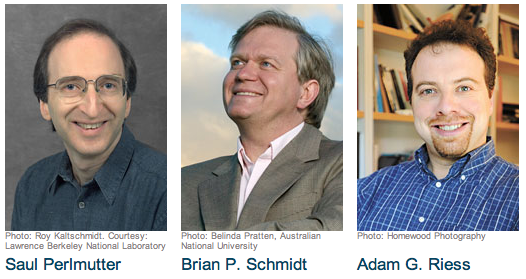
Photos of the 2011 Physics Nobel Prize Winners: Saul Perlmutter, Brian Schmidt and Adam Riess.

Photos of the 2011 Physics Nobel Prize Winners.

The Royal Swedish Academy of Sciences has decided to award the Nobel Prize in Physics for 2011 with one half to

Saul Perlmutter
The Supernova Cosmology Project, Lawrence Berkeley National Laboratory and University of California, Berkeley, CA, USA

and the other half jointly to

Brian P. Schmidt
The High-z Supernova Search Team, Australian National University, Weston Creek, Australia

and

Adam G. Riess
The High-z Supernova Search Team, Johns Hopkins University and Space Telescope Science Institute, Baltimore, MD, USA

“for the discovery of the accelerating expansion of the Universe through observations of distant supernovae”

Once again the USA dominates the physics category, Brian Schmidt is a USA and Australian citizen. It will be interesting to see if this starts to change in the next decade. I believe it will at some point fairly soon, the question is at what point.

“Some say the world will end in fire, some say in ice…” Robert Frost, Fire and Ice, 1920

What will be the final destiny of the Universe? Probably it will end in ice, if we are to believe this year’s Nobel Laureates in Physics. They have studied several dozen exploding stars, called supernovae, and discovered that the Universe is expanding at an ever-accelerating rate. The discovery came as a complete surprise even to the Laureates themselves.

In 1998, cosmology was shaken at its foundations as two research teams presented their findings. Headed by Saul Perlmutter, one of the teams had set to work in 1988. Brian Schmidt headed another team, launched at the end of 1994, where Adam Riess was to play a crucial role.

The research teams raced to map the Universe by locating the most distant supernovae. More sophisticated telescopes on the ground and in space, as well as more powerful computers and new digital imaging sensors (CCD, Nobel Prize in Physics in 2009), opened the possibility in the 1990s to add more pieces to the cosmological puzzle.

The teams used a particular kind of supernova, called type Ia supernova. It is an explosion of an old compact star that is as heavy as the Sun but as small as the Earth. A single such supernova can emit as much light as a whole galaxy. All in all, the two research teams found over 50 distant supernovae whose light was weaker than expected – this was a sign that the expansion of the Universe was accelerating. The potential pitfalls had been numerous, and the scientists found reassurance in the fact that both groups had reached the same astonishing conclusion.

For almost a century, the Universe has been known to be expanding as a consequence of the Big Bang about 14 billion years ago. However, the discovery that this expansion is accelerating is astounding. If the expansion will continue to speed up the Universe will end in ice.

The acceleration is thought to be driven by dark energy, but what that dark energy is remains an enigma – perhaps the greatest in physics today. What is known is that dark energy constitutes about three quarters of the Universe. Therefore the findings of the 2011 Nobel Laureates in Physics have helped to unveil a Universe that to a large extent is unknown to science. And everything is possible again.

As usually the Nobel committee does a great job of providing the public open scientific information. Others that claim to promote science can learn from them. They do a great job of making the science understandable to a lay person.

The discovery came as a complete surprise even to the Nobel Laureates themselves. What they saw would be like throwing a ball up in the air, and instead of having it come back down, watching as it disappears more and more rapidly into the sky, as if gravity could not manage to reverse the ball’s trajectory. Something similar seemed to be happening across the entire Universe.

The growing rate of the expansion implies that the Universe is being pushed apart by an unknown form of energy embedded in the fabric of space. This dark energy makes up a large part of the Universe, more than 70 %, and it is an enigma, perhaps the greatest in physics today. No wonder, then, that cosmology was shaken at its foundations when two different research groups presented similar results in 1998.

Related: The Nobel Prize in Physics 20092006 Nobel Prize in Physics2011 Nobel Prize in Physiology or MedicineIs Dark Matter an Illusion?5% of the Universe is Normal Matter, What About the Other 95%?
Continue reading