Tag Archives: bacteria

How Lysozyme Protein in Our Tear-Drops Kill Bacteria

A disease-fighting protein in our teardrops has been tethered to a tiny transistor, enabling UC Irvine scientists to discover exactly how it destroys dangerous bacteria. The research could prove critical to long-term work aimed at diagnosing cancers and other illnesses in their very early stages.

Ever since Nobel laureate Alexander Fleming found that human tears contain antiseptic proteins called lysozymes about a century ago, scientists have tried to solve the mystery of how they could relentlessly wipe out far larger bacteria. It turns out that lysozymes have jaws that latch on and chomp through rows of cell walls like someone hungrily devouring an ear of corn.

“Those jaws chew apart the walls of the bacteria that are trying to get into your eyes and infect them,” said molecular biologist and chemistry professor Gregory Weiss, who co-led the project with associate professor of physics & astronomy Philip Collins.

The researchers decoded the protein’s behavior by building one of the world’s smallest transistors – 25 times smaller than similar circuitry in laptop computers or smartphones. Individual lysozymes were glued to the live wire, and their eating activities were monitored.

“Our circuits are molecule-sized microphones,” Collins said. “It’s just like a stethoscope listening to your heart, except we’re listening to a single molecule of protein.”

It took years for the UCI scientists to assemble the transistor and attach single-molecule teardrop proteins. The scientists hope the same novel technology can be used to detect cancerous molecules. It could take a decade to figure out but would be well worth it, said Weiss, who lost his father to lung cancer.

“If we can detect single molecules associated with cancer, then that means we’d be able to detect it very, very early,” Weiss said. “That would be very exciting, because we know that if we treat cancer early, it will be much more successful, patients will be cured much faster, and costs will be much less.”

The project was sponsored by the National Cancer Institute and the National Science Foundation. Co-authors of the Science paper are Yongki Choi, Issa Moody, Patrick Sims, Steven Hunt, Brad Corso and Israel Perez.

Related: full press releaseWhy ‘Licking Your Wounds’ WorksHow Bleach Kills BacteriaAlgorithmic Self-Assembly

Staphylococcal Food Poisoning

I pretty much don’t get sick, which is great. Twice in the last month I got something like food poisoning (which is more sickness than I get most years). So I looked online for some information on what might cause my symptoms and how fast it is possible for the onset of symptoms.

Staphylococcal food poisoning is a gastrointestinal illness. It is caused by eating foods contaminated with toxins produced by Staphylococcus aureus. It seems like a possible culprit. My guess is the onset for me has been within 2 hours (or it was a coincidence. That fast of an onset seems rare (based on my limited research).

The United States Center for Disease Control says symptoms can last 24-48 hours. For me symptoms came and went within 15 minutes. Rapid fever and “heat” feeling everywhere, diarea, gone. No more than 15 minutes from start to finish. I really find it very odd how I can feel so weird quickly and then just as quickly it is all gone.

The bacterium can also be found in unpasteurinzed milk and cheese products. Staphylococcus is salt tolerant and can grow in salty foods like ham. As the bacterium multiplies in food, it produces toxins that can cause food poisoning. Staphylococcal toxins are resistant to heat and cannot be destroyed by cooking. Foods at highest risk of producing toxins from Staphylococcus aureus are those that are made by hand and require no cooking. Some examples of foods that have caused staphylococcal food poisoning are sliced meat, puddings, pastries and sandwiches. The foods may not smell bad or look spoiled in order to produce the toxins.

Unrefrigerated or improperly refrigerated meats, potato and egg salads, cream pastries are possible paths to the food poisoning. I suspect ghee, in my case.

The CDC says that staphylococcal toxins are fast acting, sometimes causing illness in as little as 30 minutes after eating.contaminated foods, but symptoms usually develop within one to six hours. Patients typically experience several of the following: nausea, retching, vomiting, stomach cramps, and diarrhea. The illness cannot be passed to other people and it typically lasts for one day, but sometimes it can last up to three days. In a small minority of patients the illness may be more severe. They don’t seem to agree it can disappear in 15 minutes, otherwise it seems a possible cause.

Of course being essentially total ignorant about this stuff I could also be completely off base. I find this interesting though so I am doing some more reading.

I think it would be nice if the CDC would put links on pages to other causes with similar symptoms. Wouldn’t that be a good usability feature?

Related: What You Need to Know About Foodborne Illness-Causing OrganismsTracking the Ecosystem Within UsHealthy Diet, Healthy Living, Healthy WeightThe Man Who Unboiled an Egg

YouTube SpaceLab Experiment Competition

YouTube SpaceLab is an open competition inviting 14 – 18 year olds (anywhere in the world) to create an idea for a science experiment in space. You don’t have to actually do the experiment, you just have to record yourself explaining it.

Entries must have be submitted on YouTube by 07:59 GMT on December 8th.

The winning experiments will be conducted on the International Space Station (ISS) and beamed live on YouTube for the whole planet to see.

Winners get the choice to either watch the rocket blast off with your idea on it in Japan or take a specially tailored astronaut training course in Russia when you turn 18. There are other amazing prizes for the runners-up too.

Here is an example entry from 3 students in UK on an experiment to learn about quorum sensing by bacteria in the micro gravity of space.

Related: Google Science Fair 2011 ProjectsBacteria Communicate Using a Chemical Language (quorum sensing)11 Year Old Using Design of ExperimentsResearch by group of 8 to 10 Year Olds Published in Royal Society Journal

Bacteria Living Inside Animals Cells

Interesting discussion on the bacteria living inside our cells. For example, many plants have bacteria that get inside the root system and then help fix nitrogen for the plant. Some sea slugs take the chloroplasts from algae they eat and incorporate it themselves, allowing them to get energy from light (photosynthesis): they become photosynthetic slugs.

Adults need science education more than kids do is also a good segment. And I agree strongly that we (as individuals and society) lose a great deal when we fail to help people enjoy learning about science during their whole lives.

I also like the usability of this widget above, where it lets you include the internal links easily into a video.

Related: Symbiotic relationship between ants and bacteriaBiologists Identified a New Way in Which Bacteria Hijack Healthy CellsUsing Bacteria to Carry Nanoparticles Into CellsThe Economic Consequences of Investing in Science Education

Biologists Identified a New Way in Which Bacteria Hijack Healthy Cells

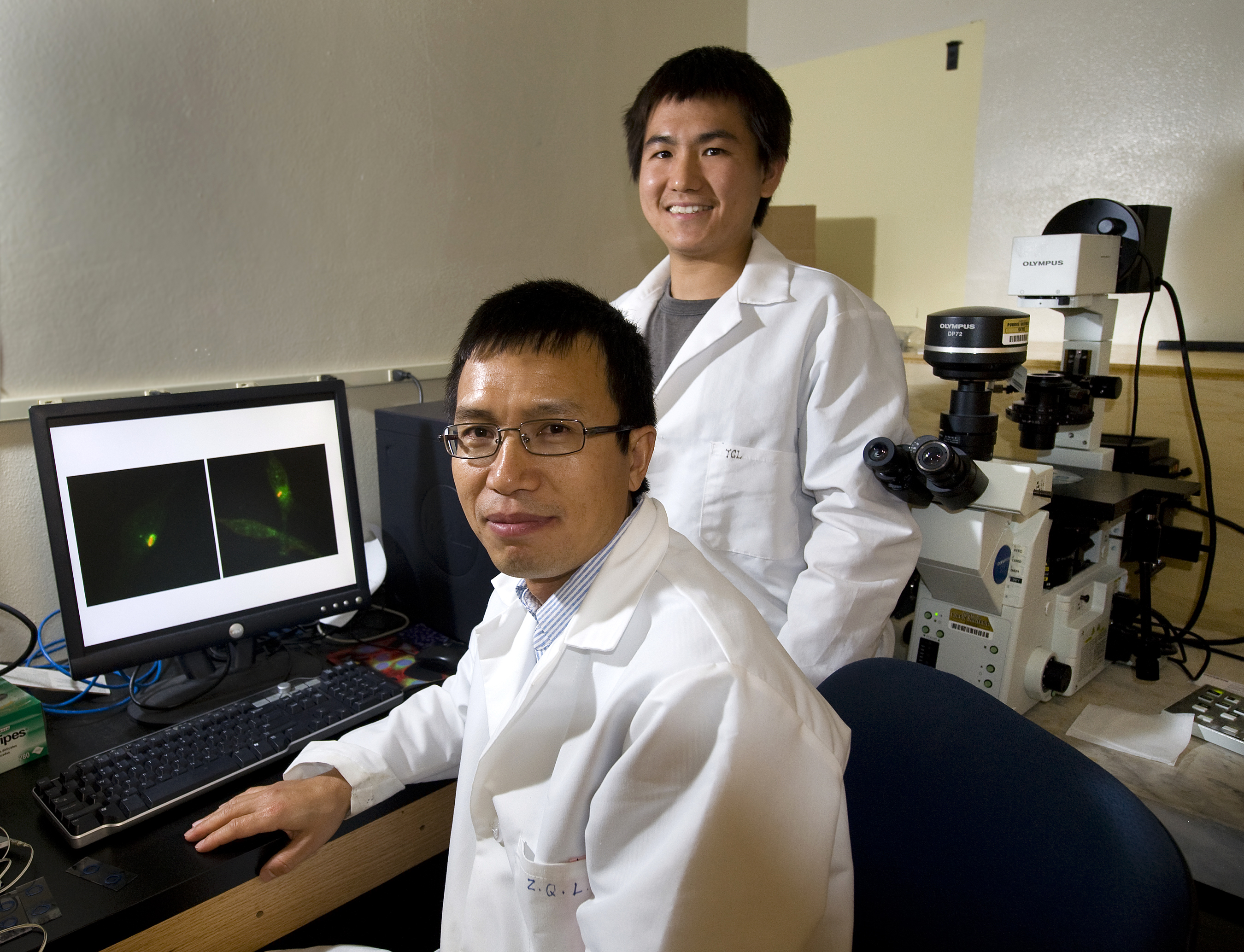
photo of Zhao-Qing Luo and Yunhao Tan

Associate professor of biological sciences Zhao-Qing Luo, foreground, and graduate student Yunhao Tan identified a new way in which bacteria modify healthy cells during infection. Shown on the computer screen are cells infected with a mutant strain of the bacteria Legionella pneumophila used in their research.

Purdue University biologists identified a new way in which bacteria hijack healthy cells during infection, which could provide a target for new antibiotics. Zhao-Qing Luo, the associate professor of biological sciences who led the study, said the team discovered a new enzyme used by the bacterium Legionella pneumophila – which causes Legionnaires’ disease – to control its host cell in order to take up residence.

“Legionnaires’ disease is a severe form of pneumonia, and this finding could lead to the design of a new therapy that saves lives,” Luo said. “At the same time it also provides great insight into a general mechanism of both bacterial infection and cell signaling events in higher organisms including humans.”

Successful infection by Legionella pneumophila requires the delivery of hundreds of proteins into the host cells that alter various functions to turn the naturally hostile environment into one tailor-made for bacterial replication. These proteins tap into existing communication processes within the cells in which an external signal, such as a hormone, triggers a cascade of slight modifications to proteins that eventually turns on a gene that changes the cell’s behavior, he said.

“Pathogens are successful because they know how information in our cells is relayed and they amplify some signals and block others in order to evade the immune system and keep the cell from defending itself,” Luo said. “Despite our understanding of this, we do not know much about how the proteins delivered by the bacteria accomplish this – how they work. This time we were able to pinpoint an enzyme and see how it disrupted and manipulated a specific signaling pathway in order to create a better environment for itself.”

The signaling pathway involved was only recently identified, and the discovery by Luo and graduate student Yunhao Tan also provides a key insight into its process. The signaling pathway involves a new form of protein modification called AMPylation in order to relay instructions to change cell behavior and has been found to be used by almost all organisms, Luo said.

The bacterium affects the host cell’s functions differently during different phases of the infection process, tapping into signaling pathways to turn on and off certain natural cellular activities. SidD stops the AMPylation process four hours after the start of infection in order to reverse an earlier modification that would be detrimental to the cell if left in place, he said.

Read the full press release.

Related: Using Bacteria to Carry Nanoparticles Into CellsDisrupting Bacterial Communication to Thwart ThemScientists Target Bacteria Where They LiveAre you ready for a world without antibiotics?

Cancer Vaccines

A reader commented on a previous post (MIT Engineers Design New Type of Nanoparticle for Vacines) asking about how vaccines can fight cancer. Preventative vaccines can build up immune response to viruses which cause cancer. So the vaccine actually works against the virus which prevents the virus from causing cancer.

The U.S. Food and Drug Administration (FDA) has approved two vaccines, Gardasil® and Cervarix®, that protect against infection by the two types of human papillomavirus (HPV) – types 16 and 18 – that cause approximately 70% of all cases of cervical cancer worldwide. At least 17 other types of HPV are responsible for the remaining 30% of cervical cancer cases. HPV types 16 and/or 18 also cause some vaginal, vulvar, anal, penile, and oropharyngeal cancers.

Many scientists believe that microbes cause or contribute to between 15% and 25% of all cancers diagnosed worldwide each year, with the percentages being lower in developed than developing countries.

Vaccines can also help stimulate the immune system to fight cancers.

B cells make antibodies, which are large secreted proteins that bind to, inactivate, and help destroy foreign invaders or abnormal cells. Most preventive vaccines, including those aimed at hepatitis B virus (HBV) and human papillomavirus (HPV), stimulate the production of antibodies that bind to specific, targeted microbes and block their ability to cause infection. Cytotoxic T cells, which are also known as killer T cells, kill infected or abnormal cells by releasing toxic chemicals or by prompting the cells to self-destruct (a process known as apoptosis).

Other types of lymphocytes and leukocytes play supporting roles to ensure that B cells and killer T cells do their jobs effectively. These supporting cells include helper T cells and dendritic cells, which help activate killer T cells and enable them to recognize specific threats.

Cancer treatment vaccines are designed to work by activating B cells and killer T cells and directing them to recognize and act against specific types of cancer. They do this by introducing one or more molecules known as antigens into the body, usually by injection. An antigen is a substance that stimulates a specific immune response. An antigen can be a protein or another type of molecule found on the surface of or inside a cell.

Related: National Cancer Institute (USA)Nanoparticles With Scorpion Venom Slow Cancer SpreadUsing Bacteria to Carry Nanoparticles Into CellsGlobal Cancer Deaths to Double by 2030
Continue reading

Evidence of Extraterrestrial Life Discovered?

Has evidence of extraterrestrial life been discovered? In Fossils of Cyanobacteria in CI1 Carbonaceous Meteorites , Richard B. Hoover, Ph.D. NASA/Marshall Space Flight Center, puts forth his evidence on the discovery of evidence of cyanobacteria in meteorites.

Dr. Hoover has discovered evidence of microfossils similar to Cyanobacteria, in freshly fractured slices of the interior surfaces of the Alais, Ivuna, and Orgueil CI1 carbonaceous meteorites. Based on Field Emission Scanning Electron Microscopy (FESEM) and other measures, Dr. Hoover has concluded they are indigenous to these meteors and are similar to trichomic cyanobacteria and other trichomic prokaryotes such as filamentous sulfur bacteria. He concludes these fossilized bacteria are not Earthly contaminants but are the fossilized remains of living organisms which lived in the parent bodies of these meteors, e.g. comets, moons, and other astral bodies. The implications are that life is everywhere, and that life on Earth may have come from other planets.

The importance of this claim is hard to ignore. The journal includes a statement from Dr. Rudy Schild, Center for Astrophysics, Harvard-Smithsonian, Editor-in-Chief, Journal of Cosmology:

Dr. Richard Hoover is a highly respected scientist and astrobiologist with a prestigious record of accomplishment at NASA. Given the controversial nature of his discovery, we have invited 100 experts and have issued a general invitation to over 5000 scientists from the scientific community to review the paper and to offer their critical analysis. Our intention is to publish the commentaries, both pro and con, alongside Dr. Hoover’s paper. In this way, the paper will have received a thorough vetting, and all points of view can be presented. No other paper in the history of science has undergone such a thorough analysis, and no other scientific journal in the history of science has made such a profoundly important paper available to the scientific community, for comment, before it is published. We believe the best way to advance science, is to promote debate and discussion.

Read the full paper.

The filaments have been observed to be embedded in freshly fractured internal surfaces of the stones. They exhibit features (e.g., the size and size ranges of the internal cells and their location and arrangement within sheaths) that are diagnostic of known genera and species of trichomic cyanobacteria and other trichomic prokaryotes such as the filamentous sulfur bacteria. ESEM and FESEM studies of living and fossil cyanobacteria show similar features in uniseriate and multiseriate, branched or unbranched, isodiametric or tapered, polarized or unpolarized filaments with trichomes encased within thin or thick external sheaths. Filaments found in the CI1 meteorites have also been detected that exhibit structures consistent with the specialized cells and structures used by cyanobacteria for reproduction (baeocytes, akinetes and hormogonia), nitrogen fixation (basal, intercalary or apical heterocysts) and attachment or motility (fimbriae).

These studies have led to the conclusion that the filaments found in the CI1 carbonaceous meteorites are indigenous fossils rather than modern terrestrial biological contaminants that entered the meteorites after arrival on Earth. The δ13C and D/H content of amino acids and other organics found in these stones are shown to be consistent with the interpretation that comets represent the parent bodies of the CI1 carbonaceous meteorites. The implications of the detection of fossils of cyanobacteria in the CI1 meteorites to the possibility of life on comets, Europa and Enceladus are discussed.

Has life been found in a meteorite? by Phil Plait
Continue reading

Scientific Inquiry: Arsenic for Phosphorus in Bacteria Cells

As would be expected with significant new scientific claims, scientists are examining the evidence. On her blog, Rosie Redfield, who runs a microbiology research lab in the Life Sciences Centre at the University of British Columbia, disputes NASA’s recent claims. This is how science is suppose to work. Scientists provide evidence. Other scientists review the evidence, try to verify the claims with experiments of their own and the scientific inquiry process moves toward new knowledge.

Arsenic-associated bacteria (NASA’s claims)

NASA’s shameful analysis of the alleged bacteria in the Mars meteorite made me very suspicious of their microbiology, an attitude that’s only strengthened by my reading of this paper. Basically, it doesn’t present ANY convincing evidence that arsenic has been incorporated into DNA (or any other biological molecule).

The authors then grew some cells with radioactive arsenate (73-As) and no phosphate, washed and dissolved them, and used extraction with phenol and phenol:chloroform to separate the major macromolecules. The protein fraction at the interface between the organic and aqueous phases had about 10% of the arsenic label but, because the interface material is typically contaminated with liquid from the aqueous phase, this is not good evidence that the cells’ protein contained covalently-bound arsenate in place of phosphorus. About 75% of the arsenic label was in the ‘supernatant ‘fraction. The authors describe this fraction as DNA/RNA, but it also contains most of the small water-soluble molecules of the cell, so its high arsenic content is not evidence that the DNA and RNA contain arsenic in place of phosphorus. The authors use very indirect evidence to argue that the distribution of arsenic mirrors that expected for phosphate, but this argument depends on so many assumptions that it should be ignored.

I don’t know whether the authors are just bad scientists or whether they’re unscrupulously pushing NASA’s ‘There’s life in outer space!’ agenda. I hesitate to blame the reviewers, as their objections are likely to have been overruled by Science’s editors in their eagerness to score such a high-impact publication.

New claims have to provide strong evidence. time will tell if this discovery is actually a discovery. It will be amazing if it is, so I am pulling for it. But the story will need to have much more confirmation before we can be certain.

Arsenate-based DNA: a big idea with big holes

The study published in Science has a number of flaws. In particular, one subtle but critical piece of evidence has been overlooked, and it demonstrates that the DNA in question actually has a phosphate – not an arsenate -backbone.

Wolfe-Simon et al. used a technique called nanoSIMS to analyze elemental concentrations of the agarose gel at the location of the DNA band. They determined that the part of the gel containing DNA also contained both arsenic and phosphorus. But what did they really analyze?

The answer is that the nanoSIMS determined the concentration of arsenic in the gel – not specifically in the DNA.

Finally, there’s a simple experiment that could resolve this debate: analyze the nucleotides directly. Show a mass spectrum of DNA sequences demonstrating that nucleotides contain arsenate instead of phosphate. This is a very simple experiment, and would be quite convincing – but it has not been performed.

Related: It’s not an arsenic-based life formMono Lake bacteria build their DNA using arsenicClose Encounters of the Media Kind

Changing Life as We Know It

Update: Independent researchers find no evidence for arsenic life in Mono Lake

NASA has made a discovery that changes our understanding of the very makeup of life itself on earth. I think my favorite scientific discipline name is astrobiology. NASA pursues a great deal of this research not just out in space but also looking at earth based life. Their astrobiology research has changed the fundamental knowledge about what comprises all known life on Earth.

photo of Felisa Wolfe-Simon

Felisa Wolfe-Simon processing mud from Mono Lake to inoculate media to grow microbes on arsenic.

Carbon, hydrogen, nitrogen, oxygen, phosphorus and sulfur are the six basic building blocks of all known forms of life on Earth. Phosphorus is part of the chemical backbone of DNA and RNA, the structures that carry genetic instructions for life, and is considered an essential element for all living cells.

Phosphorus is a central component of the energy-carrying molecule in all cells (adenosine triphosphate) and also the phospholipids that form all cell membranes. Arsenic, which is chemically similar to phosphorus, is poisonous for most life on Earth. Arsenic disrupts metabolic pathways because chemically it behaves similarly to phosphate.

Researchers conducting tests in the harsh, but beautiful (see photo), environment of Mono Lake in California have discovered the first known microorganism on Earth able to thrive and reproduce using the toxic chemical arsenic. The microorganism substitutes arsenic for phosphorus in its cell components.

“The definition of life has just expanded,” said Ed Weiler, NASA’s associate administrator for the Science Mission Directorate. “As we pursue our efforts to seek signs of life in the solar system, we have to think more broadly, more diversely and consider life as we do not know it.” This finding of an alternative biochemistry makeup will alter biology textbooks and expand the scope of the search for life beyond Earth.

In science such huge breakthroughs are not just excepted without debate, however, which is wise.

Thriving on Arsenic:

In other words, every experiment Wolfe-Simon performed pointed to the same conclusion: GFAJ-1 can substitute arsenic for phosphorus in its DNA. “I really have no idea what another explanation would be,” Wolfe-Simon says.

But Steven Benner, a distinguished fellow at the Foundation for Applied Molecular Evolution in Gainesville, FL, remains skeptical. If you “replace all the phosphates by arsenates,” in the backbone of DNA, he says, “every bond in that chain is going to hydrolyze [react with water and fall apart] with a half-life on the order of minutes, say 10 minutes.” So “if there is an arsenate equivalent of DNA in that bug, it has to be seriously stabilized” by some as-yet-unknown mechanism.

It is sure a great story if it is true though. Other scientists will examine more data and confirm or disprove the claims.

“We know that some microbes can breathe arsenic, but what we’ve found is a microbe doing something new — building parts of itself out of arsenic,” said Felisa Wolfe-Simon, a NASA Astrobiology Research Fellow in residence at the U.S. Geological Survey in Menlo Park, Calif., and the research team’s lead scientist. “If something here on Earth can do something so unexpected, what else can life do that we haven’t seen yet?”
Continue reading

Are you ready for a world without antibiotics?

Are you ready for a world without antibiotics?

[Professor Tim Walsh] “This is potentially the end. There are no antibiotics in the pipeline that have activity against NDM 1-producing enterobacteriaceae. We have a bleak window of maybe 10 years, where we are going to have to use the antibiotics we have very wisely, but also grapple with the reality that we have nothing to treat these infections with.”

And this is the optimistic view – based on the assumption that drug companies can and will get moving on discovering new antibiotics to throw at the bacterial enemy. Since the 1990s, when pharma found itself twisting and turning down blind alleys, it has not shown a great deal of enthusiasm for difficult antibiotic research. And besides, because, unlike with heart medicines, people take the drugs for a week rather than life, and because resistance means the drugs become useless after a while, there is just not much money in it.

“The emergence of antibiotic resistance is the most eloquent example of Darwin’s principle of evolution that there ever was,” says Livermore. “It is a war of attrition. It is naive to think we can win.”

I have been writing about the huge risks we are talking with our future for years. The careless misuse of antibiotics is very costly (in human lives, in the future). Bacteria pose great risks to us. We need to take antibiotics to fight serious threats. The misuse of antibiotics by doctors, patients, agri-business… is the problem. And we are all living a much riskier future because far to little is being done to reduce the misuse of antibiotics.

More and more antibiotic treatments are losing effectiveness as bacteria evolve resistance. The evolution is accelerated by misuse. This costs lives today, but is likely to costs many thousands and hundreds of thousands and possible more in the next 50 years.

The NDM-1-producing bacteria were highly resistant to all antibiotics except tigecycline and colistin. In some cases, isolates were resistant to all antibiotics. The emergence of NDM-1 positive bacteria is potentially a serious global public health problem as there are few new anti-Gram-negative antibiotics in development and none that are effective against NDM-1.

Related: Antibiotics Breed Superbugs Faster Than ExpectedAntibiotics Too Often Prescribed for Sinus WoesBacteria Race Ahead of DrugsFDA May Make Decision That Will Speed Antibiotic Drug ResistanceRaised Without AntibioticsWaste Treatment Plants Result in Super BacteriaHow Bleach Kills BacteriaCDC Urges Increased Effort to Reduce Drug-Resistant Infections