Tag Archives: food

Deadly Trio of Acidification, Warming and Deoxygenation Threaten Our Oceans

An international panel of marine scientists is demanding urgent remedies to halt ocean degradation based on findings that the rate, speed and impacts of change in the global ocean are greater, faster and more imminent
than previously thought.

Professor Dan Laffoley, International Union for Conservation of Nature, said: “What these latest reports make absolutely clear is that deferring action will increase costs in the future and lead to even greater, perhaps irreversible, losses. The UN climate report confirmed that the ocean is bearing the brunt of human-induced changes to our planet. These findings give us more cause for alarm – but also a roadmap for action. We must use it.“

Results from the latest International Programme on the State of the Ocean (IPSO)/IUCN review of science on anthropogenic stressors on the ocean go beyond the conclusion reached last week by the UN climate change panel the IPCC that the ocean is absorbing much of the warming and unprecedented levels of carbon dioxide and warn that the cumulative impact of this with other ocean stressors is far graver than previous estimates.

Decreasing oxygen levels in the ocean caused by climate change and nitrogen runoff, combined with other chemical pollution and rampant overfishing are undermining the ability of the ocean to withstand these so-called ‘carbon perturbations’, meaning its role as Earth’s ‘buffer’ is seriously compromised.

Professor Alex Rogers of Somerville College, Oxford, and Scientific Director of IPSO said: “The health of the ocean is spiraling downwards far more rapidly than we had thought. We are seeing greater change, happening faster, and the effects are more imminent than previously anticipated. The situation should be of the gravest concern to everyone since everyone will be affected by changes in the ability of the ocean to support life on Earth.”

Among the latest assessments of factors affecting ocean health, the panel identified the following areas as of greatest cause for concern:
Continue reading
Another Bee Study Finds CCD is Likely Due to Combination of Factors Including Pesticides

Abstract of open access science paper funded by the United States Department of Agriculture (USDA) Crop Pollination Exposes Honey Bees to Pesticides Which Alters Their Susceptibility to the Gut Pathogen Nosema ceranae:

Recent declines in honey bee populations and increasing demand for insect-pollinated crops raise concerns about pollinator shortages. Pesticide exposure and pathogens may interact to have strong negative effects on managed honey bee colonies. Such findings are of great concern given the large numbers and high levels of pesticides found in honey bee colonies. Thus it is crucial to determine how field-relevant combinations and loads of pesticides affect bee health.

We collected pollen from bee hives in seven major crops to determine 1) what types of pesticides bees are exposed to when rented for pollination of various crops and 2) how field-relevant pesticide blends affect bees’ susceptibility to the gut parasite Nosema ceranae. Our samples represent pollen collected by foragers for use by the colony, and do not necessarily indicate foragers’ roles as pollinators. In blueberry, cranberry, cucumber, pumpkin and watermelon bees collected pollen almost exclusively from weeds and wildflowers during our sampling.

Thus more attention must be paid to how honey bees are exposed to pesticides outside of the field in which they are placed. We detected 35 different pesticides in the sampled pollen, and found high fungicide loads. The insecticides esfenvalerate and phosmet were at a concentration higher than their median lethal dose in at least one pollen sample. While fungicides are typically seen as fairly safe for honey bees, we found an increased probability of Nosema infection in bees that consumed pollen with a higher fungicide load.

Our results highlight a need for research on sub-lethal effects of fungicides and other chemicals that bees placed in an agricultural setting are exposed to.

The attempts to discover the main causes of bee colony deaths and find solutions continues to prove difficult years after the problems became major. The complex interaction of many variables makes it difficult. And special interest groups pushing pesticides and the like, which have seemed to be major contributors to the problem for years, make it even more difficult (by preventing restrictions on potentially damaging pesticide use).

The challenges in determining what is killing bees are similar to the challenges of discovering what practices are damaging human health. The success of studying complex biological interactions (to discover threats to human health) is extremely limited. I am concerned we are far too caviler about using large numbers of interventions (drugs, pesticides, massive antibiotics use in factory farms, pollution…).

Related: Europe Bans Certain Pesticides, USA Just Keeps Looking, Bees Keep DyingGermany Bans Chemicals Linked to Bee Deaths (2008)Virus Found to be One Likely Factor in Bee Colony Colapse Disorder (2007)Study of the Colony Collapse Disorder Continues as Bee Colonies Continue to Disappear

Go Slow with Genetically Modified Food

My thoughts on Genetically Modified Organisms (GMO), specifically GM foods, basically boil down to:

  • messing with genes could create problems
  • we tend to (and especially those seeking to gain an advantage tend to – even if “we” overall wouldn’t the people in the position to take aggressive measures do) ignore risks until the problems are created (often huge costs at that point)
  • I think we should reduce risk and therefore make it hard to justify using GMO techniques
  • I agree occasionally we should do so, like it seems with oranges and bananas.
  • I agree the practice can be explained in a way that makes it seem like there is no (or nearly no) risk, I don’t trust we will always refrain from stepping into an area where there is a very bad result

Basically I would suggest being very cautious with GMO. I like science and technology but I think we often implement things poorly. I think we are not being cautious enough now, and should reduce the use of GMO to critical needs to society (patents on the practices need to be carefully studied and perhaps not permitted – the whole patent system is so broken now that it should be questioned at every turn).

Antibiotic misuse and massive overuse is an obvious example. We have doctors practicing completely unjustified misuse of antibiotics and harming society and we have factory farms massively overusing antibiotics causing society harm.

The way we casually use drugs is another example of our failure to sensibly manage risks, in my opinion. This of course is greatly pushed by those making money on getting us to use more drugs – drug companies and doctors paid by those companies. The right drugs are wonderful. But powerful drugs almost always have powerful side effects (at least in a significant number of people) and those risks are multiplied the more we take (due to interactions, weakness created by one being overwhelmed by the next etc.). We should be much more cautious but again we show evidence of failing to act cautiously which adds to my concern for using GMO.

I love antibiotics, but the way we are using them is endangering millions of lives (that is a bad thing). I don’t trust us to use science wisely and safely. We need to more consciously put barriers in place to prevent us creating massively problems.

Related: Research on Wheat RustThe AvocadoOverfishing, another example of us failing to effectively cope with systemic consequences

Webcast: Examining the Scientific Basis Around Exercise and Diet Claims

Tim Noakes is the Director of UCT/MRC Research Unit for Exercise Science and Sports Medicine, Department of Human Biology, Faculty of Health Science, University of Cape Town and Professor, Discovery Health Chair of Exercise and Sports Science, University of Cape Town.

Tim examines some questions on science and exercise and health in the webcast. He shows the problem with drinking too much during exercise and the correlation of hospital admissions correlated to the sport drinks marketing and changing of the official drinking guidelines. He also discusses the outdated ideas related to lactic acid and muscles.

He is currently studying the science of food and human health and is skeptical of low fat health claims: “No evidence that dietary fat is related to heath disease.” He is certainly more knowledgable than I but I would still be cautious of completely accepting that premise. It does seem to me there is lots of evidence that claims of causation between eating a high fat diet and heart disease were too strong (many other factors were critical – such as weight, exercise, genetics, unsaturated fat v. saturated fat…).

Tim Noaks: “50% of what we teach is wrong; the problem is we don’t know which 50% it is. Our job as educated people is to spend our lifetime trying to figure out which 50% is which. Until it is disproven accept that for which the evidence appears solid and logical and is free of covert or overt conflicts of interest, because unfortunately industry is driving what you believe in many many things. But don’t ever dismis lightly that for which there is credible evidence… and there is such clear evidence the diets we are eating are horrendous.”

As I have said before, scientific literacy is critical to allow us to make those judgements about what is credible evidence and what are outright lies, foolish claims or highly suspicious claims tainted by conflicts of interest.

Related: Can You Effectively Burn Calories by Drinking Cold Water?Static Stretching Decreases Muscle StrengthLack of Physical Activity Leads to 5.3 Million Early Deaths a YearScience Continues to Explore Causes of Weight GainStudy Finds Obesity as Teen as Deadly as Smoking

Europe Bans Certain Pesticides, USA Just Keeps Looking, Bees Keep Dying

For years the bee colony collapse disorder has been showing the difficulty of the scientific inquiry process. And that difficulty often becomes more difficult if interests with lots of money at stake want to block certain conclusions.

One-Third of U.S. Honeybee Colonies Died Last Winter, Threatening Food Supply

Multiple factors — pesticides, fungicides, parasites, viruses and malnutrition — are believed to cause the losses, which were officially announced today by a consortium of academic researchers, beekeepers and Department of Agriculture scientists.

“We’re getting closer and closer to the point where we don’t have enough bees in this country to meet pollination demands,” said entomologist Dennis vanEngelstorp of the University of Maryland, who led the survey documenting the declines.

Beekeepers lost 31 percent of their colonies in late 2012 and early 2013, roughly double what’s considered acceptable attrition through natural causes. The losses are in keeping with rates documented since 2006, when beekeeper concerns prompted the first nationwide survey of honeybee health. Hopes raised by drop in rates of loss to 22 percent in 2011-2012 were wiped out by the new numbers.

Most losses reported in the latest survey, however, don’t actually fit the CCD profile. And though CCD is largely undocumented in western Europe, honeybee losses there have also been dramatic. In fact, CCD seems to be declining, even as total losses mount. The honeybees are simply dying.

“Even if CCD went away, we’d still have tremendous losses,” said entomologist Diana Cox-Foster at Pennsylvania State University. “CCD losses are like the straw that breaks the camel’s back. The system has many other issues.”

Continue reading

The Wonderful Coconut

One of the treats of living in a tropical climate is drinking coconut water. I love drinking the water from fresh coconuts. This video provides insight into the many uses of all parts of the coconut tree.

The Truth About Coconut Water by Kathleen M. Zelman, MPH, RD, LD – WebMD

[coconut water] has fewer calories, less sodium, and more potassium than a sports drink. Ounce per ounce, most unflavored coconut water contains 5.45 calories, 1.3 grams sugar, 61 milligrams (mg) of potassium, and 5.45 mg of sodium compared to Gatorade, which has 6.25 calories, 1.75 grams of sugar, 3.75 mg of potassium, and 13.75 mg of sodium.

There are some health benefits to consuming coconut water. It’s an all-natural way to hydrate, reduce sodium, and add potassium to diets. Most Americans don’t get enough potassium in their diets because they don’t eat enough fruits, vegetables, or dairy, so coconut water can help fill in the nutritional gaps.

Beyond that, the scientific literature does not support the hype that it will help with a laundry list of diseases. “There is a lot of hype about coconut water, yet the research is just not there to support many of the claims and much more research is needed,” says Cheung.

I have tried bottled coconut water which was pitiful. I don’t know if that was just a bad type and good options exist or the fresh stuff is just much much better. But I’ll stick to fresh coconut water as long as I can.

Related: Does Diet Soda Result in Weight Gain?Can You Effectively Burn Calories by Drinking Cold Water?How do Plants Grow Into the Sunlight?Eat food. Not too much. Mostly plants.

Can You Effectively Burn Calories by Drinking Cold Water?

Neil deGrasse Tyson stated on Twitter:

Wanna lose 1200 Calories a month? Drink a liter of ice water a day. You burn the energy just raising the water to body temp.

What if your body is trying to cool down? I would imagine we have to use energy to cool off (though I am no expert on this)? So if you drink cold water and your body has less need to cool off, couldn’t this actually end up “saving” your body needing to burn calories – and thus cause yourself to gain weight?

This model would be similar to a server room that was cooled with air conditioning and cold winter air to cool off the servers. If there was less cold air used then more electricity would be used running the air conditioner to cool down the servers. I don’t know if it is a decent analogy though – maybe that isn’t an usable model for how we cool off.

I know we cool off partially by pushing water out onto the exterior of our skin to have it evaporate and cool us off. I would think that takes energy to do.

I do get that it takes energy to raise the temperature of the water you consume. It does make sense to me that if you were cold (like say I was during the winter living in the house I grew up in) you would use energy raising the temperature of the water.

What the overall energy situation is if your body needs to cool down seems questionable to me. Please let me know your thoughts. In any event his statement is accurate. It is just that the implication may lead people astray; that you can consume 1,200 Calories extra to balance the 1,200 Calories drinking cold water uses (or loss weight by having reduced your excess Calories by 1,200 if you eat exactly the same things you would without the cold water).

Related: Why is it Colder at Higher Elevations?Does Diet Soda Result in Weight Gain?Why Does Hair Turn Grey as We Age?How Corn Syrup Might Be Making Us FatWhy Wasn’t the Earth Covered in Ice 4 Billion Years Ago (When the Sun was Dimmer)

Quick Webcast With a Few Interesting Science Facts

Interesting facts: I didn’t know that we require 13 minerals or that alcoholic beverages contain amounts of all the minerals we need. An amazing fact: the average person walks the equivalent of 3 times around the earth in a lifetime.

The minerals we need (and the recommended daily amount)

Calcium – 1,200 mg
Magnesium – 320 mg
Phosphorus – 700 mg
Potassium – 4.7 g
Sodium – ?
Chloride?

trace amounts needed
Cobalt (as Vitamin B12) – 2.4 mcg
Copper – 1,156 mcg
Iodine – 150 mcg
Iron – 8 mg
Manganese – 1.8 mg
Niacin – 14 mg
Riboflavin – 1.1 mg
Selenium – 55 mcg
Thiamin – 1.1 mg
Zinc – 8 mg
Chromium?, Molybdenum? Fluoride?

Frankly, in my quick looks around the internet I am not sure what they base the claim we need only 13 minerals on. It seems we need trace amounts of more minerals – did they just ignore those not in alcohol?

I couldn’t find good sources confirming just what minerals are needed. Many list some minerals but don’t list others. I am not really sure what the answer is. I am glad I seem to somehow get whatever I need just by eating somewhat healthfully. It is pretty cool we get these things that way. Of course if we didn’t our ancestors wouldn’t have survived to create descendants that finally became us – as they had a much harder time than me (who can just go the restaurant and grocery store and get all sorts of wonderful food).

Related: the atoms that make up the human body, were created in the crucible of starsScience Explained: Cool Video of ATP Synthase, Which Provides Usable Energy to UsVideo of Young Richard Feynman Talking About Scientific ThinkingScientific Illiteracy Leads to Failure to Vaccinate Which Leads to Death

How Corn Syrup Might Be Making Us Fat

How Corn Syrup Might Be Making Us Hungry–and Fat by Katherine Harmon

…Glucose lowered the activity of the hypothalamus but fructose actually prompted a small spike to this area. As might be expected from these results, the glucose drink alone increased the feelings of fullness reported by volunteers, which indicates that they would be less likely to consume more calories after having something sweetened with glucose than something sweetened with more fructose.

Fructose and glucose look similar molecularly, but fructose is metabolized differently by the body and prompts the body to secrete less insulin than does glucose (insulin plays a role in telling the body to feel full and in dulling the reward the body gets from food). Fructose also fails to reduce the amount of circulating ghrelin (a hunger-signaling hormone) as much as glucose does. (Animal studies have shown that fructose can, indeed, cross the blood-brain barrier and be metabolized in the hypothalamus.) Previous studies have shown that this effect was pronounced in animal models…

Most of the science indicates calories consumed is by far the dominant factor in weight gain. Different foods with the same calories can affect how hungry you feel. Thus the biggest factor in reducing weight gain seems to be reducing calories and one way to help is to eat food that leaves you feeling full and avoid foods that don’t.

The science is not completely clear though on whether certain diets can have a significant affect above and beyond calorie levels. I am skeptical of such claims, however. There are concerns beyond calories for healthy eating – getting a well balanced diet is important.

Healthy physical activity is also important. Burning off calories with exercise allows more consumption without weight gain. And exercise is important for health not just to avoid gaining weight.

Related: Researchers Find High-Fructose Corn Syrup Results in More Weight GainDoes Drinking Diet Soda Result in Weight Gain?Waste from Gut Bacteria Helps Host Control WeightModeling Weight Loss Over the Long TermHow Caffeine Affects Your Body

Cancer Risks From Our Food

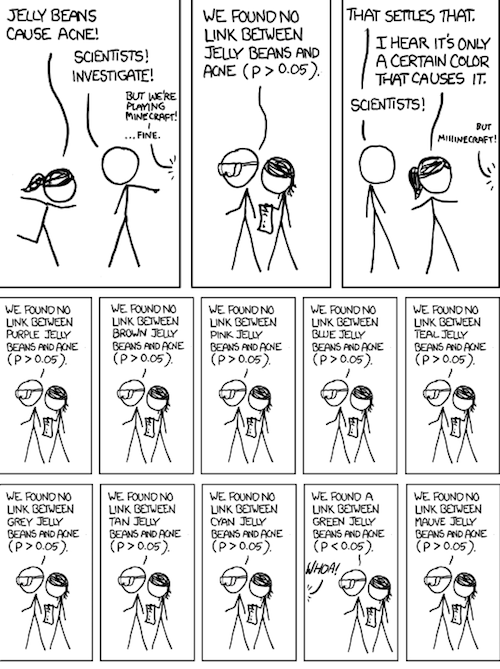
comic showing the dangers of drawing false conclusion based on statistical significance

Randall Munroe illustrates RA Fisher’s point that you must think to draw reasonable conclusions from data. Click the image to see the full xkcd comic.

Pretty much everything you eat is associated with cancer. Don’t worry about it. by Sarah Kliff

The changes in cancer risk were all over the map: 39 percent found an increased risk, 33 percent found a decreased risk and 23 percent showed no clear evidence either way.

The vast majority of those studies, Schoenfeld and Ioannidis found, showed really weak associations between the ingredient at hand and cancer risk. A full 80 percent of the studies had shown statistical relationships that were “weak or nominally significant,” as measured by the study’s P-values. Seventy-five percent of the studies purporting to show a higher cancer risk fell into this category, as did 76 percent of those showing a lower cancer risk.

Sadly the evidence is often not very compelling but creates uncertainly in the public. Poorly communicated results and scientific illiteracy (both from publishers and the public) leads to more confusion than is necessary. Even with well done studies, good communication and a scientifically literate population nutrition and human health conclusion are more often questionable than they are clear.

Related: Researchers Find Switch That Allows Cancer Cells to SpreadGlobal Cancer Deaths to Double by 2030Physical Inactivity Leads to 5.3 Million Early Deaths a Year