Tag Archives: John Hunter

Thanksgiving, Appropriately

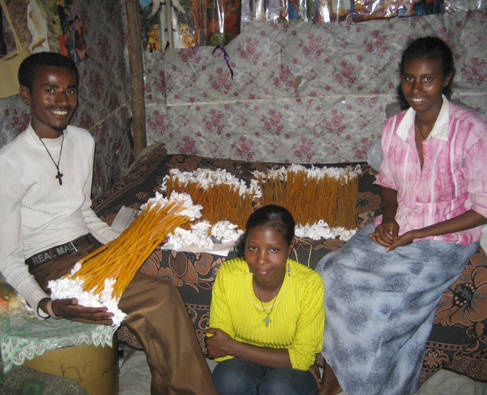
photo of Frew Wube in Ethiopia

This is a post from my Curious Cat Investing and Economics Blog: Financial Thanksgiving. I have tweaked a bit to tie into appropriate technology since that is the related area to me on this blog.

For me, giving back to others is part of my personal financial plan. As I have said most people that are actually able to read this are financially much better off than billions of other people today. At least they have the potential to be if they don’t chose to live beyond their means. Here are some of the ways I give back to others.

Kiva is a wonderful organization and particularly well suited to discuss because they do a great job of using the internet to make the experience rewarding for people looking to help – as I have mentioned before: Reducing Poverty. One of my goals for this blog is to increase the number of readers participating in Kiva – see current Curious Cat Kivans. I have also created a lending team on Kiva. Kiva added a feature that allows people to connect online. When you make a loan you may link you loan to a group.

I actually give more to Trickle Up, I have been giving to them for a long time. They appeal to my same desire to help people help themselves. I believe in the power of capitalism and people to provide long term increases in standards of living. I love the idea of providing support that grows over time. I like investing and reaping the rewards myself later (with investment I make for myself). But I also like to do that with my gifts. I would like to be able to provide opportunities to many people and have many of them take advantage of that to build a better life for themselves, their families and their children.

The photo shows Frew Wube, Haimanot and Melkan (brother and two sisters), an entrepreneur that received a grant from Trickle up. Trickle Up provides grants to entrepreneur, similar to micro loans, except the entrepreneur does not have to pay back the grant. They are able to use the full funds to invest in their business and use all the income they are able to generate to increase their standard of living and re-invest in the business.
Continue reading
Toward a More Open Scientific Culture

Michael Nielsen wrote a great post, The Future of Science, which is also the topic of a book he is writing. He discusses how scientific advancement has often been delayed as those making discoveries did not share them openly. And how 300 years ago scientific journals and reward systems created ways for scientists to be rewarded for publication. And he continues with the need for the process to again change and promote more open sharing of scientific knowledge, which I agree with and have written about previously: Publishers Continue to Fight Open Access to Science, Science Journal Publishers Stay Stupid, The Future of Scholarly Publication, etc..

Why were Hooke, Newton, and their contemporaries so secretive? In fact, up until this time discoveries were routinely kept secret.

This cultural transition was just beginning in the time of Hooke and Newton, but a little over a century later the great physicist Michael Faraday could advise a younger colleague to “Work. Finish. Publish.” The culture of science had changed so that a discovery not published in a scientific journal was not truly complete. Today, when a scientist applies for a job, the most important part of the application is their published scientific papers.

This has been a great advance. Now we need to continue that advance to use the internet to make that publication open and increase the advantage of shared knowledge to society.

The adoption of the journal system was achieved by subsidizing scientists who published their discoveries in journals. This same subsidy now inhibits the adoption of more effective technologies, because it continues to incentivize scientists to share their work in conventional journals, and not in more modern media.

This means: making many more types of content available than just scientific papers; allowing creative reuse and modification of existing work through more open licensing and community norms; making all information not just human readable but also machine readable; providing open APIs to enable the building of additional services on top of the scientific literature, and possibly even multiple layers of increasingly powerful services. Such extreme openness is the ultimate expression of the idea that others may build upon and extend the work of individual scientists in ways they themselves would never have conceived.

To create an open scientific culture that embraces new online tools, two challenging tasks must be achieved: (1) build superb online tools; and (2) cause the cultural changes necessary for those tools to be accepted.

I agree we need to take advantage of the new possibilities to advance the practice of science. His full post is well worth reading.

Related: Open Source: The Scientific Model Applied to ProgrammingThe Future of Science is Open by Bill HookerDinosaurs Fight Against Open ScienceOpen Access Journal WarsI Support the Public Library of ScienceDoes the Data Deluge Make the Scientific Method Obsolete?

Bacteria and Efficient Food Digestion

Gut Bacteria May Cause And Fight Disease, Obesity

“We’re all sterile until we’re born,” says Glenn Gibson, a microbiologist at the University of Reading in Britain. “We haven’t got anything in us right up until the time we come into this big, bad, dirty world.”

But as soon as we pass out of the birth canal, when we are fetched by a doctor’s hands, placed in a hospital crib, put on our mother’s breast, when we drag a thumb across a blanket and stick that thumb in our mouths, when we swallow our first soft food, we are invaded by all sorts of bacteria. Once inside, they multiply – until the bacteria inside us outnumber our human cells.

University of Chicago immunologist Alexander Chervonsky, with collaborators from Yale University, recently reported that doses of the right stomach bacteria can stop the development of type 1 diabetes in lab mice. “By changing who is living in our guts, we can prevent type 1 diabetes,” he told The Wall Street Journal.

The bottom line: We now have two sets of genes to think about – the ones we got from our parents and the ones of organisms living inside us. Our parents’ genes we can’t change, but the other set? Now that is one of the newest and most exciting fields in cell biology.

Follow link with related podcast: Gut bacteria may cause and fight, disease, obesity. This whole area of the ecosystem within us and our health I find fascinating. And I fall for confirmation bias on things like becoming inefficient at converting food to energy as a way reduce obesity.

You could have two people sitting down to a bowl of cheerios, they could each eat the same number of cheerios but because of a difference in their gut bacteria one will get more calories than the other.

.

They then gave an example of the difference being 95 calories versus 99 calories. Hardly seems huge but it would add up. Still that is a less amazing difference than I was expecting.

Related: Energy Efficiency of DigestionWaste from Gut Bacteria Helps Host Control WeightObesity Epidemic Partially ExplainedForeign Cells Outnumber Human Cells in Our Bodies

William G. Hunter Award 2008: Ronald Does

The recipient of the 2008 William G. Hunter Award is Ronald Does. The Statistics Division of the American Society for Quality (ASQ) uses the attributes that characterize Bill Hunter’s (my father – John Hunter) career – consultant, educator for practitioners, communicator, and integrator of statistical thinking into other disciplines to decide the recipient. In his acceptance speech Ronald Does said:

The first advice I received from my new colleagues was to read the book by Box, Hunter and Hunter. The reason was clear. Because I was not familiar with industrial statistics I had to learn this from the authors who were really practicing statisticians. It took them years to write this landmark book.

For the past 15 years I have been the managing director of the Institute for Business and Industrial Statistics. This is a consultancy firm owned by the University of Amsterdam. The interaction between scientific research and the application of quality technology via our consultancy work is the core operating principle of the institute. This is reflected in the type of people that work for the institute, all of whom are young professionals having strong ambitions in both the academic world and in business and industry.

The kickoff conference attracted approximately 80 statisticians and statistical practitioners from all over Europe. ENBIS was officially founded in June 2001 as “an autonomous Society having as its objective the development and improvement of statistical methods, and their application, throughout Europe, all this in the widest sense of the words” Since the first meeting membership has grown to about 1300 from nearly all European countries.

Related: 2007 William G. Hunter AwardThe Importance of Management ImprovementDesigned ExperimentsPlaying Dice and Children’s Numeracy

Reducing Poverty

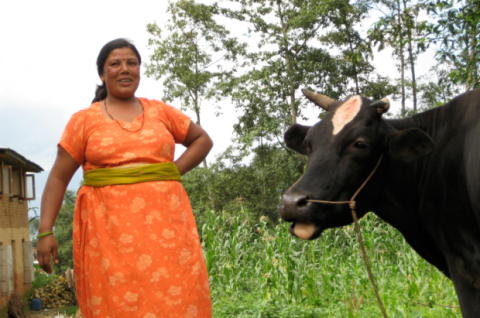
photo of Rita Bashnet

Today is blog action day, which this year is focused on poverty. We have highlighted various uses of appropriate technology, many of which help those in poverty improve their lives. Such as: Water Pump Merry-go-Round and Smokeless Stove Uses 80% Less Fuel.

I am also very interested in using micro loans to help entrepreneur improve their lives – I have written about Kiva before. Kiva fellows are funded by Kiva (fellows are unpaid) to go to spend time in the countries Kiva facilitates loans for working with the local partners. This post is about Rita Bashnet (in photo) an entrepreneur from Nepal:

Field visits are by far the best part about being a Kiva Fellow. You’re given the opportunity to hop on a motorbike, hike up a village trail, and actually see the impact of a Kiva loan firsthand.

Five years ago, Ms. Rita took her first loan of NRs. 10,000 (USD $150) and purchased some extra seed and fertilizer in the hopes of expanding her small vegetable patch. With the profits from this initial investment and a second loan from Patan Business and Professional Women (they offer a graduated loan program), she then purchased her first dairy cow.

After hearing about a program that subsidized the installation of methane gas storage tanks, Ms. Rita took another loan and applied for the program. With this new system, she is now able to capture the valuable gas released from her cow’s waste in a simple controlled-release storage tank. Today she no longer purchases gas from the city and can even sell some during times of shortage.

Ms. Rita exemplifies the potential of microfinance. A combination of access to capital and strategic investment has allowed her and her family to drastically improve their economic situation in a short five years.

Great story, and exactly my hope for using capitalism to improve the standard of living for people around the globe.

If you haven’t loaned money through Kiva, please consider it now. If you do (or already have a Kiva page), send me your Kiva lender link and I will add it to Curious Cat Kivans. I would love to add more of our readers to that page.

Related: Using Capitalism to Make a Better WorldAppropriate TechnologyFixing the World on $2 a DayTrickle Up

More Mysterious Space Phenomenon

One of the things I really hope this blog helps accomplish is to show how science progresses (which explains why I use that tag so often, 3rd most, other popular tags: animals (most used), engineers 2nd, fun and webcasts tied for 4th).

Science is a process of continual learning as curiosity leads us to seek better understanding. On a small scale this can mean a person learning more about knowledge already understood by others. But it also means the scientific community facing new questions and coming up with new explanations for the new questions raised by observations (and testing those new explanations…). Mysterious New ‘Dark Flow’ Discovered in Space

Patches of matter in the universe seem to be moving at very high speeds and in a uniform direction that can’t be explained by any of the known gravitational forces in the observable universe. Astronomers are calling the phenomenon “dark flow.” The stuff that’s pulling this matter must be outside the observable universe, researchers conclude.

They discovered that the clusters were moving nearly 2 million mph (3.2 million kph) toward a region in the sky between the constellations of Centaurus and Vela. This motion is different from the outward expansion of the universe (which is accelerated by the force called dark energy).

“We found a very significant velocity, and furthermore, this velocity does not decrease with distance, as far as we can measure,” Kashlinsky told SPACE.com. “The matter in the observable universe just cannot produce the flow we measure.”

Related: Laws of Physics May Need a RevisionGreat Physics Webcast LecturesChallenging the Science Status QuoParasite Rex

Backyard Wildlife: Great Spreadwing Damselfly

photo of Dragonfly

If you know the what type of dragonfly is in the photo, please add a comment (update: a comment indicates it is not a dragonfly but a Great Spreadwing Archilestes grandis damselfly – I really enjoy getting feedback like this. It appears the most common way to differentiate the two is how the wings are at rest but the Spreadwing is an exception). I had a small preying mantis drop on my head, and then the ground, a month ago in my backyard. But when I got my digital camera I couldn’t find it again. The variety of insects you can see can be amazing, especially if you don’t use poisons and chemicals in your yard.

Photo by John Hunter, creative commons attribution license.

Related: Backyard Wildlife: Sharpshinned HawkBackyard Wildlife: Foxposts on insects

Science Sortof Explains: Hiccups

photo of Red Hot Pepper by John Hunter

I love spicy food (Indian food is my favorite food). In my garden, this year, I am growing some spicy peppers (which honestly I don’t really like on their own – I have discovered). Still I eat them some and I get the hiccups almost every time. So I finally used Google to find out why. That lead to – MayoClinic on Hiccups:

A hiccup is an unintentional contraction of your diaphragm – the muscle that separates your chest from your abdomen and plays an important role in breathing. This contraction makes your vocal cords close very briefly, which produces the sound of a hiccup.

Although there’s often no clear cause for a bout of hiccups, some factors that can trigger acute or transient hiccups include: Eating spicy food. Spicy food may cause irritation to the nerves that control normal contractions of your diaphragm.

I must say the internet is great. Still that is hardly a great explanation for me. I almost never get the hickups eating spicy meals but every time I eat a hot pepper on its own I seem to (which happens very quickly and then ends pretty quickly – under 5 seconds). I guess somehow the other food in my mouth disrupts the potential nerve irritation so that it doesn’t cause a hiccup? It doesn’t seem like the raw pepper is hotter (higher Scoville Heat Unit) than the food, so I don’t think it is just a matter of more “heat” causing the hiccups.

Photo by John Hunter, Creative Commons Attribution-Share Alike (see requirements for use).

Related: The World’s Hottest ChiliScience Explains: Flame Colorposts on scientific explanations for what we experienceBackyard Wildlife: BirdsSave Money on Food with a Gardenfood related posts

Photos of Parfrey’s Glen, Wisconsin

John Hunter Durwood Glen

photo of Yellow Flower in Parfreys Glen

See more photos from my visit to Parfrey’s Glen Natural Area in Wisconsin, about an hour outside of Madison. It really was amazingly beautiful – the pictures do not do it justice. The Parfrey’s Glen trail is under a mile but well worth visiting. If you want to hike more try the Ice Age National Scenic Trail or nearby Devil’s Lake State Park. The top photo is of me (John Hunter) at nearby Durwood’s Glen. The yellow flower is from Parfrey’s Glen.

Photo of yellow flower by John Hunter is available for use: Creative Commons Attribution-Share Alike (see requirements for use).

Related: Hoh Rain Forest and Ruby Beach, Olympic National parkC&O Towpath – Monocacy Aqueduct, MarylandNature Recreation DecliningCurious Cat photo traveloguesBull Run Trail, Virginia

Parfrey’s Glen is Wisconsin’s first State Natural Area, is a spectacular gorge deeply incised into the sandstone conglomerate of the south flank of the Baraboo Hills. The exposed Cambrian strata provide excellent opportunities for geological interpretation. The walls of the glen – a Scottish word for a narrow, rocky ravine – are sandstone with embedded pebbles and boulders of quartzite.