Tag Archives: Life Science

Synthetic Biologists Design a Gene that Forces Cancer Cells to Commit Suicide

Killing a cancer cell from the inside out

To create their tumor-killing program, the researchers designed a logic circuit — a system that makes a decision based on multiple inputs. In this case, the circuit is made of genes that detect molecules specific to a type of cervical cancer cell. If the right molecules are present, the genes initiate production of a protein that stimulates apoptosis, or programmed cell death. If not, nothing happens.

Because the genes used to create the circuits can be easily swapped in and out, this approach could also yield new treatments or diagnostics for many other diseases, according to Ron Weiss, an MIT associate professor of biological engineering and one of the leaders of the research team. “This is a general technology for disease-state detection,” he says.

the researchers created a synthetic gene for a protein, called hBax, that promotes cell death. They designed the gene with two separate safeguards against the killing of healthy, non-HeLa cells: It can be turned off by high levels of microRNAs that are ordinarily low in HeLa, and can also be deactivated by low levels of microRNAs that are normally plentiful in HeLa. A single discrepancy from the target microRNA profile is enough to shut off production of the cell-death protein.

If all microRNA levels match up with the HeLa profile, the protein is produced and the cell dies. In any other cell, the protein never gets made, and the synthetic genes eventually break down.

More very cool research. It is exciting to see how much can be done when we invest in science and engineering research. Of course the path from initial research to implemented solutions is long and complex and often fails to deliver on the initial hopes. But some remarkable breakthroughs achieve spectacular results that we benefit from every day.

Related: Cancer VaccinesResearchers Find Switch That Allows Cancer Cells to SpreadGlobal Cancer Deaths to Double by 2030Cloned Immune Cells Clear Patient’s Cancer

What Happens If the Overuse of Antibiotics Leads to Them No Longer Working?

Antibiotics have been a miraculous tool to keep up healthy. Like vaccines this full value of this tool is wasted if it is used improperly. Vaccines value is wasted when they are not used enough. Antibiotics lose potency when they are overused. The overuse of anti-biotics on humans is bad (especially the huge amount of just lazy, not scientific use). But the massive overuse in livestock is much worse, it seems to me.

The health system in the USA is broken in a huge way in which it is broken is the failure to address creating systemic behavior that promotes human health and instead just treating illness. It is much better to avoid a situation where we breed super bugs and then try to treat those super bugs that have evolved to be immune to the antibiotics we have to use.

When antibiotics no longer work

While the source of the current salmonella outbreak remains murky, we can reasonably speculate about the genesis of the bug’s drug-resistance: the reportedly endemic overuse of antibiotics by the agricultural industry.

Drugs are given to livestock for multiple reasons. An obvious one is for the treatment of diseases. When livestock are sick, veterinarians administer a significant dosage in hopes of eliminating the animal’s affliction. Another reason is preventative. Animals in close quarters are more susceptible to infection, so farmers will often administer medicine to healthy animals in order to nip anything nasty in the bud. Most controversially, though, members of the agricultural industry use antibiotics for the express purpose of promoting livestock growth.

It’s a well-known, if not entirely intuitive, fact that healthy animals who are fed small, or “sub-therapeutic,” doses of antibiotics will wind up larger than their unmedicated counterparts. In many such cases, these drugs are given to livestock through their feed or water, and without the prescription or oversight of a veterinarian, according to Dr. Gail Hansen, a senior officer at the Pew Campaign on Human Health and Industrial Farming.

An estimated 80 percent of all antibiotics in the U.S. are given to food-producing livestock, according to the FDA. And approximately 83 percent of that medicine is “administered flock- or herd-wide at low levels for non-therapeutic purposes, such as growth promotion and routine disease prevention,” according to a lawsuit filed against the FDA in May. These figures could have very real consequences for public health, because the Catch-22 of this antibiotic abandon is the widespread development of drug-resistant bacteria, colloquially referred to as “super-bugs.”

In 2006, the European Union banned all use of antibiotics on livestock for growth promotion. And the U.S. Senate will consider similar legislation this year. Sen. Dianne Feinstein, D-Calif., reintroduced the “Preservation of Antibiotics for Medical Treatment Act” last month, which would significantly rein in agricultural drug use, and strictly prohibit the application of sub-therapeutic doses of drugs that have benefits for humans.

Still, the agricultural industry disputes data about its use of antibiotics and the rise of super-bugs, and it has aggressively fought efforts to legislate the matter. As a result, it’s hard to tell how far the legislation might proceed.

Related: Antibiotics Too Often Prescribed for Sinus WoesOveruse of Antibiotics (2005)FDA May Make Decision That Will Speed Antibiotic Drug Resistance (2007)

The end of the era of antibiotics

How did this happen? The driving forces are Darwin and human carelessness. Bacteria are constantly evolving, adapting to the changing conditions they face. Antibiotics usually kill bacteria. But sometimes a bacteria will develop a biological defense – particularly if too small a dose is used.

Antibiotics require a prescription in America, but our nation is still very much a part of the problem. Patients routinely demand these drugs, and doctors acquiesce, for respiratory infections and other ailments that will not respond to antibiotics because they are caused by a virus. We use soap with antimicrobial agents when regular soap does equally well. And we allow farmers to feed antibiotics to livestock in horrifying amounts, not to treat illnesses but to make farming more efficient.

The Potential Role of Concentrated Animal Feeding Operations in Infectious Disease Epidemics and Antibiotic Resistance

This working group, which was part of the Conference on Environmental Health Impacts of Concentrated Animal Feeding Operations: Anticipating Hazards—Searching for Solutions, considered the state of the science around these issues and concurred with the World Health Organization call for a phasing-out of the use of antimicrobial growth promotants for livestock and fish production. We also agree that all therapeutic antimicrobial agents should be available only by prescription for human and veterinary use.

Antibiotic Resistance in Livestock: More at Risk Than Steak
Continue reading

Biologists Identified a New Way in Which Bacteria Hijack Healthy Cells

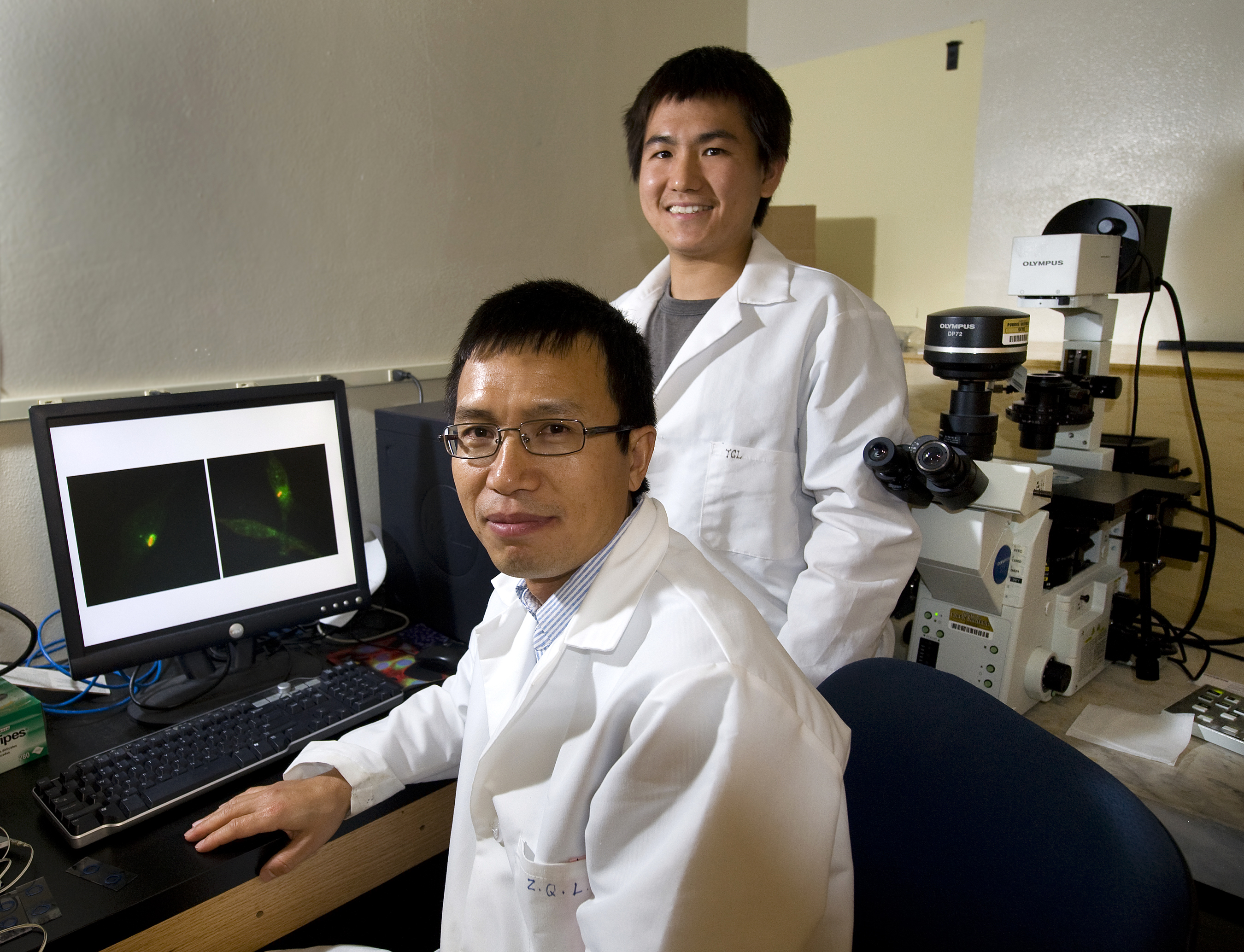
photo of Zhao-Qing Luo and Yunhao Tan

Associate professor of biological sciences Zhao-Qing Luo, foreground, and graduate student Yunhao Tan identified a new way in which bacteria modify healthy cells during infection. Shown on the computer screen are cells infected with a mutant strain of the bacteria Legionella pneumophila used in their research.

Purdue University biologists identified a new way in which bacteria hijack healthy cells during infection, which could provide a target for new antibiotics. Zhao-Qing Luo, the associate professor of biological sciences who led the study, said the team discovered a new enzyme used by the bacterium Legionella pneumophila – which causes Legionnaires’ disease – to control its host cell in order to take up residence.

“Legionnaires’ disease is a severe form of pneumonia, and this finding could lead to the design of a new therapy that saves lives,” Luo said. “At the same time it also provides great insight into a general mechanism of both bacterial infection and cell signaling events in higher organisms including humans.”

Successful infection by Legionella pneumophila requires the delivery of hundreds of proteins into the host cells that alter various functions to turn the naturally hostile environment into one tailor-made for bacterial replication. These proteins tap into existing communication processes within the cells in which an external signal, such as a hormone, triggers a cascade of slight modifications to proteins that eventually turns on a gene that changes the cell’s behavior, he said.

“Pathogens are successful because they know how information in our cells is relayed and they amplify some signals and block others in order to evade the immune system and keep the cell from defending itself,” Luo said. “Despite our understanding of this, we do not know much about how the proteins delivered by the bacteria accomplish this – how they work. This time we were able to pinpoint an enzyme and see how it disrupted and manipulated a specific signaling pathway in order to create a better environment for itself.”

The signaling pathway involved was only recently identified, and the discovery by Luo and graduate student Yunhao Tan also provides a key insight into its process. The signaling pathway involves a new form of protein modification called AMPylation in order to relay instructions to change cell behavior and has been found to be used by almost all organisms, Luo said.

The bacterium affects the host cell’s functions differently during different phases of the infection process, tapping into signaling pathways to turn on and off certain natural cellular activities. SidD stops the AMPylation process four hours after the start of infection in order to reverse an earlier modification that would be detrimental to the cell if left in place, he said.

Read the full press release.

Related: Using Bacteria to Carry Nanoparticles Into CellsDisrupting Bacterial Communication to Thwart ThemScientists Target Bacteria Where They LiveAre you ready for a world without antibiotics?

NASA’s Mars Curiosity Rover

Curiosity is the name of the new rover from NASA. It will be launched to continue the exploration of Mars so successfully done by Spirit and Opportunity (2 previous Mars rovers that did some amazing work and laster years longer than expected). The rover is NASA’s Mars Science Laboratory, a mobile robot for investigating Mars’ past or present ability to sustain microbial life.

photo of NASA's Mars Rover: Curiosity

Once on the surface, the rover will be able to roll over obstacles up to 75 centimeters (29 inches) high and travel up to 90 meters per hour. On average, the rover is expected to travel about 30 meters per hour, based on power levels, slippage, steepness of the terrain, visibility, and other variables.

The rover is about the size of a small SUV — 10 feet long (not including the arm), 9 feet wide and 7 feet tall. It weighs 900 kilograms (2,000 pounds)

The rover will carry a radioisotope power system that generates electricity from the heat of plutonium’s radioactive decay. This power source gives the mission an operating lifespan on Mars’ surface of a full martian year (687 Earth days) or more, while also providing significantly greater mobility and operational flexibility, enhanced science payload capability, and exploration of a much larger range of latitudes and altitudes than was possible on previous missions to Mars.

Related: Mars Rover Continues ExplorationMars Rovers Getting Ready for Another Adventure (2007)Sunset on Mars

Hydromedusae, Siphonophora, Cnidarians, Ctenophores

Jellyfish is a common name for gelatinous water dwelling animals. The diversity of these invertebrates is amazing. And what actually counts as a jellyfish is not easy to determine. Watch this great video to learn about Cnidarians, Urochordata, Polychaetes and Ctenophores.

Related: Darwin’s JellyfishesOcean LifeCritter Cam: Sea Lion versus OctopusImage of Map Showing Concentration of Life in Oceans

CDC Report on Failures to Vaccinate

Science brought us the miracle of vaccines and the near elimination of many diseases. Unfortunately people are choosing to bring those diseases to many more people because they failed to get vaccinated or failed to vaccinate their children. The needless pain and suffering caused by these poor decisions are a sad testament to scientific illiteracy.

The financial implications of the US measles outbreaks

One reason measles outbreaks are so scary (and so difficult to contain) is that measles is the most infectious microbe known to man–it’s transmission rate is around 90 percent. It has also killed more children than any other disease in history.

The most significant factor in the spread of measles in the United States is declining vaccination rates — and, similar to what occurred in the UK in the early part of the last decade, that decline can be traced back to the press-fueled panic…

CDC report on Measles

Children and adults who remain unvaccinated and develop measles also put others in their community at risk…

In Europe in recent years, measles has been fatal for several children and adolescents, including some who could not be vaccinated because they were immune compromised.

Rapid control efforts by state and local public health agencies, which are both time intensive and costly, have been a key factor in limiting the size of outbreaks and preventing the spread of measles into communities with increased numbers of unvaccinated persons. Nonetheless, maintenance of high 2-dose MMR vaccination coverage is the most critical factor for sustaining elimination. For measles, even a small decrease in coverage can increase the risk for large outbreaks and endemic transmission, as occurred in the United Kingdom in the past decade…

Related: Vaccines Don’t Provide Miraculous Results if We Don’t Take ThemThe Illusion of Understanding500 Year Floods

Nice Program on Mexican Free-tailed Bats

Mexican free-tailed bats in the Central Valley, California: the voracious insect-eating species protects the local crops from pests. Bats really are wonderful animals and very beneficial to people. They eat many insects and some also help pollinate some plants. The Mexican free-tailed bats seem to even benefit from human activity (taking advantage of bridge underpasses as homes, for example), but many other bat species are in trouble.

Related: Nectar-Feeding BatsResearchers Work to Protect Bats Against Deadly DiseaseMoth Jams Bat Sonar

New Discovery Finds Fungi Different From All Known Forms is Ubiquitous

A New, Somewhat Moldy Branch On The Tree Of Life

Many fungi are already familiar. There are mushrooms, yeasts, molds like the one that makes penicillin, plant diseases such as rusts and smuts. Mildew in your shower is one, along with athlete’s foot. There are even fungi that infect insects — as well as fungi that live on other fungi.

Biologists figure they’ve probably only cataloged about 10 percent of all fungal species. But they thought they at least knew all of the major groups.

They found novel bits of DNA — related to fungi, but clearly different from all of the known varieties — just about everywhere, “including pond water, lake water, freshwater sediments and marine sediments,” Richards says. “Almost everywhere we looked we found this novel group.”

They then brought samples back to the lab and devised a technique to make the organisms containing this novel DNA glow under a microscope. As a result, they’ve managed to get a few glimpses of these mysterious life forms, which they have named cryptomycota.

“We know they have at least three stages to their life cycle,” Richards says. “One is where they attach to a host, which are photosynthetic algae. Another stage … they form swimming tails so they can presumably find food. And [there’s] another stage, which we call the cyst phase, where they go to sleep.”

Science continues to explore and find new wonders around us. There is so much still to learn.

Related: Mycoremediation and its Applications In Oil SpillsMost Dinosaurs Remain UndiscoveredIron-breathing Species Isolated in Antarctic for Millions of YearsFungus-gardening Ant Species Has Given Up Sex Completely

Cancer Vaccines

A reader commented on a previous post (MIT Engineers Design New Type of Nanoparticle for Vacines) asking about how vaccines can fight cancer. Preventative vaccines can build up immune response to viruses which cause cancer. So the vaccine actually works against the virus which prevents the virus from causing cancer.

The U.S. Food and Drug Administration (FDA) has approved two vaccines, Gardasil® and Cervarix®, that protect against infection by the two types of human papillomavirus (HPV) – types 16 and 18 – that cause approximately 70% of all cases of cervical cancer worldwide. At least 17 other types of HPV are responsible for the remaining 30% of cervical cancer cases. HPV types 16 and/or 18 also cause some vaginal, vulvar, anal, penile, and oropharyngeal cancers.

Many scientists believe that microbes cause or contribute to between 15% and 25% of all cancers diagnosed worldwide each year, with the percentages being lower in developed than developing countries.

Vaccines can also help stimulate the immune system to fight cancers.

B cells make antibodies, which are large secreted proteins that bind to, inactivate, and help destroy foreign invaders or abnormal cells. Most preventive vaccines, including those aimed at hepatitis B virus (HBV) and human papillomavirus (HPV), stimulate the production of antibodies that bind to specific, targeted microbes and block their ability to cause infection. Cytotoxic T cells, which are also known as killer T cells, kill infected or abnormal cells by releasing toxic chemicals or by prompting the cells to self-destruct (a process known as apoptosis).

Other types of lymphocytes and leukocytes play supporting roles to ensure that B cells and killer T cells do their jobs effectively. These supporting cells include helper T cells and dendritic cells, which help activate killer T cells and enable them to recognize specific threats.

Cancer treatment vaccines are designed to work by activating B cells and killer T cells and directing them to recognize and act against specific types of cancer. They do this by introducing one or more molecules known as antigens into the body, usually by injection. An antigen is a substance that stimulates a specific immune response. An antigen can be a protein or another type of molecule found on the surface of or inside a cell.

Related: National Cancer Institute (USA)Nanoparticles With Scorpion Venom Slow Cancer SpreadUsing Bacteria to Carry Nanoparticles Into CellsGlobal Cancer Deaths to Double by 2030
Continue reading

New Analysis of Primordial Soup Experiment Half a Century Later

Open access paper: Primordial synthesis of amines and amino acids in a 1958 Miller H2S-rich spark discharge experiment

Archived samples from a previously unreported 1958 Stanley Miller electric discharge experiment containing hydrogen sulfide (H2S) were recently discovered and analyzed using high-performance liquid chromatography and time-of-flight mass spectrometry. We report here the detection and quantification of primary amine-containing compounds in the original sample residues, which were produced via spark discharge using a gaseous mixture of H2S, CH4, NH3, and CO2. A total of 23 amino acids and 4 amines, including 7 organosulfur compounds, were detected in these samples.

The major amino acids with chiral centers are racemic within the accuracy of the measurements, indicating that they are not contaminants introduced during sample storage. This experiment marks the first synthesis of sulfur amino acids from spark discharge experiments designed to imitate primordial environments. The relative yield of some amino acids, in particular the isomers of aminobutyric acid, are the highest ever found in a spark discharge experiment.

The simulated primordial conditions used by Miller may serve as a model for early volcanic plume chemistry and provide insight to the possible roles such plumes may have played in abiotic organic synthesis. Additionally, the overall abundances of the synthesized amino acids in the presence of H2S are very similar to the abundances found in some carbonaceous meteorites, suggesting that H2S may have played an important role in prebiotic reactions in early solar system environments.

Related: All present-day Life on Earth Has A Single AncestorLife Untouched by the SunAmazing Designs of LifeAlbert Einstein, Marylin Monroe Hybrid Image