Tag Archives: physics

New Physics Prize Gives 9 Physicists $3 million Each

A new physics prize created by Russian billionaire who started a PhD in physics before switching to an MBA and getting rich (investing in Facebook, Twitter, Zynga and Groupon) has announced the first 9 winners. The award includes awards worth $3 million; the Nobel prize paid $1.1 million last year.

Yuri Milner awards make nine fundamental physics pioneers rich

The nine will now form a committee to select a winner, or winners, for next year. The prize will be given in the first quarter of each year

According to Milner, the new prizes are not intended to compete with the Nobels, and differ in crucial ways. They can go to younger researchers because experimental verification of theoretical breakthroughs is not required. And, unlike a Nobel prize, which can be shared by three scientists at most, the Milner prize imposes no limit.

Alongside the main prize, Milner’s foundation will give two further awards, the first being an annual New Horizons in Physics prize for promising junior researchers, and a special ad-hoc fundamental physics prize that can be awarded at any time, forgoing the usual nomination process. Milner said the latter prize might, for example, recognise experimental results that are clearly and immediately groundbreaking.

Milner, 50, left Moscow State University in 1985 with an advanced degree in theoretical physics. He later abandoned a PhD at the Russian Academy of Sciences for an MBA at the Wharton School of Business at the University of Pennsylvania.

winners:
Nima Arkani-Hamed, Institute for Advanced Study, Princeton. For original approaches to outstanding problems in particle physics, including the proposal of large extra dimensions, new theories for the Higgs boson, novel realisations of supersymmetry, theories for dark matter, and the exploration of new mathematical structures in gauge theory scattering amplitudes.

Ashoke Sen, Harish-Chandra Research Institute, Allahabad. For uncovering striking evidence of strong-weak duality in certain supersymmetric string theories and gauge theories, opening the path to the realisation that all string theories are different limits of the same underlying theory.

7 of the 9 winners are currently working in the USA (1 in India and 1 in France). 4 are at Princeton and 1 each at MIT, Cal Tech and Stanford.

Related: 2011 Nobel Prize in PhysicsShaw Laureates 20082008 USA Medals of Science and National Medals of Technology and Innovation
Scientific Inquiry Process Finds More Evidence Supporting Einstein’s Theory

As scientists have been able to see farther and deeper into the universe, the laws that govern its expansion have been revealed to be under the influence of an unexplained force.

In a paper on the arXiv, Astrophysical Tests of Modified Gravity: Constraints from Distance Indicators in the Nearby Universe, are a vindication of Einstein’s theory of gravity. Having survived several decades of tests in the solar system, it has passed this new test in galaxies beyond our own as well.

In 1998, astrophysicists made an observation that turned gravity on its ear: the universe’s rate of expansion is speeding up. If gravity acts the same everywhere, stars and galaxies propelled outward by the Big Bang should continuously slow down, like objects thrown from an explosion do here on Earth.

This observation used distant supernovae to show that the expansion of the universe was speeding up rather than slowing down. This indicated that something was missing from physicists’ understanding of how the universe responds to gravity, which is described by Einstein’s theory of general relativity. Two branches of theories have sprung up, each trying to fill its gaps in a different way.

One branch — dark energy — suggests that the vacuum of space has an energy associated with it and that energy causes the observed acceleration. The other falls under the umbrella of “scalar-tensor” gravity theories, which effectively posits a fifth force (beyond gravity, electromagnetism and the strong and weak nuclear forces) that alters gravity on cosmologically large scales.

“These two possibilities are both radical in their own way,” University of Pennsylvania astrophysicist Bhuvnesh Jain said. “One is saying that general relativity is correct, but we have this strange new form of energy. The other is saying we don’t have a new form of energy, but gravity is not described by general relativity everywhere.”

Jain’s research is focused on the latter possibility; he is attempting to characterize the properties of this fifth force that disrupts the predictions general relativity makes outside our own galaxy, on cosmic length scales. Jain’s recent breakthrough came about when he and his colleagues realized they could use the troves of data on a special property of a common type of star as an exquisite test of gravity.

Continue reading

Teen Solves Puzzle That Has Stumped Mathematicians for 300 Years

Teen solves Newton’s 300-year-old riddle

An Indian-born teenager has won a research award for solving a mathematical problem first posed by Sir Isaac Newton more than 300 years ago that has baffled mathematicians ever since.

The solution devised by Shouryya Ray, 16, makes it possible to calculate exactly the path of a projectile under gravity and subject to air resistance. Shouryya, who lives in Dresden, eastern Germany, came up with the solutions to this and a second mathematical riddle while working on a school project.

Only partial solutions had been discovered up to now, requiring simplified assumptions or calculations by computer. Shouryya’s elegant solutions could contribute to greater precision in fields such as ballistics.

Related: Teen Tackles Centuries-old Numbers challenge (this time it was an Iraqi immigrant in Sweden)Numeracy: The Educational Gift That Keeps on GivingOur Brains Reorganize As We Learn Math

Video of Young Richard Feynman Talking About Scientific Thinking

The enjoyable video above shows a young Richard Feynman discussing how scientific thinking can advance our understanding of the world.

Related: Feynman “is a second Dirac, only this time human”Science and the Excitement, the Mystery and the Awe of a FlowerClassic Feynman: All the Adventures of a Curious Character

Brian Cox – Lecture on Science and Quantum Mechanics

Brian Cox gave a wonderful lecture at the Royal Institution of Great Britain. This is one more great thing the internet makes possible: have great fun while you learn. Enjoy.

With the help of Jonathan Ross, Simon Pegg, Sarah Millican and James May, Brian shows how diamonds – the hardest material in nature – are made up of nothingness; how things can be in an infinite number of places at once; why everything we see or touch in the universe exists; and how a diamond in the heart of London is in communication with the largest diamond in the cosmos.

Related: Quantum Mechanics Made Relatively Simple Podcasts by Hana BetheBrian Cox Particle Physics WebcastPhysicists Observe New Property of Matter

Christian Science Monitor Scientific Literacy Quiz

This is a nice science quiz that you should learn from while taking it (unless you are extremely knowledgeable already and know every answer).

It is multiple choice, and even on some I got right, I wasn’t completely sure between two choices for example (What is the heaviest noble gas?). I managed to guess pretty well but also missed a couple.

It has one hugely annoying usability failure: after answering the question it loads a new page with the right answer and you have to click again to get the next question. Doing this for 50 questions is extremely tiresome and pointless. They correct answer could be shown at the top and also show the next question.

Some questions in the quiz:

  1. Newton’s First Law of Motion describes what phenomenon?
  2. What word, which comes from a Greek term meaning “good kernel,” describes an organism whose cells contain chromosomes inside a nucleus bounded by a membrane, as distinguished from bacterial forms of life?
  3. DNA contains adenine, cytosine, guanine, and what other nucleotide base, which is not found in RNA? (I had no idea on this one)
  4. What term describes the single initial cell of a new organism that has been produced by means of sexual reproduction?
  5. What term for an elementary particle and a fundamental constituent of matter gets its name from a line in James Joyce’s 1939 novel “Finnegans Wake”?

I managed to get 39 right, which honestly include lots of educated guesses and lucky guesses. It almost seemed the test was 30% on your ability to translate Greek or Latin. Overall I think it was difficult and I was lucky to get 39 right. It would be nice to show participant results like an earlier Science Knowledge Quiz did. Percentage getting each question would be interesting too, along with the distribution of answers.

They do provide all your answers (and the correct answers) on one page once you finish (with is a nice usability touch).

Related: Nearly Half of Adults in the USA Don’t Know How Long it Takes the Earth to Circle the SunTen Things Everyone Should Know About ScienceUnderstanding the Evolution of Human Beings by Country

A Possible Explanation for the Faster Than Light Result Anomaly

Faster-than-Light Neutrino Puzzle Claimed Solved by Special Relativity

So what is the satellites’ motion with respect to the OPERA experiment? These probes orbit from West to East in a plane inclined at 55 degrees to the equator. Significantly, that’s roughly in line with the neutrino flight path. Their relative motion is then easy to calculate.

So from the point of view of a clock on board a GPS satellite, the positions of the neutrino source and detector are changing. “From the perspective of the clock, the detector is moving towards the source and consequently the distance travelled by the particles as observed from the clock is shorter,” says van Elburg.

By this he means shorter than the distance measured in the reference frame on the ground.

The OPERA team overlooks this because it thinks of the clocks as on the ground not in orbit.

How big is this effect? Van Elburg calculates that it should cause the neutrinos to arrive 32 nanoseconds early. But this must be doubled because the same error occurs at each end of the experiment. So the total correction is 64 nanoseconds, almost exactly what the OPERA team observes.

It is great to see the scientific process at work. Those is support of the scientific method support open access science and this explanation is available via arxiv: Times Of Flight Between A Source And A Detector Observed From A GPS Satellite.

Related: Faster Than Light Speed Anomaly Reported by CERNMore Dark Matter Experiment ResultsThe Architecture of Access to Scientific Knowledge

2011 Nobel Prize in Physics

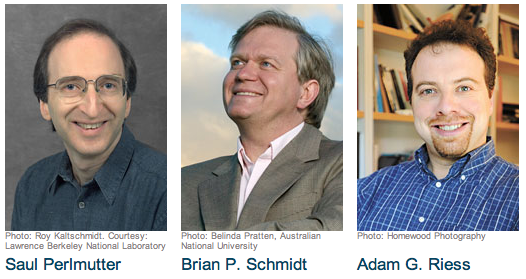
Photos of the 2011 Physics Nobel Prize Winners: Saul Perlmutter, Brian Schmidt and Adam Riess.

Photos of the 2011 Physics Nobel Prize Winners.

The Royal Swedish Academy of Sciences has decided to award the Nobel Prize in Physics for 2011 with one half to

Saul Perlmutter
The Supernova Cosmology Project, Lawrence Berkeley National Laboratory and University of California, Berkeley, CA, USA

and the other half jointly to

Brian P. Schmidt
The High-z Supernova Search Team, Australian National University, Weston Creek, Australia

and

Adam G. Riess
The High-z Supernova Search Team, Johns Hopkins University and Space Telescope Science Institute, Baltimore, MD, USA

“for the discovery of the accelerating expansion of the Universe through observations of distant supernovae”

Once again the USA dominates the physics category, Brian Schmidt is a USA and Australian citizen. It will be interesting to see if this starts to change in the next decade. I believe it will at some point fairly soon, the question is at what point.

“Some say the world will end in fire, some say in ice…” Robert Frost, Fire and Ice, 1920

What will be the final destiny of the Universe? Probably it will end in ice, if we are to believe this year’s Nobel Laureates in Physics. They have studied several dozen exploding stars, called supernovae, and discovered that the Universe is expanding at an ever-accelerating rate. The discovery came as a complete surprise even to the Laureates themselves.

In 1998, cosmology was shaken at its foundations as two research teams presented their findings. Headed by Saul Perlmutter, one of the teams had set to work in 1988. Brian Schmidt headed another team, launched at the end of 1994, where Adam Riess was to play a crucial role.

The research teams raced to map the Universe by locating the most distant supernovae. More sophisticated telescopes on the ground and in space, as well as more powerful computers and new digital imaging sensors (CCD, Nobel Prize in Physics in 2009), opened the possibility in the 1990s to add more pieces to the cosmological puzzle.

The teams used a particular kind of supernova, called type Ia supernova. It is an explosion of an old compact star that is as heavy as the Sun but as small as the Earth. A single such supernova can emit as much light as a whole galaxy. All in all, the two research teams found over 50 distant supernovae whose light was weaker than expected – this was a sign that the expansion of the Universe was accelerating. The potential pitfalls had been numerous, and the scientists found reassurance in the fact that both groups had reached the same astonishing conclusion.

For almost a century, the Universe has been known to be expanding as a consequence of the Big Bang about 14 billion years ago. However, the discovery that this expansion is accelerating is astounding. If the expansion will continue to speed up the Universe will end in ice.

The acceleration is thought to be driven by dark energy, but what that dark energy is remains an enigma – perhaps the greatest in physics today. What is known is that dark energy constitutes about three quarters of the Universe. Therefore the findings of the 2011 Nobel Laureates in Physics have helped to unveil a Universe that to a large extent is unknown to science. And everything is possible again.

As usually the Nobel committee does a great job of providing the public open scientific information. Others that claim to promote science can learn from them. They do a great job of making the science understandable to a lay person.

The discovery came as a complete surprise even to the Nobel Laureates themselves. What they saw would be like throwing a ball up in the air, and instead of having it come back down, watching as it disappears more and more rapidly into the sky, as if gravity could not manage to reverse the ball’s trajectory. Something similar seemed to be happening across the entire Universe.

The growing rate of the expansion implies that the Universe is being pushed apart by an unknown form of energy embedded in the fabric of space. This dark energy makes up a large part of the Universe, more than 70 %, and it is an enigma, perhaps the greatest in physics today. No wonder, then, that cosmology was shaken at its foundations when two different research groups presented similar results in 1998.

Related: The Nobel Prize in Physics 20092006 Nobel Prize in Physics2011 Nobel Prize in Physiology or MedicineIs Dark Matter an Illusion?5% of the Universe is Normal Matter, What About the Other 95%?
Continue reading

Faster Than Light Speed Anomaly Reported by CERN

The OPERA result is based on the observation of over 15000 neutrino events measured at Gran Sasso, and appears to indicate that the neutrinos travel at a velocity 20 parts per million above the speed of light, nature’s cosmic speed limit. Given the potential far-reaching consequences of such a result, independent measurements are needed before the effect can either be refuted or firmly established. This is why the OPERA collaboration has decided to open the result to broader scrutiny. The collaboration’s result is available on the preprint server arxiv.org.

The OPERA measurement is at odds with well-established laws of nature, though science frequently progresses by overthrowing the established paradigms. For this reason, many searches have been made for deviations from Einstein’s theory of relativity, so far not finding any such evidence. The strong constraints arising from these observations makes an interpretation of the OPERA measurement in terms of modification of Einstein’s theory unlikely, and give further strong reason to seek new independent measurements.

“This result comes as a complete surprise,” said OPERA spokesperson, Antonio Ereditato of the University of Bern. “After many months of studies and cross checks we have not found any instrumental effect that could explain the result of the measurement. While OPERA researchers will continue their studies, we are also looking forward to independent measurements to fully assess the nature of this observation.”

“When an experiment finds an apparently unbelievable result and can find no artefact of the measurement to account for it, it’s normal procedure to invite broader scrutiny, and this is exactly what the OPERA collaboration is doing, it’s good scientific practice,” said CERN Research Director Sergio Bertolucci. “If this measurement is confirmed, it might change our view of physics, but we need to be sure that there are no other, more mundane, explanations. That will require independent measurements.” This is a great reminder of the proper application of the scientific inquiry process. Our understanding moves forward based on evidence and incredible results require a high burden of proof before we accept them.

In order to perform this study, the OPERA Collaboration teamed up with experts in metrology from CERN and other institutions to perform a series of high precision measurements of the distance between the source and the detector, and of the neutrinos’ time of flight. The distance between the origin of the neutrino beam and OPERA was measured with an uncertainty of 20 cm over the 730 km travel path. The neutrinos’ time of flight was determined with an accuracy of less than 10 nanoseconds by using sophisticated instruments including advanced GPS systems and atomic clocks. The time response of all elements of the CNGS beam line and of the OPERA detector has also been measured with great precision.

“We have established synchronization between CERN and Gran Sasso that gives us nanosecond accuracy, and we’ve measured the distance between the two sites to 20 centimetres,” said Dario Autiero, the CNRS researcher who will give this afternoon’s seminar. “Although our measurements have low systematic uncertainty and high statistical accuracy, and we place great confidence in our results, we’re looking forward to comparing them with those from other experiments.”

“The potential impact on science is too large to draw immediate conclusions or attempt physics interpretations. My first reaction is that the neutrino is still surprising us with its mysteries.” said Ereditato. “Today’s seminar is intended to invite scrutiny from the broader particle physics community.”

The OPERA experiment was inaugurated in 2006, with the main goal of studying the rare transformation (oscillation) of muon neutrinos into tau neutrinos. One first such event was observed in 2010, proving the unique ability of the experiment in the detection of the elusive signal of tau neutrinos.

This is great stuff, wether it turns out to be an amazing result that changes our understanding of physics or even if it doesn’t (if it turns out the apparent result is not what it seems). It is great to see us attempt to learn. My guess is that we find some explanation for the anomaly that does avoids something traveling faster than the speed of light.

Brian Cox on the BBC 6: “This is the way science works, we go away and do it again and check, and then do it again and check. If it is confirmed then it will be the most significant discovery in physics in the last, at least, 100 years.”

Related: full press releaseThe Sun is a Miasma of Incandescent PlasmaGravity and the Scientific MethodMore Mysterious Space PhenomenonNeutrino particle traveling faster than light? Two ways it could rewrite physics

Is Dark Matter an Illusion?

Open access letter asks – Is dark matter an illusion created by the gravitational polarization of the quantum vaccum? by Dragan Slavkov Hajdukovic, CERN

Assuming that a particle and its antiparticle have the gravitational charge of the opposite sign, the physical vacuum may be considered as a fluid of virtual gravitational dipoles. Following this hypothesis, we present the first indications that dark matter may not exist and that the phenomena for which it was invoked might be explained by the gravitational polarization of the quantum vacuum by the known baryonic matter.

Let us start with a major unresolved problem. The measured galaxy rotation curves remain roughly constant at large radii. Faster than expected orbits, require a larger central force, which, in the framework of our theory of gravity, cannot be explained by the existing baryonic matter. The analogous problem persists also at the scale of clusters of galaxies.

The favoured solution is to assume that our current theory of gravity is correct, but every galaxy resides in a halo of dark matter made of unknown non-baryonic particles (for a brief review on dark matter see for instance: Einasto, 2010). A full list of the proposed dark matter particles would be longer than this letter; let us mention only weekly interacting massive particles and axions. In spite of the significant efforts dark particles have never been detected…

The scientific inquiry process continues to be used to try and explain the evidence we gather. Unsettled areas of science show how difficult the discovery process is. Once we have settled on theories it is so easy to explain why basic truths of evolution, geology, chemistry… result in what the evidence shows. But getting to the scientific consensus is a challenging process.


Dark Matter Is an Illusion, New Antigravity Theory Says

Physicist David Evans called the new study a “very interesting theoretical exercise,” but he said he isn’t ready to abandon dark matter just yet. “The evidence for dark matter is now very compelling,” said Evans, of the University of Birmingham, who leads the U.K. team for the ALICE detector at CERN’s Large Hadron Collider.

For example, in 2006 astronomers unveiled a photo of two colliding galaxies known as the Bullet cluster that purportedly showed the separation of matter from dark matter. A similar effect was observed in the Pandora cluster earlier this summer, said Evans, who was not involved in the study.

Hajdukovic said he is currently expanding his theory to account for these observations. His preliminary calculations, he said, suggest that “what is observed in the Bullet cluster and more recently at the Pandora cluster may be understood in the framework of the gravitational polarization of the quantum vacuum.”

CERN physicist Michael Doser agreed that Hajdukovic’s ideas are “unorthodox” but did not immediately dismiss the new theory…
“In a few years,” Doser said, “we should definitely be in a position to confirm or refute [Hajdukovic’s] hypothesis.”

Related: The Mystery of Empty SpaceWhy do we Need Dark Energy to Explain the Observable Universe?Dark Matter Experiment ResultsLooking for Signs of Dark Matter Over Antarctica