Tag Archives: Research

Russia Launches Mars Moon Probe

Russians launch Mars moon probe

Russia has launched an audacious bid to scoop up rock and dust samples from the Martian moon Phobos and bring them back to Earth for study.

Moscow has despatched a total of 16 missions to the Red Planet since the 1960s. None has successfully completed its goals, with the most recent endeavour – the sophisticated Mars-96 spacecraft – being destroyed in a failed launch.

Once on the surface, a robotic arm will pick up samples of the regolith (“soil”). Some of this material will be analysed there and then, but a portion of it – about 200g – will be transferred to a canister for return to Earth.

This canister and its departure stage should be sent home within a few days of Phobos-Grunt’s arrival on the moon. All being well, the canister should fall to Earth in the Kazakh desert in August 2014.

Potato-shaped Phobos is a fascinating target. Although it has been studied extensively by passing satellites, it still holds many secrets – not just about itself, but also the planet below.

The mission also is carrying a Chinese satellite that will be launched into orbit around Mars. This mission shows the future of space exploration. The USA continues to reduce the funding for space exploration while countries such as China are greatly increasing their funding.

I expect the leading space exploration will become much more global and the USA will take a less prominent role as the USA decides to spend funds elsewhere instead of scientific missions in space. Politicians in the USA have also stopped NASA from collaborating internationally which further reduces the USA role in the future of scientific research in space.

Russia seems to be making a new push to invest in space after a period of reduced funding. Russia’s economy still has many weaknesses, but in the last decade the oil wealth has provided some wealth and Russia is interested in using some of those funds for space exploration.

Update: This attempt failed also, making Russia 0 for 17 on Mars attempts. In the last few years Russia has shown a renewed interest in investing in space exploration. But their struggles show that it isn’t easy to in effect restart a program. Space exploration requires a great deal of very complex work. I hope they can get back on track and efforts in other countries also do well: China, Japan…

Related: NASA’s Mars Curiosity RoverMagnetic Portals Connect Sun and EarthGreat Astronaut Self Portrait

Epigenetic Effects on DNA from Living Conditions in Childhood Persist Well Into Middle Age

Family living conditions in childhood are associated with significant effects in DNA that persist well into middle age, according to new research by Canadian and British scientists.

The team, based at McGill University in Montreal, University of British Columbia in Vancouver and the UCL Institute of Child Health in London looked for gene methylation associated with social and economic factors in early life. They found clear differences in gene methylation between those brought up in families with very high and very low standards of living. More than twice as many methylation differences were associated with the combined effect of the wealth, housing conditions and occupation of parents (that is, early upbringing) than were associated with the current socio-economic circumstances in adulthood. (1252 differences as opposed to 545).

I find Epigenetics to be a very interesting area. My basic understanding as I grew up was that you inherited your genes. But epigenetics explores how your genes change over time. This has been a very active area of research recently. Your DNA remains the same during your life. But the way those genes are expressed changes.

I don’t know of any research supporting the idea I mention in this example, but, to explain the concept in a simple way: you may carry genes in your DNA for processing food in different ways. If you have very limited diet the way your body reacts could be to express genes that specialize in maximizing the acquisition of nutrition from food. And it could be that your body sets these expressions based on your conditions when young; if later, your diet changes you may have set those genes to be expressed in a certain way. Again this is an example to try and explain the concept, not something where I know of research that supports evidence for this example.

The findings by these universities, were unfortunately published in a closed way. Universities should not support the closing of scientific knowledge. Several universities, that support open science, require open publication of scientific research. It is unfortunate some universities continue to support closed science.

The research could provide major evidence as to why the health disadvantages known to be associated with low socio-economic position can remain for life, despite later improvement in living conditions. The study set out to explore the way early life conditions might become ‘biologically-embedded’ and so continue to influence health, for better or worse, throughout life. The scientists decided to look at DNA methylation, a so-called epigenetic modification that is linked to enduring changes in gene activity and hence potential health risks. (Broadly, methylation of a gene at a significant point in the DNA reduces the activity of the gene.)

Related: DNA Passed to Descendants Changed by Your LifeBlack Raspberries Alter Hundreds of Genes Slowing CancerBreastfeeding Linked to More Intelligent Kids

Continue reading

2011 Nobel Prize in Chemistry

photo of Dan Shechtman

Dan Shechtman, Israel Institute of Technology, 2011 Nobel Laurette in Chemistry

The Royal Swedish Academy of Sciences has decided to award the Nobel Prize in Chemistry for 2011 to Dan Shechtman, Technion – Israel Institute of Technology, Haifa, Israel for the discovery of quasicrystals.

In quasicrystals, we find the fascinating mosaics reproduced at the level of atoms: regular patterns that never repeat themselves. However, the configuration found in quasicrystals was considered impossible, and Dan Shechtman had to fight a fierce battle against established science. The Nobel Prize in Chemistry 2011 has fundamentally altered how chemists conceive of solid matter.

On the morning of 8 April 1982, an image counter to the laws of nature appeared in Dan Shechtman’s electron microscope. In all solid matter, atoms were believed to be packed inside crystals in symmetrical patterns that were repeated periodically over and over again. For scientists, this repetition was required in order to obtain a crystal.

Shechtman’s image, however, showed that the atoms in his crystal were packed in a pattern that could not be repeated. Such a pattern was considered just as impossible as creating a football using only six-cornered polygons, when a sphere needs both five- and six-cornered polygons. His discovery was extremely controversial. In the course of defending his findings, he was asked to leave his research group. However, his battle eventually forced scientists to reconsider their conception of the very nature of matter.

Aperiodic mosaics, such as those found in the medieval Islamic mosaics of the Alhambra Palace in Spain and the Darb-i Imam Shrine in Iran, have helped scientists understand what quasicrystals look like at the atomic level. In those mosaics, as in quasicrystals, the patterns are regular – they follow mathematical rules – but they never repeat themselves.

When scientists describe Shechtman’s quasicrystals, they use a concept that comes from mathematics and art: the golden ratio. This number had already caught the interest of mathematicians in Ancient Greece, as it often appeared in geometry. In quasicrystals, for instance, the ratio of various distances between atoms is related to the golden mean.

Following Shechtman’s discovery, scientists have produced other kinds of quasicrystals in the lab and discovered naturally occurring quasicrystals in mineral samples from a Russian river. A Swedish company has also found quasicrystals in a certain form of steel, where the crystals reinforce the material like armor. Scientists are currently experimenting with using quasicrystals in different products such as frying pans and diesel engines.

Related: 2009 Nobel Prize in Chemistry: the Structure and Function of the RibosomeThe Nobel Prize in Chemistry 2008Nobel Prize in Chemistry (2006)

Read more on the science he has worked on. Our understanding of science is built on the discoveries of our predecessors and on the discoveries that counter what we thought we knew.
Continue reading

Driving Via Direct Signals from the Brain

Last year we learned of Google’s Self Driving Car, which is actually making great progress in the real world (cool). And a few years ago I wrote about Toyota’s wheelchair you control with your mind. Now Nissan is looking at cars that you drive aided by accessing brain signals.

This idea is a bit scary to me, the self driving car is less so. But it is great to see us pushing the engineering boundaries forward. It is such a shame that the huge economic failures in the USA, Europe and Japan are rightly grabbing much of the attention these days. If we just reduced the waste and corruption in the political and financial systems it would allow us to take more joy is the great time we do for awesome engineering breakthroughs. Still, if we can try to block out those painful economic realities, these types of breakthroughs are really cool.

The webcast shows the work of the Artificial Intelligence Group of the Freie Universität Berlin in Germany (BrainDriver).

Related: Nissan’s Cars Will Read Your MindResearching Direct Brain Interfaces for Text EntryWave Disk Engine Could Increase Efficiency 5 Times

And Nissan is collaborating with the École Polytechnique Fédérale de Lausanne in Switzerland (EPFL) on a car that uses your brain signals (along with signals the computer gets via its own sensors) to aid in driving.
Continue reading

2011 Nobel Prize in Physics

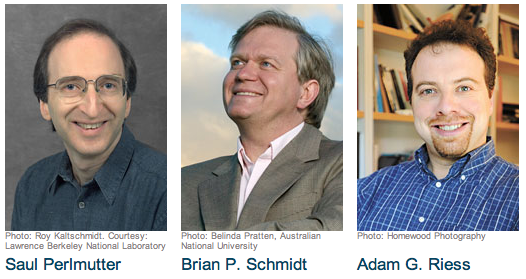
Photos of the 2011 Physics Nobel Prize Winners: Saul Perlmutter, Brian Schmidt and Adam Riess.

Photos of the 2011 Physics Nobel Prize Winners.

The Royal Swedish Academy of Sciences has decided to award the Nobel Prize in Physics for 2011 with one half to

Saul Perlmutter
The Supernova Cosmology Project, Lawrence Berkeley National Laboratory and University of California, Berkeley, CA, USA

and the other half jointly to

Brian P. Schmidt
The High-z Supernova Search Team, Australian National University, Weston Creek, Australia

and

Adam G. Riess
The High-z Supernova Search Team, Johns Hopkins University and Space Telescope Science Institute, Baltimore, MD, USA

“for the discovery of the accelerating expansion of the Universe through observations of distant supernovae”

Once again the USA dominates the physics category, Brian Schmidt is a USA and Australian citizen. It will be interesting to see if this starts to change in the next decade. I believe it will at some point fairly soon, the question is at what point.

“Some say the world will end in fire, some say in ice…” Robert Frost, Fire and Ice, 1920

What will be the final destiny of the Universe? Probably it will end in ice, if we are to believe this year’s Nobel Laureates in Physics. They have studied several dozen exploding stars, called supernovae, and discovered that the Universe is expanding at an ever-accelerating rate. The discovery came as a complete surprise even to the Laureates themselves.

In 1998, cosmology was shaken at its foundations as two research teams presented their findings. Headed by Saul Perlmutter, one of the teams had set to work in 1988. Brian Schmidt headed another team, launched at the end of 1994, where Adam Riess was to play a crucial role.

The research teams raced to map the Universe by locating the most distant supernovae. More sophisticated telescopes on the ground and in space, as well as more powerful computers and new digital imaging sensors (CCD, Nobel Prize in Physics in 2009), opened the possibility in the 1990s to add more pieces to the cosmological puzzle.

The teams used a particular kind of supernova, called type Ia supernova. It is an explosion of an old compact star that is as heavy as the Sun but as small as the Earth. A single such supernova can emit as much light as a whole galaxy. All in all, the two research teams found over 50 distant supernovae whose light was weaker than expected – this was a sign that the expansion of the Universe was accelerating. The potential pitfalls had been numerous, and the scientists found reassurance in the fact that both groups had reached the same astonishing conclusion.

For almost a century, the Universe has been known to be expanding as a consequence of the Big Bang about 14 billion years ago. However, the discovery that this expansion is accelerating is astounding. If the expansion will continue to speed up the Universe will end in ice.

The acceleration is thought to be driven by dark energy, but what that dark energy is remains an enigma – perhaps the greatest in physics today. What is known is that dark energy constitutes about three quarters of the Universe. Therefore the findings of the 2011 Nobel Laureates in Physics have helped to unveil a Universe that to a large extent is unknown to science. And everything is possible again.

As usually the Nobel committee does a great job of providing the public open scientific information. Others that claim to promote science can learn from them. They do a great job of making the science understandable to a lay person.

The discovery came as a complete surprise even to the Nobel Laureates themselves. What they saw would be like throwing a ball up in the air, and instead of having it come back down, watching as it disappears more and more rapidly into the sky, as if gravity could not manage to reverse the ball’s trajectory. Something similar seemed to be happening across the entire Universe.

The growing rate of the expansion implies that the Universe is being pushed apart by an unknown form of energy embedded in the fabric of space. This dark energy makes up a large part of the Universe, more than 70 %, and it is an enigma, perhaps the greatest in physics today. No wonder, then, that cosmology was shaken at its foundations when two different research groups presented similar results in 1998.

Related: The Nobel Prize in Physics 20092006 Nobel Prize in Physics2011 Nobel Prize in Physiology or MedicineIs Dark Matter an Illusion?5% of the Universe is Normal Matter, What About the Other 95%?
Continue reading

2011 Nobel Prize in Physiology or Medicine

The Nobel Assembly at Karolinska Institutet has today decided that The Nobel Prize in Physiology or Medicine 2011 shall be divided, with one half jointly to Bruce A. Beutler and Jules A. Hoffmann for their discoveries concerning the activation of innate immunity and the other half to Ralph M. Steinman for his discovery of the dendritic cell and its role in adaptive immunity.

This year’s Nobel Laureates have revolutionized our understanding of the immune system by discovering key principles for its activation.

Scientists have long been searching for the gatekeepers of the immune response by which man and other animals defend themselves against attack by bacteria and other microorganisms. Bruce Beutler and Jules Hoffmann discovered receptor proteins that can recognize such microorganisms and activate innate immunity, the first step in the body’s immune response. Ralph Steinman discovered the dendritic cells of the immune system and their unique capacity to activate and regulate adaptive immunity, the later stage of the immune response during which microorganisms are cleared from the body.

The discoveries of the three Nobel Laureates have revealed how the innate and adaptive phases of the immune response are activated and thereby provided novel insights into disease mechanisms. Their work has opened up new avenues for the development of prevention and therapy against infections, cancer, and inflammatory diseases.

We live in a dangerous world. Pathogenic microorganisms (bacteria, virus, fungi, and parasites) threaten us continuously but we are equipped with powerful defense mechanisms (please see image below). The first line of defense, innate immunity, can destroy invading microorganisms and trigger inflammation that contributes to blocking their assault. If microorganisms break through this defense line, adaptive immunity is called into action. With its T and B cells, it produces antibodies and killer cells that destroy infected cells. After successfully combating the infectious assault, our adaptive immune system maintains an immunologic memory that allows a more rapid and powerful mobilization of defense forces next time the same microorganism attacks. These two defense lines of the immune system provide good protection against infections but they also pose a risk. If the activation threshold is too low, or if endogenous molecules can activate the system, inflammatory disease may follow.

The components of the immune system have been identified step by step during the 20th century. Thanks to a series of discoveries awarded the Nobel Prize, we know, for instance, how antibodies are constructed and how T cells recognize foreign substances. However, until the work of Beutler, Hoffmann and Steinman, the mechanisms triggering the activation of innate immunity and mediating the communication between innate and adaptive immunity remained enigmatic.

Related: 2009 Nobel Prize in Physiology or MedicineNobel Prize in Physiology or Medicine 20082009 Nobel Prize in Chemistry: the Structure and Function of the Ribosome

photo of Ralph Steinman

Ralph Steinman was awarded the Nobel Prize for his discovery of the dendritic cell and its role in adaptive immunity. He was born in Canada and was a professor at Rockefeller University at the end of his career.

Continue reading

Faster Than Light Speed Anomaly Reported by CERN

The OPERA result is based on the observation of over 15000 neutrino events measured at Gran Sasso, and appears to indicate that the neutrinos travel at a velocity 20 parts per million above the speed of light, nature’s cosmic speed limit. Given the potential far-reaching consequences of such a result, independent measurements are needed before the effect can either be refuted or firmly established. This is why the OPERA collaboration has decided to open the result to broader scrutiny. The collaboration’s result is available on the preprint server arxiv.org.

The OPERA measurement is at odds with well-established laws of nature, though science frequently progresses by overthrowing the established paradigms. For this reason, many searches have been made for deviations from Einstein’s theory of relativity, so far not finding any such evidence. The strong constraints arising from these observations makes an interpretation of the OPERA measurement in terms of modification of Einstein’s theory unlikely, and give further strong reason to seek new independent measurements.

“This result comes as a complete surprise,” said OPERA spokesperson, Antonio Ereditato of the University of Bern. “After many months of studies and cross checks we have not found any instrumental effect that could explain the result of the measurement. While OPERA researchers will continue their studies, we are also looking forward to independent measurements to fully assess the nature of this observation.”

“When an experiment finds an apparently unbelievable result and can find no artefact of the measurement to account for it, it’s normal procedure to invite broader scrutiny, and this is exactly what the OPERA collaboration is doing, it’s good scientific practice,” said CERN Research Director Sergio Bertolucci. “If this measurement is confirmed, it might change our view of physics, but we need to be sure that there are no other, more mundane, explanations. That will require independent measurements.” This is a great reminder of the proper application of the scientific inquiry process. Our understanding moves forward based on evidence and incredible results require a high burden of proof before we accept them.

In order to perform this study, the OPERA Collaboration teamed up with experts in metrology from CERN and other institutions to perform a series of high precision measurements of the distance between the source and the detector, and of the neutrinos’ time of flight. The distance between the origin of the neutrino beam and OPERA was measured with an uncertainty of 20 cm over the 730 km travel path. The neutrinos’ time of flight was determined with an accuracy of less than 10 nanoseconds by using sophisticated instruments including advanced GPS systems and atomic clocks. The time response of all elements of the CNGS beam line and of the OPERA detector has also been measured with great precision.

“We have established synchronization between CERN and Gran Sasso that gives us nanosecond accuracy, and we’ve measured the distance between the two sites to 20 centimetres,” said Dario Autiero, the CNRS researcher who will give this afternoon’s seminar. “Although our measurements have low systematic uncertainty and high statistical accuracy, and we place great confidence in our results, we’re looking forward to comparing them with those from other experiments.”

“The potential impact on science is too large to draw immediate conclusions or attempt physics interpretations. My first reaction is that the neutrino is still surprising us with its mysteries.” said Ereditato. “Today’s seminar is intended to invite scrutiny from the broader particle physics community.”

The OPERA experiment was inaugurated in 2006, with the main goal of studying the rare transformation (oscillation) of muon neutrinos into tau neutrinos. One first such event was observed in 2010, proving the unique ability of the experiment in the detection of the elusive signal of tau neutrinos.

This is great stuff, wether it turns out to be an amazing result that changes our understanding of physics or even if it doesn’t (if it turns out the apparent result is not what it seems). It is great to see us attempt to learn. My guess is that we find some explanation for the anomaly that does avoids something traveling faster than the speed of light.

Brian Cox on the BBC 6: “This is the way science works, we go away and do it again and check, and then do it again and check. If it is confirmed then it will be the most significant discovery in physics in the last, at least, 100 years.”

Related: full press releaseThe Sun is a Miasma of Incandescent PlasmaGravity and the Scientific MethodMore Mysterious Space PhenomenonNeutrino particle traveling faster than light? Two ways it could rewrite physics

Amber Pieces Containing Remains from Dinosaurs and Birds Show Feather Evolution

Dinosaur feather evolution trapped in Canadian amber

a study of amber found near Grassy Lake in Alberta – dated from what is known as the Late Cretaceous period – has unearthed a full range of feather structures that demonstrate the progression. “We’re finding two ends of the evolutionary development that had been proposed for feathers trapped in the same amber deposit,” said Ryan McKellar of the University of Alberta, lead author of the report.

The team’s find confirms that the filaments progressed to tufts of filaments from a single origin, called barbs. In later development, some of these barbs can coalesce into a central branch called a rachis. As the structure develops further, further branches of filments form from the rachis.

“We’ve got feathers that look to be little filamentous hair-like feathers, we’ve got the same filaments bound together in clumps, and then we’ve got a series that are for all intents and purposes identical to modern feathers,” Mr McKellar told BBC News.

“We’re catching some that look to be dinosaur feathers and another set that are pretty much dead ringers for modern birds.”

a picture is emerging that many dinosaurs were not the dull-coloured, reptilian-skinned creatures that they were once thought to be. “If you were to transport yourself back 80 million years to western North America and walk around the forest… so many of the animals would have been feathered,” said Dr Norell.

“We’re getting more and more evidence… that these animals were also brightly coloured, just like birds are today.”

Very cool. Science really is great.

Related: Dino-Era Feathers Found Encased in Amber (2008)Dinosaur Remains Found with Intact Skin and TissueMarine Plankton From 100 Million Years Ago Found in AmberGiant Duck-Billed Dinosaur Discovered in Mexico

Is Dark Matter an Illusion?

Open access letter asks – Is dark matter an illusion created by the gravitational polarization of the quantum vaccum? by Dragan Slavkov Hajdukovic, CERN

Assuming that a particle and its antiparticle have the gravitational charge of the opposite sign, the physical vacuum may be considered as a fluid of virtual gravitational dipoles. Following this hypothesis, we present the first indications that dark matter may not exist and that the phenomena for which it was invoked might be explained by the gravitational polarization of the quantum vacuum by the known baryonic matter.

Let us start with a major unresolved problem. The measured galaxy rotation curves remain roughly constant at large radii. Faster than expected orbits, require a larger central force, which, in the framework of our theory of gravity, cannot be explained by the existing baryonic matter. The analogous problem persists also at the scale of clusters of galaxies.

The favoured solution is to assume that our current theory of gravity is correct, but every galaxy resides in a halo of dark matter made of unknown non-baryonic particles (for a brief review on dark matter see for instance: Einasto, 2010). A full list of the proposed dark matter particles would be longer than this letter; let us mention only weekly interacting massive particles and axions. In spite of the significant efforts dark particles have never been detected…

The scientific inquiry process continues to be used to try and explain the evidence we gather. Unsettled areas of science show how difficult the discovery process is. Once we have settled on theories it is so easy to explain why basic truths of evolution, geology, chemistry… result in what the evidence shows. But getting to the scientific consensus is a challenging process.


Dark Matter Is an Illusion, New Antigravity Theory Says

Physicist David Evans called the new study a “very interesting theoretical exercise,” but he said he isn’t ready to abandon dark matter just yet. “The evidence for dark matter is now very compelling,” said Evans, of the University of Birmingham, who leads the U.K. team for the ALICE detector at CERN’s Large Hadron Collider.

For example, in 2006 astronomers unveiled a photo of two colliding galaxies known as the Bullet cluster that purportedly showed the separation of matter from dark matter. A similar effect was observed in the Pandora cluster earlier this summer, said Evans, who was not involved in the study.

Hajdukovic said he is currently expanding his theory to account for these observations. His preliminary calculations, he said, suggest that “what is observed in the Bullet cluster and more recently at the Pandora cluster may be understood in the framework of the gravitational polarization of the quantum vacuum.”

CERN physicist Michael Doser agreed that Hajdukovic’s ideas are “unorthodox” but did not immediately dismiss the new theory…
“In a few years,” Doser said, “we should definitely be in a position to confirm or refute [Hajdukovic’s] hypothesis.”

Related: The Mystery of Empty SpaceWhy do we Need Dark Energy to Explain the Observable Universe?Dark Matter Experiment ResultsLooking for Signs of Dark Matter Over Antarctica

The Politics of Anti-Science

In the 1960’s the USA had an unrealistic view of how much studying and learning about science and engineering could do. Investing is science and engineering is an extremely wise economic (and cultural) endeavor but it isn’t going to solve all the problems that exist. Somehow today we find ourselves with a large number of politically powerful people we take strong anti-science positions. These tactics reduce funding and support for beneficial research and are short sited approaches to public administration. This is an unfortunate turn of events that is damaging the American economy and will have huge damages going forward.

Thankfully other countries have seen how wise investing in science and engineering is and have more than taken up the slack created by the anti-science community. Two favorite tactics of the anti-science leaders is to try and create confusion where there is none and to turn the focus away from serious matters and instead playing silly political games. The silly games will draw donors and voters so if they care about those things more than the country and the future of the country it is a sound tactic. The damage it causes the country however I would hope would limit the use of such tactics however that has not been the case recently.

‘Shrimp On A Treadmill’: The Politics Of ‘Silly’ Studies

Take the case of the “shrimp on a treadmill.” Burnett says the senator’s report linked that work to a half-million-dollar research grant. But that money actually went to a lot of different research that he and his colleagues did on this economically important seafood species.

The treadmills were just a small part of it, a way to measure how shrimp respond to changes in water quality. Burnett says the first treadmill was built by a colleague from scraps and was basically free, and the second was fancier and cost about $1,000. The senator’s report was misleading, says Burnett, “and it suggests that much money was spent on seeing how long a shrimp can run on a treadmill, which was totally out of context.”

John Hart, a Coburn spokesperson, said in an email that “our report never claimed all the money was spent on shrimp on a treadmill. The scientists doth protest too much. Receiving federal funds is a privilege, not a right. If they don’t want their funding scrutinized, don’t ask.”

What the politicians are doing is exactly what this spokesperson suggests – they are withdrawing from the anti-science culture created by some in Washington: they are moving their research to countries that support rather than attack science. That is a very bad thing for the USA. There are a number of very bad economic policies a government can take. Driving scientists and engineers into the arms of other countries is one of the worst.
Continue reading