Tag Archives: Research

Insightful Problem Solving in an Asian Elephant

Another example of very cool animal behavior. This Asian Elephant, seemed to consider the problem, devise a solution and then go get a stool to reach food that could not be reached without a tool.

Insightful Problem Solving in an Asian Elephant

The “aha” moment or the sudden arrival of the solution to a problem is a common human experience. Spontaneous problem solving without evident trial and error behavior in humans and other animals has been referred to as insight. Surprisingly, elephants, thought to be highly intelligent, have failed to exhibit insightful problem solving in previous cognitive studies. We tested whether three Asian elephants (Elephas maximus) would use sticks or other objects to obtain food items placed out-of-reach and overhead. Without prior trial and error behavior, a 7-year-old male Asian elephant showed spontaneous problem solving by moving a large plastic cube, on which he then stood, to acquire the food. In further testing he showed behavioral flexibility, using this technique to reach other items and retrieving the cube from various locations to use as a tool to acquire food. In the cube’s absence, he generalized this tool utilization technique to other objects and, when given smaller objects, stacked them in an attempt to reach the food. The elephant’s overall behavior was consistent with the definition of insightful problem solving. Previous failures to demonstrate this ability in elephants may have resulted not from a lack of cognitive ability but from the presentation of tasks requiring trunk-held sticks as potential tools, thereby interfering with the trunk’s use as a sensory organ to locate the targeted food.

Further inspired by Köhler’s chimpanzee studies, in experiment 4 we conducted 8 additional sessions to investigate whether Kandula would stack items to reach food. For these sessions, the baited branches were hung at a height that could be reached by stacking three butcher block cutting boards or by the use of other objects. In addition, the elephant was given sticks and other enrichment items. Kandula first touched several items and then moved two items, a plastic disk and a block under the suspended branches, placing one front foot on each in an unsuccessful attempt to reach for the branch. He solved the problem in an unexpected novel manner, moving and standing on the object closest in size to the absent cube, a large ball. Standing on unstable platforms such as this had not been previously observed. He repeated this behavior 9 times during this session. During the session’s last minutes, Kandula picked up a block ~2 m from the food and placed it directly on top of a block that he placed under the food in a previous attempt. He stood on the stacked blocks and attempted to reach the food but was unsuccessful. He stacked two blocks again in the second and sixth sessions but each time his trunk was several inches from the food.

This is very cool research. I do wonder why they didn’t provide more videos (and in a more user-friendly format than .mov files). I made them available via YouTube.

It seems like a very interesting area to have more experiments with more elephants (and continuing to work with Kandula: he seems to be very curious elephant, good for him).

Related: Orangutan Attempts to Hunt Fish with SpearBird Using Bait to Catch FishCrows Transferring Their Understanding to Novel ProblemCapuchin Monkeys Using Stone ToolsFighting Elephant Poaching With SciencePhoto of Fish Using a Rock to Open a Clam
Continue reading
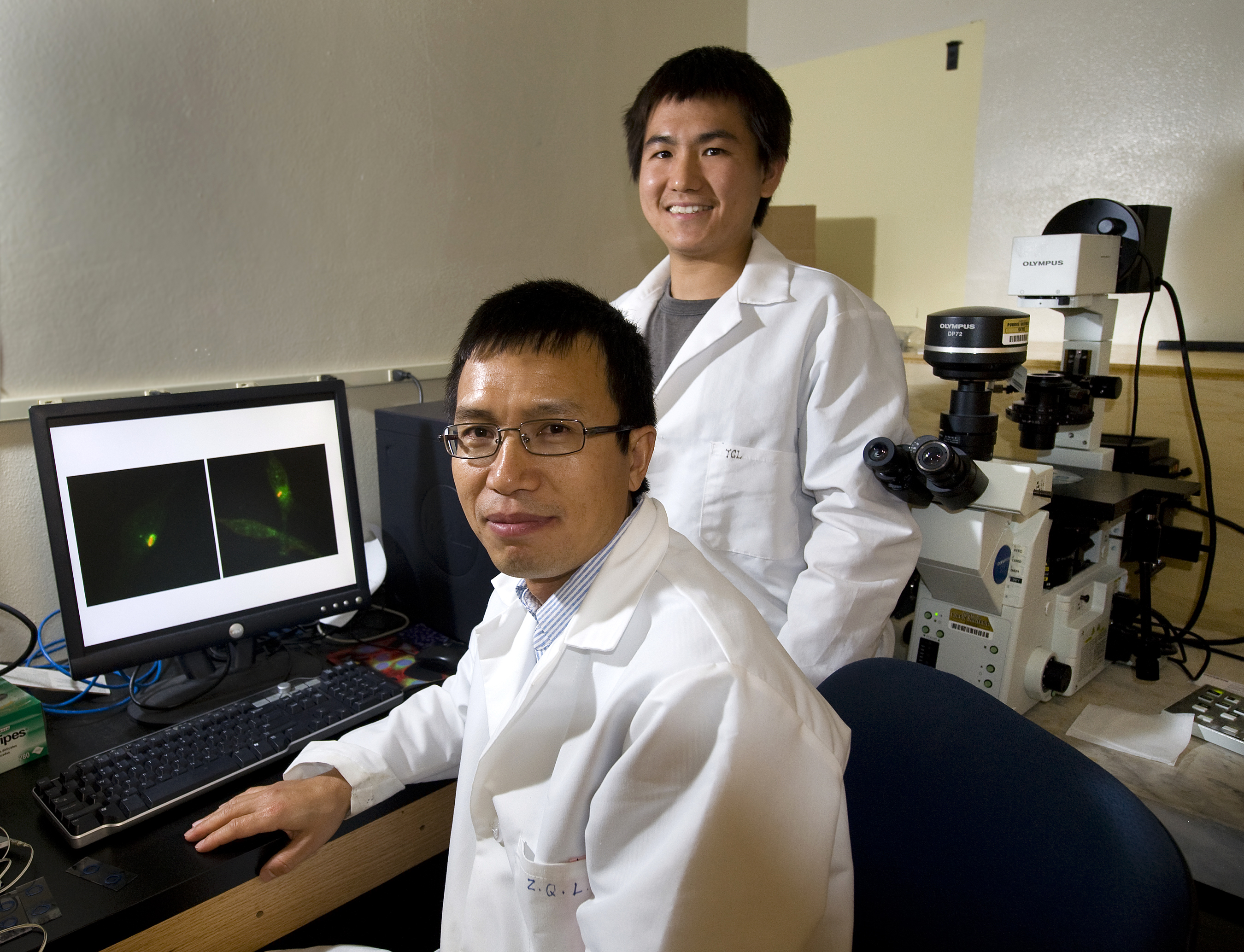
Biologists Identified a New Way in Which Bacteria Hijack Healthy Cells

photo of Zhao-Qing Luo and Yunhao Tan

Associate professor of biological sciences Zhao-Qing Luo, foreground, and graduate student Yunhao Tan identified a new way in which bacteria modify healthy cells during infection. Shown on the computer screen are cells infected with a mutant strain of the bacteria Legionella pneumophila used in their research.

Purdue University biologists identified a new way in which bacteria hijack healthy cells during infection, which could provide a target for new antibiotics. Zhao-Qing Luo, the associate professor of biological sciences who led the study, said the team discovered a new enzyme used by the bacterium Legionella pneumophila – which causes Legionnaires’ disease – to control its host cell in order to take up residence.

“Legionnaires’ disease is a severe form of pneumonia, and this finding could lead to the design of a new therapy that saves lives,” Luo said. “At the same time it also provides great insight into a general mechanism of both bacterial infection and cell signaling events in higher organisms including humans.”

Successful infection by Legionella pneumophila requires the delivery of hundreds of proteins into the host cells that alter various functions to turn the naturally hostile environment into one tailor-made for bacterial replication. These proteins tap into existing communication processes within the cells in which an external signal, such as a hormone, triggers a cascade of slight modifications to proteins that eventually turns on a gene that changes the cell’s behavior, he said.

“Pathogens are successful because they know how information in our cells is relayed and they amplify some signals and block others in order to evade the immune system and keep the cell from defending itself,” Luo said. “Despite our understanding of this, we do not know much about how the proteins delivered by the bacteria accomplish this – how they work. This time we were able to pinpoint an enzyme and see how it disrupted and manipulated a specific signaling pathway in order to create a better environment for itself.”

The signaling pathway involved was only recently identified, and the discovery by Luo and graduate student Yunhao Tan also provides a key insight into its process. The signaling pathway involves a new form of protein modification called AMPylation in order to relay instructions to change cell behavior and has been found to be used by almost all organisms, Luo said.

The bacterium affects the host cell’s functions differently during different phases of the infection process, tapping into signaling pathways to turn on and off certain natural cellular activities. SidD stops the AMPylation process four hours after the start of infection in order to reverse an earlier modification that would be detrimental to the cell if left in place, he said.

Read the full press release.

Related: Using Bacteria to Carry Nanoparticles Into CellsDisrupting Bacterial Communication to Thwart ThemScientists Target Bacteria Where They LiveAre you ready for a world without antibiotics?

H-index Rank for Countries: for Science Publications

The SCImago Journal and Country Rank provides journal and country scientific indicators. As stated in previous posts, these types of rankings have limitations but they are also interesting. The table shows the top 6 countries by h-index and then some others I chose to list (the top 6 repeat from my post in 2008 – Country H-index Rank for Science Publications). The h-index provides a numeric indication of scientific production and significance (by looking at the citations given papers by other papers). Read more about the h-index (Hirsh index).

Country h-index h-index (2007) % of World
Population
total Cites
USA

1,139 793     4.5% 87,296,701
United Kingdom

689 465     .9% 21,030,171
Germany

607 408     1.2% 17,576,464
France

554 376     1.0% 12,168,898
Canada

536 370     .5% 10,375,245
Japan

527 372     1.8% 14,341,252
Additional countries of interest
18) China

279 161 19.4% 5,614,294
21) South Korea

258 161     .7% 2,710,566
22) Brazil

239 148  2.8% 1,970,704
25) India

227 146 17.5% 2,590,791
31) Singapore

196 .01% 871,512

Related: Top Countries for Science and Math Education: Finland, Hong Kong and KoreaWorldwide Science and Engineering Doctoral Degree Data Top 15 Manufacturing Countries in 2009Science and Engineering Doctoral Degrees WorldwideRanking Universities Worldwide (2008)Government Debt as Percentage of GDP 1990-2009: USA, Japan, Germany, China…

5% of the Universe is Normal Matter, What About the Other 95%?

Dark Matters from PHD Comics on Vimeo.

Great discussion and illustration of the state of our understanding of physics, matter, dark matter and the rest of the stuff our universe has from PhD comics. What is the universe made of? 5% of it is normal matter (the stardust we are made of), 20% dark matter and the other 75% – we have no idea!

Dark Cosmos is a nice book on some of these ideas. It is 5 years old so missing some of the latest discoveries.

Related: Why do we Need Dark Energy to Explain the Observable Universe?The Mystery of Empty SpaceFriday Fun, CERN Version
Continue reading

New Analysis of Primordial Soup Experiment Half a Century Later

Open access paper: Primordial synthesis of amines and amino acids in a 1958 Miller H2S-rich spark discharge experiment

Archived samples from a previously unreported 1958 Stanley Miller electric discharge experiment containing hydrogen sulfide (H2S) were recently discovered and analyzed using high-performance liquid chromatography and time-of-flight mass spectrometry. We report here the detection and quantification of primary amine-containing compounds in the original sample residues, which were produced via spark discharge using a gaseous mixture of H2S, CH4, NH3, and CO2. A total of 23 amino acids and 4 amines, including 7 organosulfur compounds, were detected in these samples.

The major amino acids with chiral centers are racemic within the accuracy of the measurements, indicating that they are not contaminants introduced during sample storage. This experiment marks the first synthesis of sulfur amino acids from spark discharge experiments designed to imitate primordial environments. The relative yield of some amino acids, in particular the isomers of aminobutyric acid, are the highest ever found in a spark discharge experiment.

The simulated primordial conditions used by Miller may serve as a model for early volcanic plume chemistry and provide insight to the possible roles such plumes may have played in abiotic organic synthesis. Additionally, the overall abundances of the synthesized amino acids in the presence of H2S are very similar to the abundances found in some carbonaceous meteorites, suggesting that H2S may have played an important role in prebiotic reactions in early solar system environments.

Related: All present-day Life on Earth Has A Single AncestorLife Untouched by the SunAmazing Designs of LifeAlbert Einstein, Marylin Monroe Hybrid Image

Evidence of Extraterrestrial Life Discovered?

Has evidence of extraterrestrial life been discovered? In Fossils of Cyanobacteria in CI1 Carbonaceous Meteorites , Richard B. Hoover, Ph.D. NASA/Marshall Space Flight Center, puts forth his evidence on the discovery of evidence of cyanobacteria in meteorites.

Dr. Hoover has discovered evidence of microfossils similar to Cyanobacteria, in freshly fractured slices of the interior surfaces of the Alais, Ivuna, and Orgueil CI1 carbonaceous meteorites. Based on Field Emission Scanning Electron Microscopy (FESEM) and other measures, Dr. Hoover has concluded they are indigenous to these meteors and are similar to trichomic cyanobacteria and other trichomic prokaryotes such as filamentous sulfur bacteria. He concludes these fossilized bacteria are not Earthly contaminants but are the fossilized remains of living organisms which lived in the parent bodies of these meteors, e.g. comets, moons, and other astral bodies. The implications are that life is everywhere, and that life on Earth may have come from other planets.

The importance of this claim is hard to ignore. The journal includes a statement from Dr. Rudy Schild, Center for Astrophysics, Harvard-Smithsonian, Editor-in-Chief, Journal of Cosmology:

Dr. Richard Hoover is a highly respected scientist and astrobiologist with a prestigious record of accomplishment at NASA. Given the controversial nature of his discovery, we have invited 100 experts and have issued a general invitation to over 5000 scientists from the scientific community to review the paper and to offer their critical analysis. Our intention is to publish the commentaries, both pro and con, alongside Dr. Hoover’s paper. In this way, the paper will have received a thorough vetting, and all points of view can be presented. No other paper in the history of science has undergone such a thorough analysis, and no other scientific journal in the history of science has made such a profoundly important paper available to the scientific community, for comment, before it is published. We believe the best way to advance science, is to promote debate and discussion.

Read the full paper.

The filaments have been observed to be embedded in freshly fractured internal surfaces of the stones. They exhibit features (e.g., the size and size ranges of the internal cells and their location and arrangement within sheaths) that are diagnostic of known genera and species of trichomic cyanobacteria and other trichomic prokaryotes such as the filamentous sulfur bacteria. ESEM and FESEM studies of living and fossil cyanobacteria show similar features in uniseriate and multiseriate, branched or unbranched, isodiametric or tapered, polarized or unpolarized filaments with trichomes encased within thin or thick external sheaths. Filaments found in the CI1 meteorites have also been detected that exhibit structures consistent with the specialized cells and structures used by cyanobacteria for reproduction (baeocytes, akinetes and hormogonia), nitrogen fixation (basal, intercalary or apical heterocysts) and attachment or motility (fimbriae).

These studies have led to the conclusion that the filaments found in the CI1 carbonaceous meteorites are indigenous fossils rather than modern terrestrial biological contaminants that entered the meteorites after arrival on Earth. The δ13C and D/H content of amino acids and other organics found in these stones are shown to be consistent with the interpretation that comets represent the parent bodies of the CI1 carbonaceous meteorites. The implications of the detection of fossils of cyanobacteria in the CI1 meteorites to the possibility of life on comets, Europa and Enceladus are discussed.

Has life been found in a meteorite? by Phil Plait
Continue reading

Lobopodians from China a Few Million Years Ago

image of a lobopodian fosil nicknamed the walking cactus

image of a lobopodian fosil from Nature

Cactus Walking On 20 Legs Found In China

There was a wild period — roughly 520 million years ago — when life, for no obvious reason, burst into a crazy display of weird new fantastic forms — producing creatures in shapes never seen before or since. Consider this animal, the newest fossil discovery from Jianni Liu in China. She calls it “the walking cactus.”

This is not a plant, not a sculpture. It was a live animal, with no eyes, what may or may not be a head, mostly a gaggle of limbs, armor-plated, covered in thorns, attached to a stomach.

What is it? Taxonomically, Jianni Liu thinks it’s a lobopodian, a group of animals described as “worms with legs.” Lobopodians are about the craziest looking critters that ever lived. A whole zoo of them appear in the rocks around Chengjiang, China.

All we know, says Richard Fortey in his classic history Life, is that a long time ago, the first of these strange animals popped into view and for a short while “there was a chain reaction, unstoppable once it started, a bacchanalia of zoological inventiveness, which has never been matched again.”

Every living thing on earth today is what’s left over from that amazing burst of forms. It’s true we now live on land and in the air, not just in the sea. We have grasses and flowers and beetles in more varieties than you can imagine, and yet, in some deep architectural way, the developmental paths were set way back then, 500 million years ago. The Walking Cactus is just another souvenir of that crazy moment.

Very cool. Actual science is so full of such interesting things. The Cambrian explosion of life, about 540-490 million years ago, marked the beginning of complex life on earth. Before Cambrian, the sea floor was covered by microbial mats. By the end of the period, burrowing animals had destroyed the mats through bioturbation, and gradually turned the seabeds into what they are today. Generally it is accepted that there were no land plants at this time, although it is likely that a microbial “scum” comprising fungi, algae, and possibly lichens covered the land.

Complex organisms gradually became more common in the millions of years immediately preceding the Cambrian, but it was not until this period that mineralized (readily fossilized) organisms became common. Before about 580 million years ago, most organisms were simple, composed of individual cells occasionally organized into colonies. Over the following 70 or 80 million years the rate of evolution accelerated by an order of magnitude (as defined in terms of the extinction and origination rate of species) and the diversity of life began to resemble today’s.

Related: 500 Million-year-old Stromatolite FossilFossils of Sea MonsterDinosaur Remains Found with Intact Skin and TissueAncient Whale Uncovered in Egyptian DesertSouth African Fossils Could be New Hominid Species

Red-light Cameras Save Lives, Could Save More if Used in More Cities

Red light cameras saved 159 lives in 2004-08 in 14 of the biggest US cities, a new analysis by the Insurance Institute for Highway Safety shows. Had cameras been operating during that period in all large cities, a total of 815 deaths would have been prevented.

“The cities that have the courage to use red light cameras despite the political backlash are saving lives,” says Institute president Adrian Lund. The researchers found that in the 14 cities that had cameras during 2004-08, the combined per capita rate of fatal red light running crashes fell 35 percent, compared with 1992-96. The rate also fell in the 48 cities without camera programs in either period, but only by 14 percent.

The rate of all fatal crashes at intersections with signals — not just red light running crashes — fell 14 percent in the camera cities and crept up 2 percent in the noncamera cities. In the camera cities, there were 17 percent fewer fatal crashes per capita at intersections with signals in 2004-08 than would have been expected. That translates into 159 people who are alive because of the automated enforcement programs.

This result shows that red light cameras reduce not only fatal red light running crashes, but other types of fatal intersection crashes as well. One possible reason for this is that red light running fatalities are undercounted due to a lack of witnesses to explain what happened in a crash. Drivers also may be more cautious in general when they know there are cameras around.

Based on these calculations, if red light cameras had been in place for all 5 years in all 99 US cities with populations over 200,000, a total of 815 deaths could have been avoided.

“Somehow, the people who get tickets because they have broken the law have been cast as the victims,” Lund says. “We rarely hear about the real victims — the people who are killed or injured by these lawbreakers.” Red light running killed 676 people and injured an estimated 113,000 in 2009. Nearly two-thirds of the deaths were people other than the red light running drivers — occupants of other vehicles, passengers in the red light runners’ vehicles, bicyclists, or pedestrians.

Previous research has established that red light cameras deter would-be violators and reduce crashes at intersections with signals. Institute studies of camera programs have found that red light violations fell at intersections where cameras were installed and that this effect also spilled over to intersections without cameras. An Institute study in Oxnard, Calif., found that injury crashes at intersections with traffic signals fell 29 percent citywide after automated enforcement began.

The new study adds to this by showing that cameras reduce not only violations and crashes throughout entire communities but deaths, too.

Red-light cameras save lives, study says

The 2.2 million intersection crashes recorded in 2009 made up about 41 percent of all accidents. They resulted in 81,112 serious injuries and 7,358 deaths. Police established red-light running as the cause of 676 deaths and 113,000 injuries. The vast majority of the people who died – 64 percent – were not driving the vehicle that ran the light. They were passengers, other drivers, pedestrians and cyclists.

Related: D.C. Red-Light Cameras Fail to Curb AccidentsDo Red Light Cameras Make for Safer Intersections?Traffic Congestion and a Non-SolutionEngineering a Better Blood Alcohol Sensor

Molten Salt Solar Reactor Approved by California

California has approved a molten salt solar reactor project. The plan is for a 150-megawatt solar power tower project. From the press release: the “Solar Energy Project has the ability to collect and store enough thermal energy each morning to operate at full power all afternoon and for up to 8 hours after sunset. The game-changing technology featuring inherent energy storage affords utilities with a generator that performs with the reliability and dispatchability of a conventional power generator without harmful emissions that are associated with burning coal, natural gas and oil.”

diagram of solar energy project using molton salt

molten salt solar system diagram

The heliostats focus concentrated sunlight on a receiver which sits on top of the tower. Within the receiver, the concentrated sunlight heats molten salt to over 1000 degrees Fahrenheit. The heated molten salt then flows into a thermal storage tank where it is stored, maintaining 98% thermal efficiency, and eventually pumped to a steam generator. The steam drives a standard turbine to generate electricity. This process, also known as the “Rankine cycle” is similar to a standard coal-fired power plant, except it is fueled by clean and free solar energy.

This is another green energy project that has a great deal of potential. There is a great need for such new energy sources and hopefully quite a few of these projects will let us enjoy a greener and more sustainable way to meet our future energy needs.

For those interested in the business aspects of this energy project: United Technologies provided SolarReserve with an exclusive worldwide license to develop projects using the proprietary molten salt power tower technology, which has been in development for nearly three decades.

Related: Solar Thermal in Desert, to Beat Coal by 2020Wind Power Capacity Up 170% Worldwide from 2005-2009Cost Efficient Solar Dish by StudentsSolar Tower Power Generation

Scientific Inquiry: Arsenic for Phosphorus in Bacteria Cells

As would be expected with significant new scientific claims, scientists are examining the evidence. On her blog, Rosie Redfield, who runs a microbiology research lab in the Life Sciences Centre at the University of British Columbia, disputes NASA’s recent claims. This is how science is suppose to work. Scientists provide evidence. Other scientists review the evidence, try to verify the claims with experiments of their own and the scientific inquiry process moves toward new knowledge.

Arsenic-associated bacteria (NASA’s claims)

NASA’s shameful analysis of the alleged bacteria in the Mars meteorite made me very suspicious of their microbiology, an attitude that’s only strengthened by my reading of this paper. Basically, it doesn’t present ANY convincing evidence that arsenic has been incorporated into DNA (or any other biological molecule).

The authors then grew some cells with radioactive arsenate (73-As) and no phosphate, washed and dissolved them, and used extraction with phenol and phenol:chloroform to separate the major macromolecules. The protein fraction at the interface between the organic and aqueous phases had about 10% of the arsenic label but, because the interface material is typically contaminated with liquid from the aqueous phase, this is not good evidence that the cells’ protein contained covalently-bound arsenate in place of phosphorus. About 75% of the arsenic label was in the ‘supernatant ‘fraction. The authors describe this fraction as DNA/RNA, but it also contains most of the small water-soluble molecules of the cell, so its high arsenic content is not evidence that the DNA and RNA contain arsenic in place of phosphorus. The authors use very indirect evidence to argue that the distribution of arsenic mirrors that expected for phosphate, but this argument depends on so many assumptions that it should be ignored.

I don’t know whether the authors are just bad scientists or whether they’re unscrupulously pushing NASA’s ‘There’s life in outer space!’ agenda. I hesitate to blame the reviewers, as their objections are likely to have been overruled by Science’s editors in their eagerness to score such a high-impact publication.

New claims have to provide strong evidence. time will tell if this discovery is actually a discovery. It will be amazing if it is, so I am pulling for it. But the story will need to have much more confirmation before we can be certain.

Arsenate-based DNA: a big idea with big holes

The study published in Science has a number of flaws. In particular, one subtle but critical piece of evidence has been overlooked, and it demonstrates that the DNA in question actually has a phosphate – not an arsenate -backbone.

Wolfe-Simon et al. used a technique called nanoSIMS to analyze elemental concentrations of the agarose gel at the location of the DNA band. They determined that the part of the gel containing DNA also contained both arsenic and phosphorus. But what did they really analyze?

The answer is that the nanoSIMS determined the concentration of arsenic in the gel – not specifically in the DNA.

Finally, there’s a simple experiment that could resolve this debate: analyze the nucleotides directly. Show a mass spectrum of DNA sequences demonstrating that nucleotides contain arsenate instead of phosphate. This is a very simple experiment, and would be quite convincing – but it has not been performed.

Related: It’s not an arsenic-based life formMono Lake bacteria build their DNA using arsenicClose Encounters of the Media Kind