Tag Archives: Science

A Possible Explanation for the Faster Than Light Result Anomaly

Faster-than-Light Neutrino Puzzle Claimed Solved by Special Relativity

So what is the satellites’ motion with respect to the OPERA experiment? These probes orbit from West to East in a plane inclined at 55 degrees to the equator. Significantly, that’s roughly in line with the neutrino flight path. Their relative motion is then easy to calculate.

So from the point of view of a clock on board a GPS satellite, the positions of the neutrino source and detector are changing. “From the perspective of the clock, the detector is moving towards the source and consequently the distance travelled by the particles as observed from the clock is shorter,” says van Elburg.

By this he means shorter than the distance measured in the reference frame on the ground.

The OPERA team overlooks this because it thinks of the clocks as on the ground not in orbit.

How big is this effect? Van Elburg calculates that it should cause the neutrinos to arrive 32 nanoseconds early. But this must be doubled because the same error occurs at each end of the experiment. So the total correction is 64 nanoseconds, almost exactly what the OPERA team observes.

It is great to see the scientific process at work. Those is support of the scientific method support open access science and this explanation is available via arxiv: Times Of Flight Between A Source And A Detector Observed From A GPS Satellite.

Related: Faster Than Light Speed Anomaly Reported by CERNMore Dark Matter Experiment ResultsThe Architecture of Access to Scientific Knowledge

2011 Nobel Prize in Chemistry

photo of Dan Shechtman

Dan Shechtman, Israel Institute of Technology, 2011 Nobel Laurette in Chemistry

The Royal Swedish Academy of Sciences has decided to award the Nobel Prize in Chemistry for 2011 to Dan Shechtman, Technion – Israel Institute of Technology, Haifa, Israel for the discovery of quasicrystals.

In quasicrystals, we find the fascinating mosaics reproduced at the level of atoms: regular patterns that never repeat themselves. However, the configuration found in quasicrystals was considered impossible, and Dan Shechtman had to fight a fierce battle against established science. The Nobel Prize in Chemistry 2011 has fundamentally altered how chemists conceive of solid matter.

On the morning of 8 April 1982, an image counter to the laws of nature appeared in Dan Shechtman’s electron microscope. In all solid matter, atoms were believed to be packed inside crystals in symmetrical patterns that were repeated periodically over and over again. For scientists, this repetition was required in order to obtain a crystal.

Shechtman’s image, however, showed that the atoms in his crystal were packed in a pattern that could not be repeated. Such a pattern was considered just as impossible as creating a football using only six-cornered polygons, when a sphere needs both five- and six-cornered polygons. His discovery was extremely controversial. In the course of defending his findings, he was asked to leave his research group. However, his battle eventually forced scientists to reconsider their conception of the very nature of matter.

Aperiodic mosaics, such as those found in the medieval Islamic mosaics of the Alhambra Palace in Spain and the Darb-i Imam Shrine in Iran, have helped scientists understand what quasicrystals look like at the atomic level. In those mosaics, as in quasicrystals, the patterns are regular – they follow mathematical rules – but they never repeat themselves.

When scientists describe Shechtman’s quasicrystals, they use a concept that comes from mathematics and art: the golden ratio. This number had already caught the interest of mathematicians in Ancient Greece, as it often appeared in geometry. In quasicrystals, for instance, the ratio of various distances between atoms is related to the golden mean.

Following Shechtman’s discovery, scientists have produced other kinds of quasicrystals in the lab and discovered naturally occurring quasicrystals in mineral samples from a Russian river. A Swedish company has also found quasicrystals in a certain form of steel, where the crystals reinforce the material like armor. Scientists are currently experimenting with using quasicrystals in different products such as frying pans and diesel engines.

Related: 2009 Nobel Prize in Chemistry: the Structure and Function of the RibosomeThe Nobel Prize in Chemistry 2008Nobel Prize in Chemistry (2006)

Read more on the science he has worked on. Our understanding of science is built on the discoveries of our predecessors and on the discoveries that counter what we thought we knew.
Continue reading

2011 Nobel Prize in Physics

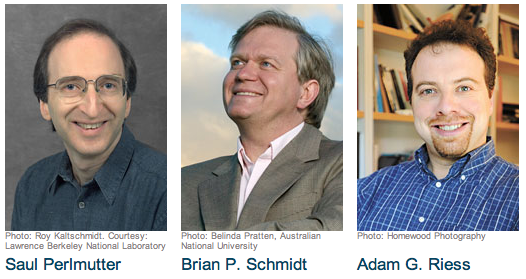
Photos of the 2011 Physics Nobel Prize Winners: Saul Perlmutter, Brian Schmidt and Adam Riess.

Photos of the 2011 Physics Nobel Prize Winners.

The Royal Swedish Academy of Sciences has decided to award the Nobel Prize in Physics for 2011 with one half to

Saul Perlmutter
The Supernova Cosmology Project, Lawrence Berkeley National Laboratory and University of California, Berkeley, CA, USA

and the other half jointly to

Brian P. Schmidt
The High-z Supernova Search Team, Australian National University, Weston Creek, Australia

and

Adam G. Riess
The High-z Supernova Search Team, Johns Hopkins University and Space Telescope Science Institute, Baltimore, MD, USA

“for the discovery of the accelerating expansion of the Universe through observations of distant supernovae”

Once again the USA dominates the physics category, Brian Schmidt is a USA and Australian citizen. It will be interesting to see if this starts to change in the next decade. I believe it will at some point fairly soon, the question is at what point.

“Some say the world will end in fire, some say in ice…” Robert Frost, Fire and Ice, 1920

What will be the final destiny of the Universe? Probably it will end in ice, if we are to believe this year’s Nobel Laureates in Physics. They have studied several dozen exploding stars, called supernovae, and discovered that the Universe is expanding at an ever-accelerating rate. The discovery came as a complete surprise even to the Laureates themselves.

In 1998, cosmology was shaken at its foundations as two research teams presented their findings. Headed by Saul Perlmutter, one of the teams had set to work in 1988. Brian Schmidt headed another team, launched at the end of 1994, where Adam Riess was to play a crucial role.

The research teams raced to map the Universe by locating the most distant supernovae. More sophisticated telescopes on the ground and in space, as well as more powerful computers and new digital imaging sensors (CCD, Nobel Prize in Physics in 2009), opened the possibility in the 1990s to add more pieces to the cosmological puzzle.

The teams used a particular kind of supernova, called type Ia supernova. It is an explosion of an old compact star that is as heavy as the Sun but as small as the Earth. A single such supernova can emit as much light as a whole galaxy. All in all, the two research teams found over 50 distant supernovae whose light was weaker than expected – this was a sign that the expansion of the Universe was accelerating. The potential pitfalls had been numerous, and the scientists found reassurance in the fact that both groups had reached the same astonishing conclusion.

For almost a century, the Universe has been known to be expanding as a consequence of the Big Bang about 14 billion years ago. However, the discovery that this expansion is accelerating is astounding. If the expansion will continue to speed up the Universe will end in ice.

The acceleration is thought to be driven by dark energy, but what that dark energy is remains an enigma – perhaps the greatest in physics today. What is known is that dark energy constitutes about three quarters of the Universe. Therefore the findings of the 2011 Nobel Laureates in Physics have helped to unveil a Universe that to a large extent is unknown to science. And everything is possible again.

As usually the Nobel committee does a great job of providing the public open scientific information. Others that claim to promote science can learn from them. They do a great job of making the science understandable to a lay person.

The discovery came as a complete surprise even to the Nobel Laureates themselves. What they saw would be like throwing a ball up in the air, and instead of having it come back down, watching as it disappears more and more rapidly into the sky, as if gravity could not manage to reverse the ball’s trajectory. Something similar seemed to be happening across the entire Universe.

The growing rate of the expansion implies that the Universe is being pushed apart by an unknown form of energy embedded in the fabric of space. This dark energy makes up a large part of the Universe, more than 70 %, and it is an enigma, perhaps the greatest in physics today. No wonder, then, that cosmology was shaken at its foundations when two different research groups presented similar results in 1998.

Related: The Nobel Prize in Physics 20092006 Nobel Prize in Physics2011 Nobel Prize in Physiology or MedicineIs Dark Matter an Illusion?5% of the Universe is Normal Matter, What About the Other 95%?
Continue reading

2011 Nobel Prize in Physiology or Medicine

The Nobel Assembly at Karolinska Institutet has today decided that The Nobel Prize in Physiology or Medicine 2011 shall be divided, with one half jointly to Bruce A. Beutler and Jules A. Hoffmann for their discoveries concerning the activation of innate immunity and the other half to Ralph M. Steinman for his discovery of the dendritic cell and its role in adaptive immunity.

This year’s Nobel Laureates have revolutionized our understanding of the immune system by discovering key principles for its activation.

Scientists have long been searching for the gatekeepers of the immune response by which man and other animals defend themselves against attack by bacteria and other microorganisms. Bruce Beutler and Jules Hoffmann discovered receptor proteins that can recognize such microorganisms and activate innate immunity, the first step in the body’s immune response. Ralph Steinman discovered the dendritic cells of the immune system and their unique capacity to activate and regulate adaptive immunity, the later stage of the immune response during which microorganisms are cleared from the body.

The discoveries of the three Nobel Laureates have revealed how the innate and adaptive phases of the immune response are activated and thereby provided novel insights into disease mechanisms. Their work has opened up new avenues for the development of prevention and therapy against infections, cancer, and inflammatory diseases.

We live in a dangerous world. Pathogenic microorganisms (bacteria, virus, fungi, and parasites) threaten us continuously but we are equipped with powerful defense mechanisms (please see image below). The first line of defense, innate immunity, can destroy invading microorganisms and trigger inflammation that contributes to blocking their assault. If microorganisms break through this defense line, adaptive immunity is called into action. With its T and B cells, it produces antibodies and killer cells that destroy infected cells. After successfully combating the infectious assault, our adaptive immune system maintains an immunologic memory that allows a more rapid and powerful mobilization of defense forces next time the same microorganism attacks. These two defense lines of the immune system provide good protection against infections but they also pose a risk. If the activation threshold is too low, or if endogenous molecules can activate the system, inflammatory disease may follow.

The components of the immune system have been identified step by step during the 20th century. Thanks to a series of discoveries awarded the Nobel Prize, we know, for instance, how antibodies are constructed and how T cells recognize foreign substances. However, until the work of Beutler, Hoffmann and Steinman, the mechanisms triggering the activation of innate immunity and mediating the communication between innate and adaptive immunity remained enigmatic.

Related: 2009 Nobel Prize in Physiology or MedicineNobel Prize in Physiology or Medicine 20082009 Nobel Prize in Chemistry: the Structure and Function of the Ribosome

photo of Ralph Steinman

Ralph Steinman was awarded the Nobel Prize for his discovery of the dendritic cell and its role in adaptive immunity. He was born in Canada and was a professor at Rockefeller University at the end of his career.

Continue reading

Faster Than Light Speed Anomaly Reported by CERN

The OPERA result is based on the observation of over 15000 neutrino events measured at Gran Sasso, and appears to indicate that the neutrinos travel at a velocity 20 parts per million above the speed of light, nature’s cosmic speed limit. Given the potential far-reaching consequences of such a result, independent measurements are needed before the effect can either be refuted or firmly established. This is why the OPERA collaboration has decided to open the result to broader scrutiny. The collaboration’s result is available on the preprint server arxiv.org.

The OPERA measurement is at odds with well-established laws of nature, though science frequently progresses by overthrowing the established paradigms. For this reason, many searches have been made for deviations from Einstein’s theory of relativity, so far not finding any such evidence. The strong constraints arising from these observations makes an interpretation of the OPERA measurement in terms of modification of Einstein’s theory unlikely, and give further strong reason to seek new independent measurements.

“This result comes as a complete surprise,” said OPERA spokesperson, Antonio Ereditato of the University of Bern. “After many months of studies and cross checks we have not found any instrumental effect that could explain the result of the measurement. While OPERA researchers will continue their studies, we are also looking forward to independent measurements to fully assess the nature of this observation.”

“When an experiment finds an apparently unbelievable result and can find no artefact of the measurement to account for it, it’s normal procedure to invite broader scrutiny, and this is exactly what the OPERA collaboration is doing, it’s good scientific practice,” said CERN Research Director Sergio Bertolucci. “If this measurement is confirmed, it might change our view of physics, but we need to be sure that there are no other, more mundane, explanations. That will require independent measurements.” This is a great reminder of the proper application of the scientific inquiry process. Our understanding moves forward based on evidence and incredible results require a high burden of proof before we accept them.

In order to perform this study, the OPERA Collaboration teamed up with experts in metrology from CERN and other institutions to perform a series of high precision measurements of the distance between the source and the detector, and of the neutrinos’ time of flight. The distance between the origin of the neutrino beam and OPERA was measured with an uncertainty of 20 cm over the 730 km travel path. The neutrinos’ time of flight was determined with an accuracy of less than 10 nanoseconds by using sophisticated instruments including advanced GPS systems and atomic clocks. The time response of all elements of the CNGS beam line and of the OPERA detector has also been measured with great precision.

“We have established synchronization between CERN and Gran Sasso that gives us nanosecond accuracy, and we’ve measured the distance between the two sites to 20 centimetres,” said Dario Autiero, the CNRS researcher who will give this afternoon’s seminar. “Although our measurements have low systematic uncertainty and high statistical accuracy, and we place great confidence in our results, we’re looking forward to comparing them with those from other experiments.”

“The potential impact on science is too large to draw immediate conclusions or attempt physics interpretations. My first reaction is that the neutrino is still surprising us with its mysteries.” said Ereditato. “Today’s seminar is intended to invite scrutiny from the broader particle physics community.”

The OPERA experiment was inaugurated in 2006, with the main goal of studying the rare transformation (oscillation) of muon neutrinos into tau neutrinos. One first such event was observed in 2010, proving the unique ability of the experiment in the detection of the elusive signal of tau neutrinos.

This is great stuff, wether it turns out to be an amazing result that changes our understanding of physics or even if it doesn’t (if it turns out the apparent result is not what it seems). It is great to see us attempt to learn. My guess is that we find some explanation for the anomaly that does avoids something traveling faster than the speed of light.

Brian Cox on the BBC 6: “This is the way science works, we go away and do it again and check, and then do it again and check. If it is confirmed then it will be the most significant discovery in physics in the last, at least, 100 years.”

Related: full press releaseThe Sun is a Miasma of Incandescent PlasmaGravity and the Scientific MethodMore Mysterious Space PhenomenonNeutrino particle traveling faster than light? Two ways it could rewrite physics

Molecule Found in Sharks Kills Many Viruses that are Deadly to People

photo of 3 dogfish sharks
Shark Molecule Kills Human Viruses, Too

“Sharks are remarkably resistant to viruses,” study researcher Michael Zasloff, of the Georgetown University Medical Center, told LiveScience. Zasloff discovered the molecule, squalamine, in 1993 in the dogfish shark, a small- to medium-size shark found in the Atlantic, Pacific, and Indian Oceans.

“It looked like no other compound that had been described in any animal or plant before. It was something completely unique,” Zasloff said. The compound is a potent antibacterial and has shown efficacy in treating human cancers and an eye condition known as macular degeneration, which causes blindness.

By studying the compound’s structure and how it works in the human body, Zasloff thought it might have some antiviral properties. He saw that the molecule works by sticking to the cell membranes of the liver and blood vessels. While there, it kicks off other proteins, some of which are essential for viruses to enter and survive in the cell.

The researchers decided to test the compound on several different live viruses that infect liver cells, including hepatitis B, dengue virus and yellow fever. They saw high efficacy across the board.

Zasloff hopes to start human trials in the next few years.

Marc Maresca, a researcher at Paul Cézanne University in Aix-en-Provence, France, who wasn’t involved in the study, agreed that the concentrations used were quite high, possibly in toxic ranges for some cells, but in an email to LiveScience Meresca also called the study “very exciting.”

Related: Alligator Blood Provides Strong Resistance to Bacteria and VirusesFemale Sharks Can Reproduce AloneMonarch Butterflies Use Medicinal Plants

Gamers Use Foldit to Solve Enzyme Configuration in 3 Weeks That Stumped Scientists for Over a Decade

Gamers have solved the structure of a retrovirus enzyme whose configuration had stumped scientists for more than a decade. The gamers achieved their discovery by playing Foldit, a very cool online game that allows players to collaborate and compete in predicting the structure of protein molecules that I wrote about before: Foldit – the Protein Folding Game. You can download it, play, and help move our understanding forward.

After scientists repeatedly failed to piece together the structure of a protein-cutting enzyme from an AIDS-like virus, they called in the Foldit players. The scientists challenged the gamers to produce an accurate model of the enzyme. They did it in only three weeks.

This class of enzymes, called retroviral proteases, has a critical role in how the AIDS virus matures and proliferates. Intensive research is under way to try to find anti-AIDS drugs that can block these enzymes, but efforts were hampered by not knowing exactly what the retroviral protease molecule looks like.

“We wanted to see if human intuition could succeed where automated methods had failed,” said Dr. Firas Khatib of the University of Washington Department of Biochemistry. Khatib is a researcher in the protein structure lab of Dr. David Baker, professor of biochemistry.

Remarkably, the gamers generated models good enough for the researchers to refine and, within a few days, determine the enzyme’s structure. Equally amazing, surfaces on the molecule stood out as likely targets for drugs to de-active the enzyme.

“These features provide exciting opportunities for the design of retroviral drugs, including AIDS drugs,” wrote the authors of a paper appearing Sept. 18 in Nature Structural & Molecular Biology. The scientists and gamers are listed as co-authors.

This is the first instance that the researchers are aware of in which gamers solved a longstanding scientific problem.

“The focus of the UW Center for Game Sciences,” said director Dr. Zoran Popovic, associate professor of computer science and engineering, “is to solve hard problems in science and education that currently cannot be solved by either people or computers alone.”

The solution of the virus enzyme structure, the researchers said, “indicates the power of online computer games to channel human intuition and three-dimensional pattern matching skills to solve challenging scientific problems.”

With names like Foldit Contenders Group and Foldit Void Crushers Group, the gamer teams were fired up for the task of real-world molecule modeling problems. The online protein folding game captivates thousands of avid players worldwide and engages the general public in scientific discovery.

Direct manipulation tools, as well as assistance from a computer program called Rosetta, encourage participants to configure graphics into a workable protein model. Teams send in their answers, and UW researchers constantly improve the design of the game and its puzzles by analyzing the players’ problem-solving strategies.

Figuring out the shape and misshape of proteins contributes to research on causes of and cures for cancer, Alzheimer’s, immune deficiencies and a host of other disorders, as well as to environmental work on biofuels.

Dr. Seth Cooper, of the UW Department of Computing Science and Engineering, is a co-creator of Foldit and its lead designer and developer. He studies human-computer exploration methods and the co-evolution of games and players.

“People have spatial reasoning skills, something computers are not yet good at,” Cooper said. “Games provide a framework for bringing together the strengths of computers and humans. The results in this week’s paper show that gaming, science and computation can be combined to make advances that were not possible before.”

Games like Foldit are evolving. To piece together the retrovirus enzyme structure, Cooper said, gamers used a new Alignment Tool for the first time to copy parts of know molecules and test their fit in an incomplete model.

According to Popovic, “Foldit shows that a game can turn novices into domain experts capable of producing first-class scientific discoveries. We are currently applying the same approach to change the way math and science are taught in school.”

Related: Letter on the discoveryAlgorithmic Self-AssemblyPhun Physics Software GameCool Mechanical Simulation System

Amber Pieces Containing Remains from Dinosaurs and Birds Show Feather Evolution

Dinosaur feather evolution trapped in Canadian amber

a study of amber found near Grassy Lake in Alberta – dated from what is known as the Late Cretaceous period – has unearthed a full range of feather structures that demonstrate the progression. “We’re finding two ends of the evolutionary development that had been proposed for feathers trapped in the same amber deposit,” said Ryan McKellar of the University of Alberta, lead author of the report.

The team’s find confirms that the filaments progressed to tufts of filaments from a single origin, called barbs. In later development, some of these barbs can coalesce into a central branch called a rachis. As the structure develops further, further branches of filments form from the rachis.

“We’ve got feathers that look to be little filamentous hair-like feathers, we’ve got the same filaments bound together in clumps, and then we’ve got a series that are for all intents and purposes identical to modern feathers,” Mr McKellar told BBC News.

“We’re catching some that look to be dinosaur feathers and another set that are pretty much dead ringers for modern birds.”

a picture is emerging that many dinosaurs were not the dull-coloured, reptilian-skinned creatures that they were once thought to be. “If you were to transport yourself back 80 million years to western North America and walk around the forest… so many of the animals would have been feathered,” said Dr Norell.

“We’re getting more and more evidence… that these animals were also brightly coloured, just like birds are today.”

Very cool. Science really is great.

Related: Dino-Era Feathers Found Encased in Amber (2008)Dinosaur Remains Found with Intact Skin and TissueMarine Plankton From 100 Million Years Ago Found in AmberGiant Duck-Billed Dinosaur Discovered in Mexico

Large Crabs Invading Antarctic as Waters Warm

photo of giant red king crab

Giant red king crabs

Large crabs are invading the Antarctic environment and due to their numbers and practices could cause havoc. They look yummy though. And eating them would be doing nature a favor unlike the overfishing of the oceans. Abstract of the open access article, A large population of king crabs in Palmer Deep on the west Antarctic Peninsula shelf and potential invasive impacts:

Lithodid crabs (and other skeleton-crushing predators) may have been excluded from cold Antarctic continental shelf waters for more than 14 Myr [million years]. The west Antarctic Peninsula shelf is warming rapidly and has been hypothesized to be soon invaded by lithodids. A remotely operated vehicle survey in Palmer Deep, a basin 120 km onto the Antarctic shelf, revealed a large, reproductive population of lithodids, providing the first evidence that king crabs have crossed the Antarctic shelf. DNA sequencing and morphology indicate the lithodid is Neolithodes yaldwyni Ahyong & Dawson, previously reported only from Ross Sea waters. We estimate a N. yaldwyni population density of 10 600 km−2 and a population size of 1.55 × 10⁶ in Palmer Deep, a density similar to lithodid populations of commercial interest around Alaska and South Georgia. The lithodid occurred at depths of more than 850 m and temperatures of more than 1.4°C in Palmer Deep, and was not found in extensive surveys of the colder shelf at depths of 430–725 m. Where N. yaldwyni occurred, crab traces were abundant, megafaunal diversity reduced and echinoderms absent, suggesting that the crabs have major ecological impacts. Antarctic Peninsula shelf waters are warming at approximately 0.01°C yr−1; if N. yaldwyni is currently limited by cold temperatures, it could spread up onto the shelf (400–600 m depths) within 1–2 decades. The Palmer Deep N. yaldwyni population provides an important model for the potential invasive impacts of crushing predators on vulnerable Antarctic shelf ecosystems.

Related: Giant Star Fish and More in Antarctica2,000 Species New to Science (600 of them crabs) from One IslandAntarctic Fish “Hibernate” in Winter