Tag Archives: scientific inquiry

Leafhopper Feeding a Gecko

Some of this stuff is just fun. The leafhopper feeds on the sap of the tree. And the Gecko will stop by and wait to be fed. The narrator explains that scientists have not determined why this happens, perhaps the Gecko keeps aware predators? That seems somewhat flimsy as a guess to me but what do I know. The narrator does say that the sweet honeydew is what remains from the sap once the leafhopper has extracted the protein.

Related: Macavity’s a Mystery CatSwimming Ants

Surprising New Diabetes Data

Surprising New Diabetes Data

But these measures are only surrogates for disease. And in many cases, the connection between “better” numbers and better health is tenuous. In the case of cholesterol, many people won’t see a health benefit from lower numbers.

Now comes yet another sobering reminder that lowering a surrogate marker doesn’t necessarily bring better health. On Feb. 6, the National Institutes of Health announced it was halting a key trial for diabetes. Researchers had hoped the trial, dubbed ACCORD (Action to Control Cardiovascular Risk in Diabetes), would show that more aggressive lowering of blood sugar would significantly reduce deaths. Instead, the opposite happened. More people in the intensive treatment group died than in the group getting standard care. “A thorough review of the data shows that the medical treatment strategy of intensively reducing blood sugar below current clinical guidelines causes harm in these…patients,” says Dr. Elizabeth Nabel, director of the National Heart, Lung & Blood Institute.

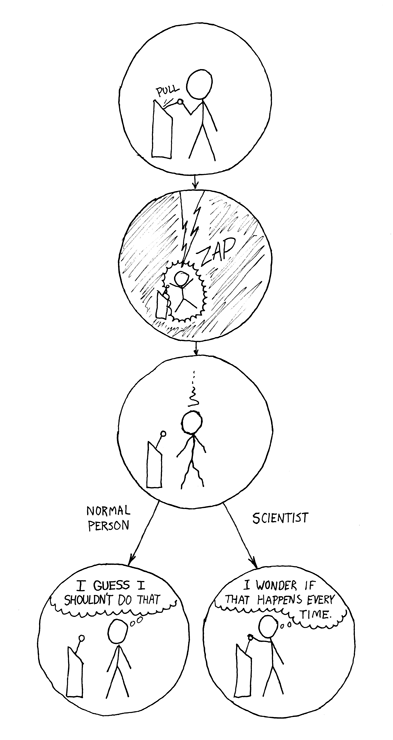
Scientific study often results in less than clear conclusions, especially in complex systems. There is great difficulty understanding what is actually going on, what interactions are present, what factors are significant, etc.. One of the great problems with the low level of scientific literacy in the USA is so many people think science is about simple absolute truth.

Scientific inquiry, especially related to health care, must attempt to gain insights from confusing signals. To gain scientific literacy one must understand basics concepts, like data is a proxy for what you aim to understand. To understand yourself you need to accept that science is not math. For a long time we are going to have to do our best to build up our understanding of human health (and other complex systems) as best we can. We need to be able to sort out what are solid conclusion, what are guesses, what seem like reasonable explanation and what level of confidence we can have in statements.

It is not enough to learn facts we need to be able to think scientifically and comprehend the subtleties surrounding the advances in scientific understanding. Some criticize newspapers and popular science for providing too simplistic a view of new scientific knowledge. While this can be a problem I really see the problem much more serious if people read obviously overly simplistic articles and don’t understand that it is just scratching the surface. The reader needs to take responsibility too. I enjoy many great articles that gloss over many of the details but provide a quick view of intriguing new breakthroughs.

Related: New Questions on Treating CholesterolEvolution is Fundamental to ScienceContradictory Medical StudiesThe Study of Bee Colony Collapses ContinuesAntibiotics Too Often Prescribed for Sinus Woes

Mistakes in Experimental Design and Interpretation

Mistakes in Experimental Design and Interpretation:

Humans are very good at detecting patterns, but rather poor at detecting randomness. We expect random incidents of cancer to be spread homogeneously, when in fact true randomness results in random clusters, not homogeneity. It is a mistake for an experiment to consider a pool of 47,000 possibilities, and then only report on the 7 cases that seem interesting.

A proper experiment states its hypothesis before gathering evidence and then puts the hypothesis to the test. Remember when you did your seventh grade science fair experiment: you made up a hypothesis first (“Hamsters will get fatter from eating Lucky Charms than Wheaties”) and then did the experiment to confirm or refute the hypothesis. You can’t just make up a hypothesis after the fact to fit the data.

This is an excellent article discussing very common errors in how people use data. We have tendencies that lead us to draw faulty conclusions from data. Given that it is important to understand what common mistakes are made to help us counter the natural tendencies.

Related: Seeing Patterns Where None ExistsIllusions, Optical and OtherUnderstanding DataDangers of Forgetting the Proxy Nature of DataHow to Deal with False Research Findingsdescriptive “theory” and normative theory

Home Experiments: Quantum Erasing

Do your own experiment on quantum erasing – Quantum Erasing in the Home (for instructions). From the accompanying article, A Do-It-Yourself Quantum Eraser:

The light patterns that you will see if you conduct the experiment successfully can be accounted for by considering the light to be a classical wave, with no quantum mechanics involved. So in that respect the experiment is a cheat and falls short of fully demonstrating the quantum nature of the effect.

Nevertheless, the individual photons that make up the light wave are indeed doing the full quantum dance with all its weirdness intact, although you could only truly prove that by sending the photons through the apparatus and detecting them one at a time. Such a procedure, unfortunately, remains beyond the average home experimenter.

Related: Science Toys You Can Make With Your KidsParticles and Waves

CERN Pressure Test Failure

photo of Femilab inner triplet quadrupole at CERN

On March 27th a high-pressure test at CERN of a Fermilab-built ‘inner-triplet’ series of three quadrupole magnets in the tunnel of the Large Hadron Collider failed. Fermilab Director on the test failure:

We test the complex features we design thoroughly. In this case we are dumbfounded that we missed some very simple balance of forces. Not only was it missed in the engineering design but also in the four engineering reviews carried out between 1998 and 2002 before launching the construction of the magnets. Furthermore even though every magnet was thoroughly tested individually, they were never tested with the exact configuration that they would have when installed at CERN–thus missing the opportunity to discover the problem sooner.

We need and want to make sure that we find the root causes of the problem and from the lessons learned build a stronger institution. Beyond that, there is no substitute for the commitment each of us makes to excellence, to critical thinking and to sweating every detail.

In a Fermilab Update on Inner Triplet Magnets at LHC they state: “The goal at CERN and Fermilab is now to redesign and repair the inner triplet magnets and, if necessary, the DFBX without affecting the LHC start-up schedule. Teams at CERN and Fermilab have identified potential repairs that could be carried out expeditiously without removing undamaged triplet magnets from the tunnel.”

Related: Fermilab Statement on LHC Magnet Test FailureAccelerators and Nobel LaureatesFind the Root Cause Instead of the Person to Blame
Continue reading

Correlation is Not Causation

Why so much medical research is rot:

People born under the astrological sign of Leo are 15% more likely to be admitted to hospital with gastric bleeding than those born under the other 11 signs. Sagittarians are 38% more likely than others to land up there because of a broken arm. Those are the conclusions that many medical researchers would be forced to make from a set of data presented to the American Association for the Advancement of Science by Peter Austin of the Institute for Clinical Evaluative Sciences in Toronto. At least, they would be forced to draw them if they applied the lax statistical methods of their own work to the records of hospital admissions in Ontario, Canada, used by Dr Austin.

Dr Austin, of course, does not draw those conclusions. His point was to shock medical researchers into using better statistics, because the ones they routinely employ today run the risk of identifying relationships when, in fact, there are none. He also wanted to explain why so many health claims that look important when they are first made are not substantiated in later studies.

As I said in, Seeing Patterns Where None Exists: “Page 8 of Statistics for Experimenters by George Box, William Hunter (my father) and Stu Hunter (no relation) shows a graph of the population (of people) versus the number of storks which shows a high correlation. “Although in this example few would be led to hypothesize that the increase in the number of storks caused the observed increase in population, investigators are sometimes guilty of this kind of mistake in other contexts.'”

Himalayas Geology

Mystery of the Himalayas Solved:

The mystery of why the Himalaya mountains and the Tibetan plateau are the highest in the world has at last been answered, with the discovery of a gigantic chunk of rock slowly sinking towards the centre of the Earth. When the massive slab – up to eight times the area of the UK and as thick as a dozen Everests on top of each other – dropped off, the lighter crust above it rebounded upwards like a cork released under water, geophysicists say. This “sudden uplift” would have raised the Himalayas by as much as 2km (1.24 miles) to their present height.

If not for the surge, Sir Edmund Hillary and Sherpa Tenzing Norgay might have found themselves reaching the “roof of the world” by conquering Aconcagua (6,962m) in Argentina while Everest languished at a mere 6,848m above sea level, 2,000m below its actual peak. The discovery of the missing mantle – the cold, heavy rock beneath the crust – was revealed last week by Professor Wang-Ping Chen at the University of Illinois, whose team used more than 200 super-sensitive seismometers strung across the Himalayas, from India deep into Tibet.

But some scientists remain sceptical. One geologist at Cambridge, who wanted to remain anonymous because he hadn’t yet read Professor Chen’s paper, suggested that the slab could be the remains of the Tethys Ocean plate. Professor England counters that both the Asian and Indian plates have moved north since then

Related: Water in Earth’s Deep MantleDrilling to the Center of the Earth

Gene Linked to Fish and Human Pigmentation

Zebra Fish photo

A Fish of a Different Color:

Until now, the genetics underlying human skin pigmentation have remained a mystery. But while studying the zebrafish–a fish common to household aquariums and research laboratories–a team of interdisciplinary scientists found a gene that plays a major role in human coloration.

Besides unraveling some of the mysteries of human variation, the research, which is featured on the cover of the Dec. 16 issue of Science, has implications for understanding a host of human diseases including cancer, diabetes and rickets.