Tag Archives: scientific inquiry

10 Year Old’s Molecule Design Becomes the Topic of a Scientific Paper

10-Year-Old Helps Professor With Theoretical Chemistry by Marimar White-Espin

[10-year-old Clara] Lazen’s teacher, Kenneth Boehr, introduced Border Star Montessori School’s 5th grade class to the periodic table, molecules and chemical bonds. Lazen found the topic interesting and Boehr gave her the tools she needed to explore the subject.

Equipped with a molecule-building kit, Lazen experimented with the colored wooden balls by creating existing molecules and some of her own.

Lazen approached Boehr and asked if the molecule she created using the kit was real. Unsure of the answer, Boehr emailed his longtime graduate school friend and chemistry professor at HSU, Robert Zoellner.

“Maybe [the molecule] is real and we’ll find out,” Zoellner responded.

Upon further research, Zoellner discovered the particular molecule, tetrakis(nitratoxycarbon) methane, Lazen had created had never been discussed in literature and possibly had never been thought of before.

The significance of the molecule Lazen created is that it has the potential to store energy. The dense structure allows for stable energy storage meaning the molecule can be used to produce energy or as an explosive.

Lazen was excited to hear her discovery could be used as an explosive. “I thought, ‘Wow, it could go boom!’ I could put [the molecule] in a bomb and it could blow up something,” she said.

Lazen’s mother, Lori Schmidt was excited to hear that not only would her daughter be a co-author to the scientific article, but the discovery would be recognized in a scientific journal. “One only dreams as a parent,”

Fun stuff.

Related: 11 Year Old Using Design of ExperimentsScience for KidsEncouraging Curiosity in KidsSarah, aged 3, Learns About Soap

How Lysozyme Protein in Our Tear-Drops Kill Bacteria

A disease-fighting protein in our teardrops has been tethered to a tiny transistor, enabling UC Irvine scientists to discover exactly how it destroys dangerous bacteria. The research could prove critical to long-term work aimed at diagnosing cancers and other illnesses in their very early stages.

Ever since Nobel laureate Alexander Fleming found that human tears contain antiseptic proteins called lysozymes about a century ago, scientists have tried to solve the mystery of how they could relentlessly wipe out far larger bacteria. It turns out that lysozymes have jaws that latch on and chomp through rows of cell walls like someone hungrily devouring an ear of corn.

“Those jaws chew apart the walls of the bacteria that are trying to get into your eyes and infect them,” said molecular biologist and chemistry professor Gregory Weiss, who co-led the project with associate professor of physics & astronomy Philip Collins.

The researchers decoded the protein’s behavior by building one of the world’s smallest transistors – 25 times smaller than similar circuitry in laptop computers or smartphones. Individual lysozymes were glued to the live wire, and their eating activities were monitored.

“Our circuits are molecule-sized microphones,” Collins said. “It’s just like a stethoscope listening to your heart, except we’re listening to a single molecule of protein.”

It took years for the UCI scientists to assemble the transistor and attach single-molecule teardrop proteins. The scientists hope the same novel technology can be used to detect cancerous molecules. It could take a decade to figure out but would be well worth it, said Weiss, who lost his father to lung cancer.

“If we can detect single molecules associated with cancer, then that means we’d be able to detect it very, very early,” Weiss said. “That would be very exciting, because we know that if we treat cancer early, it will be much more successful, patients will be cured much faster, and costs will be much less.”

The project was sponsored by the National Cancer Institute and the National Science Foundation. Co-authors of the Science paper are Yongki Choi, Issa Moody, Patrick Sims, Steven Hunt, Brad Corso and Israel Perez.

Related: full press releaseWhy ‘Licking Your Wounds’ WorksHow Bleach Kills BacteriaAlgorithmic Self-Assembly

Study of the Colony Collapse Disorder Continues as Bee Colonies Continue to Disappear

I can understand why people get complacent. We have a pretty remarkable run of science and technology finding solutions for whatever peril we face.

Also, quite often, future risks are over-blown. Then, people get habituated to reading ominous predictions, followed by a future doesn’t seem to reach those dramatic predictions. But this is a risky pattern to just expect – that no matter what we will figure out some way to avoid the consequences.

Risks actually do come true. The obvious result of overfishing, just as predicted, has resulted in collapses of fish populations over and over creating great hardship for those who had fallen victim to that prediction. If people don’t vaccinate themselves (and their kids) we will have ever increasing numbers of deaths and sickness. If we fail to use anti-biotics is a long term sustainable way, our actions will result in many deaths.

I am not sure why we find it so easy to ignore the evidence of bad consequences but we do. Partially I would imagine that as problems begin to be manifest countermeasures take affect. So in the fishing example, many people leave that line of work and so the numbers in the industry after a collapse, who are suffering in the present, are reduced. Still I find it odd how easily we ignore the risks in the future.

I do understand if there are short term benefits to ignoring the risks (or pretending they don’t exist): so you have fisherman that don’t want to take steps in advance to avoid collapse. Or you have industries and politicians that want to pretend ignoring global warming is a strategy to avoid the consequences. Or you have parents that say, well today we don’t have many risks of sicknesses people get vaccinated against (yes, because people have been vaccinated – if you stop vaccinating your children they we get to experience the avoidable pain and suffering).

I have been following the honeybee colony collapse disorder for several years (see the end of the posts for links to posts from 2006 – 2010, like this one The Study of Bee Colony Collapses Continues from 2007). It is a great example of the scientific inquiry process. It is messy and confusing and full of studies that have trouble finding what the actually causes are or what solutions will work.

There are occasionally mentions of how devestating things could get if the trend continues. In fact stories that seem so devestating that they just don’t seem real. surely either that won’t happen or if it started to some countermeasure would be found to deal with the problem and avoid the most severe consequences. That is basially how I have felt about it. But that is not because of some scientific understanding but just a feeling that hey that couldn’t really happen. Well that isn’t exactly solid evidence that it can’t.

Honeybee problem nearing a ‘critical point’

In addition to continued reports of CCD — a still somewhat mysterious phenomenon in which entire bee colonies literally disappear, alien-abduction style, leaving not even their dead bodies behind — bee populations are suffering poor health in general, and experiencing shorter life spans and diminished vitality. And while parasites, pathogens, and habitat loss can deal blows to bee health, research increasingly points to pesticides as the primary culprit.

farmers use these chemicals to protect their crops from destructive insects, but in so doing, they harm other insects essential to their crops’ production — a catch-22 that Hackenberg said speaks to the fact that “we have become a nation driven by the chemical industry.” In addition to beekeeping, he owns two farms, and even when crop analysts recommend spraying pesticides on his crops to kill an aphid population, for example, he knows that “if I spray, I’m going to kill all the beneficial insects.” But most farmers, lacking Hackenberg’s awareness of bee populations, follow the advice of the crop adviser — who, these days, is likely to be paid by the chemical industry, rather than by a state university or another independent entity.

I believe this is the latest advise of the Unites States Department of Agriculture (though their web site doesn’t make it nearly as obvious as it should that this is in fact the current advice – the document seems to indicate it is but if someone were to say no, that is outdated, it wouldn’t be hard to believe)

Continue reading

Staphylococcal Food Poisoning

I pretty much don’t get sick, which is great. Twice in the last month I got something like food poisoning (which is more sickness than I get most years). So I looked online for some information on what might cause my symptoms and how fast it is possible for the onset of symptoms.

Staphylococcal food poisoning is a gastrointestinal illness. It is caused by eating foods contaminated with toxins produced by Staphylococcus aureus. It seems like a possible culprit. My guess is the onset for me has been within 2 hours (or it was a coincidence. That fast of an onset seems rare (based on my limited research).

The United States Center for Disease Control says symptoms can last 24-48 hours. For me symptoms came and went within 15 minutes. Rapid fever and “heat” feeling everywhere, diarea, gone. No more than 15 minutes from start to finish. I really find it very odd how I can feel so weird quickly and then just as quickly it is all gone.

The bacterium can also be found in unpasteurinzed milk and cheese products. Staphylococcus is salt tolerant and can grow in salty foods like ham. As the bacterium multiplies in food, it produces toxins that can cause food poisoning. Staphylococcal toxins are resistant to heat and cannot be destroyed by cooking. Foods at highest risk of producing toxins from Staphylococcus aureus are those that are made by hand and require no cooking. Some examples of foods that have caused staphylococcal food poisoning are sliced meat, puddings, pastries and sandwiches. The foods may not smell bad or look spoiled in order to produce the toxins.

Unrefrigerated or improperly refrigerated meats, potato and egg salads, cream pastries are possible paths to the food poisoning. I suspect ghee, in my case.

The CDC says that staphylococcal toxins are fast acting, sometimes causing illness in as little as 30 minutes after eating.contaminated foods, but symptoms usually develop within one to six hours. Patients typically experience several of the following: nausea, retching, vomiting, stomach cramps, and diarrhea. The illness cannot be passed to other people and it typically lasts for one day, but sometimes it can last up to three days. In a small minority of patients the illness may be more severe. They don’t seem to agree it can disappear in 15 minutes, otherwise it seems a possible cause.

Of course being essentially total ignorant about this stuff I could also be completely off base. I find this interesting though so I am doing some more reading.

I think it would be nice if the CDC would put links on pages to other causes with similar symptoms. Wouldn’t that be a good usability feature?

Related: What You Need to Know About Foodborne Illness-Causing OrganismsTracking the Ecosystem Within UsHealthy Diet, Healthy Living, Healthy WeightThe Man Who Unboiled an Egg

Healthy Diet, Healthy Living, Healthy Weight

Living and eating healthily is tricky but not entirely confusing. The whole area of eating healthy food and what is a healthy weight is one where the scientific inquiry process and the complexity of scientific research on what is healthy for us is clear. Scientists study various issues and learn things but creating simple rules has proven difficult. Different studies seem to show benefits of contradictory advice, advice once seen as wise is now seen as wrong…

This is an area I am far from knowledgable about. Still I try to pay some attention as I like being healthy. Being sick is the quickest way to appreciate how great it is to be healthy. From various things I have skimmed it seems there is more evidence from several studies about how difficult it is to lose weight. Our bodies seem to work against our efforts.

And this, it seems to me, makes the problem of increasing childhood and teen obesity even more important to deal with as soon as issues arise.

It seems to me the most important thing to take from this, is the importance of maintaining a healthy weight: since you can’t just easily make up for a bad year of weight gain. I am not sure why I haven’t seen this note in most of what I have read – I suspect it is our reluctance to make value judgements about what is healthy. The problem I see with that is, the best advice we have is confusing enough without people with more knowledge being reluctant to state their best advice given the current knowledge. That doesn’t mean the suggestions are right, but at least they are educated guesses.

I try to eat relatively healthily. Which for me means taking steps to increase the amount of vegetables I eat (especially greens and some fiber) and decrease the amount of sweets and heavily processed food I eat (I still eat way too much heavily processed food). And I try to exercise as it seems to have many benefits including helping make up for some weaknesses in your diet (like eating too many calories and too many “empty calories). In my opinion (which on this topic may well not be worth much) eating a bit more stuff that really isn’t so good for you and exercising more is an easier tradeoff than trying to eat perfectly and do the minimum amount of exercise needed to stay healthy.

I also eat yogurt – I like it and the beneficial benefits of some bacteria seems likely. I heard recently something that surprised me which is that the beneficial bacteria remain for close to 2 weeks. I figured they would be gone in a couple days. I only heard that from one source (I can’t remember now but some seemingly knowledgable source – scientist researching the area), so it might not be accurate but it was interesting.

Here is an example of one of these health studies. They find that a low protein diet resulted in a loss of “lean weight” (muscle…) and more fat than a comparable diet with more protein. The same weight with a higher percentage of fat is not a good thing for human health. Thus the message is that a lower protein diet has this risk that must be considered (and therefor higher protein diets may well be wise). Of course things get much more complicated than that when we actually try to live by a diet.

Effect of Dietary Protein Content on Weight Gain, Energy Expenditure, and Body Composition During Overeating

Continue reading

Brian Cox – Lecture on Science and Quantum Mechanics

Brian Cox gave a wonderful lecture at the Royal Institution of Great Britain. This is one more great thing the internet makes possible: have great fun while you learn. Enjoy.

With the help of Jonathan Ross, Simon Pegg, Sarah Millican and James May, Brian shows how diamonds – the hardest material in nature – are made up of nothingness; how things can be in an infinite number of places at once; why everything we see or touch in the universe exists; and how a diamond in the heart of London is in communication with the largest diamond in the cosmos.

Related: Quantum Mechanics Made Relatively Simple Podcasts by Hana BetheBrian Cox Particle Physics WebcastPhysicists Observe New Property of Matter

A Possible Explanation for the Faster Than Light Result Anomaly

Faster-than-Light Neutrino Puzzle Claimed Solved by Special Relativity

So what is the satellites’ motion with respect to the OPERA experiment? These probes orbit from West to East in a plane inclined at 55 degrees to the equator. Significantly, that’s roughly in line with the neutrino flight path. Their relative motion is then easy to calculate.

So from the point of view of a clock on board a GPS satellite, the positions of the neutrino source and detector are changing. “From the perspective of the clock, the detector is moving towards the source and consequently the distance travelled by the particles as observed from the clock is shorter,” says van Elburg.

By this he means shorter than the distance measured in the reference frame on the ground.

The OPERA team overlooks this because it thinks of the clocks as on the ground not in orbit.

How big is this effect? Van Elburg calculates that it should cause the neutrinos to arrive 32 nanoseconds early. But this must be doubled because the same error occurs at each end of the experiment. So the total correction is 64 nanoseconds, almost exactly what the OPERA team observes.

It is great to see the scientific process at work. Those is support of the scientific method support open access science and this explanation is available via arxiv: Times Of Flight Between A Source And A Detector Observed From A GPS Satellite.

Related: Faster Than Light Speed Anomaly Reported by CERNMore Dark Matter Experiment ResultsThe Architecture of Access to Scientific Knowledge

2011 Nobel Prize in Chemistry

photo of Dan Shechtman

Dan Shechtman, Israel Institute of Technology, 2011 Nobel Laurette in Chemistry

The Royal Swedish Academy of Sciences has decided to award the Nobel Prize in Chemistry for 2011 to Dan Shechtman, Technion – Israel Institute of Technology, Haifa, Israel for the discovery of quasicrystals.

In quasicrystals, we find the fascinating mosaics reproduced at the level of atoms: regular patterns that never repeat themselves. However, the configuration found in quasicrystals was considered impossible, and Dan Shechtman had to fight a fierce battle against established science. The Nobel Prize in Chemistry 2011 has fundamentally altered how chemists conceive of solid matter.

On the morning of 8 April 1982, an image counter to the laws of nature appeared in Dan Shechtman’s electron microscope. In all solid matter, atoms were believed to be packed inside crystals in symmetrical patterns that were repeated periodically over and over again. For scientists, this repetition was required in order to obtain a crystal.

Shechtman’s image, however, showed that the atoms in his crystal were packed in a pattern that could not be repeated. Such a pattern was considered just as impossible as creating a football using only six-cornered polygons, when a sphere needs both five- and six-cornered polygons. His discovery was extremely controversial. In the course of defending his findings, he was asked to leave his research group. However, his battle eventually forced scientists to reconsider their conception of the very nature of matter.

Aperiodic mosaics, such as those found in the medieval Islamic mosaics of the Alhambra Palace in Spain and the Darb-i Imam Shrine in Iran, have helped scientists understand what quasicrystals look like at the atomic level. In those mosaics, as in quasicrystals, the patterns are regular – they follow mathematical rules – but they never repeat themselves.

When scientists describe Shechtman’s quasicrystals, they use a concept that comes from mathematics and art: the golden ratio. This number had already caught the interest of mathematicians in Ancient Greece, as it often appeared in geometry. In quasicrystals, for instance, the ratio of various distances between atoms is related to the golden mean.

Following Shechtman’s discovery, scientists have produced other kinds of quasicrystals in the lab and discovered naturally occurring quasicrystals in mineral samples from a Russian river. A Swedish company has also found quasicrystals in a certain form of steel, where the crystals reinforce the material like armor. Scientists are currently experimenting with using quasicrystals in different products such as frying pans and diesel engines.

Related: 2009 Nobel Prize in Chemistry: the Structure and Function of the RibosomeThe Nobel Prize in Chemistry 2008Nobel Prize in Chemistry (2006)

Read more on the science he has worked on. Our understanding of science is built on the discoveries of our predecessors and on the discoveries that counter what we thought we knew.
Continue reading

2011 Nobel Prize in Physics

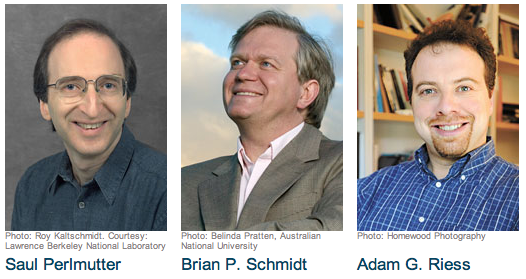
Photos of the 2011 Physics Nobel Prize Winners: Saul Perlmutter, Brian Schmidt and Adam Riess.

Photos of the 2011 Physics Nobel Prize Winners.

The Royal Swedish Academy of Sciences has decided to award the Nobel Prize in Physics for 2011 with one half to

Saul Perlmutter
The Supernova Cosmology Project, Lawrence Berkeley National Laboratory and University of California, Berkeley, CA, USA

and the other half jointly to

Brian P. Schmidt
The High-z Supernova Search Team, Australian National University, Weston Creek, Australia

and

Adam G. Riess
The High-z Supernova Search Team, Johns Hopkins University and Space Telescope Science Institute, Baltimore, MD, USA

“for the discovery of the accelerating expansion of the Universe through observations of distant supernovae”

Once again the USA dominates the physics category, Brian Schmidt is a USA and Australian citizen. It will be interesting to see if this starts to change in the next decade. I believe it will at some point fairly soon, the question is at what point.

“Some say the world will end in fire, some say in ice…” Robert Frost, Fire and Ice, 1920

What will be the final destiny of the Universe? Probably it will end in ice, if we are to believe this year’s Nobel Laureates in Physics. They have studied several dozen exploding stars, called supernovae, and discovered that the Universe is expanding at an ever-accelerating rate. The discovery came as a complete surprise even to the Laureates themselves.

In 1998, cosmology was shaken at its foundations as two research teams presented their findings. Headed by Saul Perlmutter, one of the teams had set to work in 1988. Brian Schmidt headed another team, launched at the end of 1994, where Adam Riess was to play a crucial role.

The research teams raced to map the Universe by locating the most distant supernovae. More sophisticated telescopes on the ground and in space, as well as more powerful computers and new digital imaging sensors (CCD, Nobel Prize in Physics in 2009), opened the possibility in the 1990s to add more pieces to the cosmological puzzle.

The teams used a particular kind of supernova, called type Ia supernova. It is an explosion of an old compact star that is as heavy as the Sun but as small as the Earth. A single such supernova can emit as much light as a whole galaxy. All in all, the two research teams found over 50 distant supernovae whose light was weaker than expected – this was a sign that the expansion of the Universe was accelerating. The potential pitfalls had been numerous, and the scientists found reassurance in the fact that both groups had reached the same astonishing conclusion.

For almost a century, the Universe has been known to be expanding as a consequence of the Big Bang about 14 billion years ago. However, the discovery that this expansion is accelerating is astounding. If the expansion will continue to speed up the Universe will end in ice.

The acceleration is thought to be driven by dark energy, but what that dark energy is remains an enigma – perhaps the greatest in physics today. What is known is that dark energy constitutes about three quarters of the Universe. Therefore the findings of the 2011 Nobel Laureates in Physics have helped to unveil a Universe that to a large extent is unknown to science. And everything is possible again.

As usually the Nobel committee does a great job of providing the public open scientific information. Others that claim to promote science can learn from them. They do a great job of making the science understandable to a lay person.

The discovery came as a complete surprise even to the Nobel Laureates themselves. What they saw would be like throwing a ball up in the air, and instead of having it come back down, watching as it disappears more and more rapidly into the sky, as if gravity could not manage to reverse the ball’s trajectory. Something similar seemed to be happening across the entire Universe.

The growing rate of the expansion implies that the Universe is being pushed apart by an unknown form of energy embedded in the fabric of space. This dark energy makes up a large part of the Universe, more than 70 %, and it is an enigma, perhaps the greatest in physics today. No wonder, then, that cosmology was shaken at its foundations when two different research groups presented similar results in 1998.

Related: The Nobel Prize in Physics 20092006 Nobel Prize in Physics2011 Nobel Prize in Physiology or MedicineIs Dark Matter an Illusion?5% of the Universe is Normal Matter, What About the Other 95%?
Continue reading

Faster Than Light Speed Anomaly Reported by CERN

The OPERA result is based on the observation of over 15000 neutrino events measured at Gran Sasso, and appears to indicate that the neutrinos travel at a velocity 20 parts per million above the speed of light, nature’s cosmic speed limit. Given the potential far-reaching consequences of such a result, independent measurements are needed before the effect can either be refuted or firmly established. This is why the OPERA collaboration has decided to open the result to broader scrutiny. The collaboration’s result is available on the preprint server arxiv.org.

The OPERA measurement is at odds with well-established laws of nature, though science frequently progresses by overthrowing the established paradigms. For this reason, many searches have been made for deviations from Einstein’s theory of relativity, so far not finding any such evidence. The strong constraints arising from these observations makes an interpretation of the OPERA measurement in terms of modification of Einstein’s theory unlikely, and give further strong reason to seek new independent measurements.

“This result comes as a complete surprise,” said OPERA spokesperson, Antonio Ereditato of the University of Bern. “After many months of studies and cross checks we have not found any instrumental effect that could explain the result of the measurement. While OPERA researchers will continue their studies, we are also looking forward to independent measurements to fully assess the nature of this observation.”

“When an experiment finds an apparently unbelievable result and can find no artefact of the measurement to account for it, it’s normal procedure to invite broader scrutiny, and this is exactly what the OPERA collaboration is doing, it’s good scientific practice,” said CERN Research Director Sergio Bertolucci. “If this measurement is confirmed, it might change our view of physics, but we need to be sure that there are no other, more mundane, explanations. That will require independent measurements.” This is a great reminder of the proper application of the scientific inquiry process. Our understanding moves forward based on evidence and incredible results require a high burden of proof before we accept them.

In order to perform this study, the OPERA Collaboration teamed up with experts in metrology from CERN and other institutions to perform a series of high precision measurements of the distance between the source and the detector, and of the neutrinos’ time of flight. The distance between the origin of the neutrino beam and OPERA was measured with an uncertainty of 20 cm over the 730 km travel path. The neutrinos’ time of flight was determined with an accuracy of less than 10 nanoseconds by using sophisticated instruments including advanced GPS systems and atomic clocks. The time response of all elements of the CNGS beam line and of the OPERA detector has also been measured with great precision.

“We have established synchronization between CERN and Gran Sasso that gives us nanosecond accuracy, and we’ve measured the distance between the two sites to 20 centimetres,” said Dario Autiero, the CNRS researcher who will give this afternoon’s seminar. “Although our measurements have low systematic uncertainty and high statistical accuracy, and we place great confidence in our results, we’re looking forward to comparing them with those from other experiments.”

“The potential impact on science is too large to draw immediate conclusions or attempt physics interpretations. My first reaction is that the neutrino is still surprising us with its mysteries.” said Ereditato. “Today’s seminar is intended to invite scrutiny from the broader particle physics community.”

The OPERA experiment was inaugurated in 2006, with the main goal of studying the rare transformation (oscillation) of muon neutrinos into tau neutrinos. One first such event was observed in 2010, proving the unique ability of the experiment in the detection of the elusive signal of tau neutrinos.

This is great stuff, wether it turns out to be an amazing result that changes our understanding of physics or even if it doesn’t (if it turns out the apparent result is not what it seems). It is great to see us attempt to learn. My guess is that we find some explanation for the anomaly that does avoids something traveling faster than the speed of light.

Brian Cox on the BBC 6: “This is the way science works, we go away and do it again and check, and then do it again and check. If it is confirmed then it will be the most significant discovery in physics in the last, at least, 100 years.”

Related: full press releaseThe Sun is a Miasma of Incandescent PlasmaGravity and the Scientific MethodMore Mysterious Space PhenomenonNeutrino particle traveling faster than light? Two ways it could rewrite physics