Tag Archives: scientists

Presidential Early Career Awards for Scientists and Engineers

The Presidential Early Career Awards for Scientists and Engineers, established in 1996, honors the most promising researchers in the Nation within their fields. Nine federal departments and agencies annually nominate scientists and engineers who are at the start of their independent careers and whose work shows exceptional promise for leadership at the frontiers of scientific knowledge. Participating agencies award these talented scientists and engineers with up to five years of funding to further their research in support of critical government missions.

Awards were announced today – links to some of the awardees:

  • Jelena Vuckovic, Assistant Professor of Electrical Engineering, Stanford University
  • Matthew Rodell, Physical Scientist, NASA
  • Katerina Akassoglou, Assistant Professor of Pharmacology, University of California, San Diego
  • Carlos Rinaldi, Associate Professor of Chemical Engineering University of Puerto Rico at Mayagüez
  • Ahna Skop, Assistant Professor of Genetics, University of Wisconsin-Madison
  • Krystyn J. Van Vliet, Assistant Professor of Materials Science and Engineering, MIT
  • Odest Chadwicke Jenkins, Assistant Professor, Department of Computer Science, Brown University

Related: 2006 MacArthur FellowsYoung Innovators Under 35Presidential Early Career Award for Scientists and Engineers (2006)NSF Release on 2007 awardees that are also NSF CAREER awardees
Software Patents – Bad Idea

MIT League for Programming Freedom on Software Patents, including: Why Patents Are Bad for Software, No Patents on Ideas by Thomas Jefferson and letter from Donald E. Knuth to the U.S. Patent Office

In the period 1945-1980, it was generally believed that patent law did not pertain to software. However, it now appears that some people have received patents for algorithms of practical importance–e.g., Lempel-Ziv compression and RSA public key encryption–and are now legally preventing other programmers from using these algorithms.

This is a serious change from the previous policy under which the computer revolution became possible, and I fear this change will be harmful for society. It certainly would have had a profoundly negative effect on my own work: For example, I developed software called TeX that is now used to produce more than 90% of all books and journals in mathematics and physics and to produce hundreds of thousands of technical reports in all scientific disciplines. If software patents had been commonplace in 1980, I would not have been able to create such a system, nor would I probably have ever thought of doing it, nor can I imagine anyone else doing so.

Related: Are Software Patents Evil?The Patent System Needs to be Significantly ImprovedPatenting Life is a Bad IdeaIntellectual Property Rights and InnovationPatent LawThe Differences Between Culture and CodeGoogle Patent Search Fun

Donald Knuth – Computer Scientist

photo of Donald Knuth playing his home organ

Love at First Byte by Kara Platoni:

In the early ’60s, publisher Addison-Wesley invited Knuth to write a book on compiler design. Knuth eagerly drafted 3,000 pages by hand before someone at the publishing house informed him that would make an impossibly long book. The project was reconceived as the seven-volume The Art of Computer Programming. Although Knuth has written other books in the interim, this would become his life’s work. The first three volumes were published in 1968, 1969 and 1973. Volume 4 has been in the works nearly 30 years.

Its subject, combinatorial algorithms, or computational procedures that encompass vast numbers of possibilities, hardly existed when Knuth began the series. Now the topic grows faster than anyone could reasonably chronicle it. “He says if everyone else stopped doing work he would catch up better,” deadpans Jill Knuth, his wife of nearly 45 years.

Art of Computer Programming, Volume 1: Fundamental AlgorithmsArt of Computer Programming, Volume 2: Seminumerical AlgorithmsArt of Computer Programming, Volume 3: Sorting and Searching

Usually a lone wolf, Knuth collaborated on his typography programs with some of the world’s best typographers and his students. He produced two software programs, the TeX typesetting system and the METAFONT alphabet design system, which he released to the public domain. The programs are used for the bulk of scientific publishing today. “He made everybody’s life so much better and made the scholarly work so much more beautiful,” Papadimitriou says. “He has exported a lot of good will for computer science.”

See photo:

He likes to hide jokes in the index, as in Volume 3, where “royalties, use of” leads you to a page with an illustration of an organ-pipe array, a little wink to the 16-rank organ that dominates his home. He plays four-hands music with Jill, who swears that the neighbors tend to complain that the music emanating from their house is in fact not loud enough.

Related:

Singapore woos top scientists with new labs

Singapore woos top scientists with new labs, research money by Paul Elias:

Singapore’s siren song is growing increasingly more irresistible for scientists, especially stem cell researchers who feel stifled by the U.S. government’s restrictions on their field.

Two prominent California scientists are the latest to defect to the Asian city-state, announcing earlier this month that they, too, had fallen for its glittering acres of new laboratories outfitted with the latest gizmos.

They weren’t the first defections, and Singapore officials at the Biotechnology Organization’s annual convention in Chicago this week promise they won’t be the last.

Other Asian countries, including Japan, South Korea and even China, are also here touting their burgeoning biotechnology spending to the 20,000 scientists and biotechnology executives attending the conference.

In all, the country has managed to recruit about 50 senior scientists — far short of what it needs, but a start for a tiny country of 4.5 million people off the tip of Malaysia.

Another 1,800 younger scientists from all corners of the world staff the Biopolis laboratories, which were built with $290 million in government funding and another $400 million in private investment by the two dozen biotechnology companies based there. Biopolis opened in 2003 and contains seven buildings spread over 10 acres and connected by sky bridges

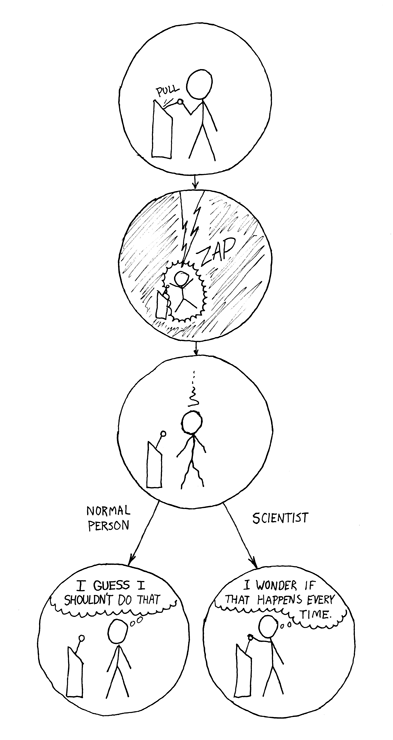
Children’s view of Scientists in England

Science ‘not for normal people’, BBC News

The Science Learning Centre in London asked 11,000 pupils for their views on science and scientists.

Around 70% of the 11-15 year olds questioned said they did not picture scientists as “normal young and attractive men and women”.

For those, like me, that believe our future will be better with more scientists and engineers some of the findings are less than ideal:

Among those who said they would not like to be scientists, reasons included: “Because you would constantly be depressed and tired and not have time for family”, and “because they all wear big glasses and white coats and I am female”.

Some of the findings were positive:

They found around 80% of pupils thought scientists did “very important work” and 70% thought they worked “creatively and imaginatively”.

A related article from BBC News provides another look at the views of students: Science seen under the right conditions by Dr Daniel Glaser.

Another article on the BBC site talks about one way to encourage more student interest in science, Science ‘must teach experiments’. To interest students in learning about science it is important to have them engaged in physical experiments. We also need to continue to show the connection between science and engineering and the students lives. Providing examples of scientists and engineer that the student relate to (and can see as a friend or a future self) would also help.