Tag Archives: university research

The Beneficial Phytochemicals in Vegetables Help Us Lead Healthy Lives

If I don’t pay attention, I won’t eat enough vegetables. Even when I do pay attention I still don’t eat enough (but get closer). Paying attention to what you eat is important for your health.

Some tips from the video.

  • Eat a wide variety of vegetables, to get the benefits each offers.
  • Cruciferous vegetables have cancer preventing benefits and enhancing the immune system. Vegetables in this category include broccoli and cauliflower.
  • Berries also have chemicals that aid in the prevention of cancer.

Related: Healthy Diet, Healthy Living, Healthy WeightEat food. Not too much. Mostly plants.Are Our Vegtables Less Nutritious?

How Lysozyme Protein in Our Tear-Drops Kill Bacteria

A disease-fighting protein in our teardrops has been tethered to a tiny transistor, enabling UC Irvine scientists to discover exactly how it destroys dangerous bacteria. The research could prove critical to long-term work aimed at diagnosing cancers and other illnesses in their very early stages.

Ever since Nobel laureate Alexander Fleming found that human tears contain antiseptic proteins called lysozymes about a century ago, scientists have tried to solve the mystery of how they could relentlessly wipe out far larger bacteria. It turns out that lysozymes have jaws that latch on and chomp through rows of cell walls like someone hungrily devouring an ear of corn.

“Those jaws chew apart the walls of the bacteria that are trying to get into your eyes and infect them,” said molecular biologist and chemistry professor Gregory Weiss, who co-led the project with associate professor of physics & astronomy Philip Collins.

The researchers decoded the protein’s behavior by building one of the world’s smallest transistors – 25 times smaller than similar circuitry in laptop computers or smartphones. Individual lysozymes were glued to the live wire, and their eating activities were monitored.

“Our circuits are molecule-sized microphones,” Collins said. “It’s just like a stethoscope listening to your heart, except we’re listening to a single molecule of protein.”

It took years for the UCI scientists to assemble the transistor and attach single-molecule teardrop proteins. The scientists hope the same novel technology can be used to detect cancerous molecules. It could take a decade to figure out but would be well worth it, said Weiss, who lost his father to lung cancer.

“If we can detect single molecules associated with cancer, then that means we’d be able to detect it very, very early,” Weiss said. “That would be very exciting, because we know that if we treat cancer early, it will be much more successful, patients will be cured much faster, and costs will be much less.”

The project was sponsored by the National Cancer Institute and the National Science Foundation. Co-authors of the Science paper are Yongki Choi, Issa Moody, Patrick Sims, Steven Hunt, Brad Corso and Israel Perez.

Related: full press releaseWhy ‘Licking Your Wounds’ WorksHow Bleach Kills BacteriaAlgorithmic Self-Assembly

Memory is Stored by Turning on Genes in Neurons (to Alter Connection Between Neurons)

I find these kind of stories so interesting. I really have so little understanding of genes. I knew memory had something to do with altering connections between neurons. I had no idea that required turning on many genes in those neurons. Life really is amazing.

Neuroscientists identify a master controller of memory

When you experience a new event, your brain encodes a memory of it by altering the connections between neurons. This requires turning on many genes in those neurons.

Lin and her colleagues found that Npas4 turns on a series of other genes that modify the brain’s internal wiring by adjusting the strength of synapses, or connections between neurons. “This is a gene that can connect from experience to the eventual changing of the circuit,” says [Yingxi] Lin

So far, the researchers have identified only a few of the genes regulated by Npas4, but they suspect there could be hundreds more. Npas4 is a transcription factor, meaning it controls the copying of other genes into messenger RNA — the genetic material that carries protein-building instructions from the nucleus to the rest of the cell. The MIT experiments showed that Npas4 binds to the activation sites of specific genes and directs an enzyme called RNA polymerase II to start copying them.

“Npas4 is providing this instructive signal,” Ramamoorthi says. “It’s telling the polymerase to land at certain genes, and without it, the polymerase doesn’t know where to go. It’s just floating around in the nucleus.”

When the researchers knocked out the gene for Npas4, they found that mice could not remember their fearful conditioning. They also found that this effect could be produced by knocking out the gene just in the CA3 region of the hippocampus. Knocking it out in other parts of the hippocampus, however, had no effect.

One of the things I aim to do in 2012 is read a few more books on biology and genes. I find it incredible what are genes actually are doing to allow us to live our lives. And I am also very ignorant on the whole area. So hopefully I can have some fun next year learning about it.

Related: Epigenetic Effects on DNA from Living Conditions in Childhood Persist Well Into Middle AgeAntigen Shift in Influenza Viruses8 Percent of the Human Genome is Old Virus GenesBrain Reorganizes As It Learns Math

Can Just A Few Minute of Exercise a Day Prevent Diabetes?

That just 1 minute of exercise a day could help prevent diabetes seems to good to be true. But research at the University of Bath indicates it might be true. I am a bit of a soft touch for seeing the benefits of exercise. And I also love health care that focuses on achieving healthy lives instead of what most of the spending focuses on: treating illness.

Performing short cycle sprints three times a week could be enough to prevent and possibly treat Type 2 diabetes researchers at the University of Bath believe.

Volunteers were asked to perform two 20-second cycle sprints, three times per week (but really this works out to under 10 minutes of total time including warm up). After six weeks researchers saw a 28% improvement in their insulin function. Type 2 diabetes occurs when blood sugar levels build up to dangerously high levels due to reduced insulin function, often caused by a sedentary lifestyle. The condition can cause life-threatening complications to the heart, kidneys, eyes and limbs, and has huge costs (monetarily and to people’s lives).

Regular exercise can help keep blood sugar levels low but busy lifestyles and lack of motivation mean 66% of the population is not getting the recommended five 30-minute sessions of moderate exercise a week.

Dr Niels Vollaard who is leading the study, said: “Our muscles have sugar stores, called glycogen, for use during exercise. To restock these after exercise the muscle needs to take up sugar from the blood. In inactive people there is less need for the muscles to do this, which can lead to poor sensitivity to insulin, high blood sugar levels, and eventually type 2 diabetes… We already knew that very intense sprint training can improve insulin sensitivity but we wanted to see if the exercise sessions could be made easier and shorter.”

In the study the resistance on the exercise bikes could be rapidly increased so volunteers were able to briefly exercise at much higher intensities than they would otherwise be able to achieve. With an undemanding warm-up and cool-down the total time of each session was only 10 minutes.

This type of study is very helpful in identifying solutions that will allow more people to lead healthy lives and save our economies large amount of money. Medical studies can’t be accepted on face value. They are often not confirmed by future studies and therefore it is unwise to rely on the results of 1 study. The results provide interesting information but need to be confirmed (and in the area of studies on human health this has been shown to be problematic – are health is quite a tricky area to study).

Related: Aerobic Exercise Plus Resistance Training Helps Control Type 2 DiabetesRegular Exercise Reduces FatigueFood Rules: An Eater’s Manual

Continue reading

Dennis Hong, Virginia Tech Mechanical Engineering Professor, Leading Robotics Innovation

Dennis Hong is the U.S. star in humanoid robotics

Hong came by his interest in science naturally. He was born in 1971 on the exclusive Palos Verdes Peninsula, outside Los Angeles, and his father, Yong Shik Hong, worked as an aerospace engineer at the federally funded Aerospace Corp. The family returned to Seoul in 1974 so the elder Hong could lead South Korea’s short-range missile program, at the bidding of then-President Park Chung Hee.

Korean fathers of that era were strict and remote. Hong’s father was engaged and intellectually indulgent. He installed a work bench in Dennis’s room when he was 4, complete with a hammer and saw. He led the children in chemistry experiments and brought home model airplanes from America.

Dennis Hong built things with scraps of wood and metal and bits of plastic. He disassembled toys and stored the parts in a chest beneath his bed.

“We spent a lot of time building things and breaking things,” said Julie Hong, Hong’s older sister. “He was the one who broke things the most and built things the most.”

Hong traveled to America to complete his university study, following his father’s credo, “Big fish must swim in the big sea.” He earned a bachelor’s in mechanical engineering at the University of Wisconsin and a master’s and doctorate at Purdue.

Dennis’ success illustrates several themes repeated in posts on this blog: the USA attracting talent from overseas, kids curiosity and exposure to science and engineering leading to great things, the value of strong science and engineering programs and professors. Robotics continue to progress very quickly. The economic impact of robotics is large already (largely in manufacturing) and will continue to grow dramatically. Likely robots will find their way into much more diverse areas over the next 2 decades. The Robotics and Mechanisms Laboratory, lead by Dennis Hong, seems poised to play a big role in that future.

Related: Robocup 2010, Robot FootballSoft Morphing Robot FutureEvolution of Altruism in RobotsToyota Develops Thought-controlled Wheelchair

Continue reading

2011 Nobel Prize in Physics

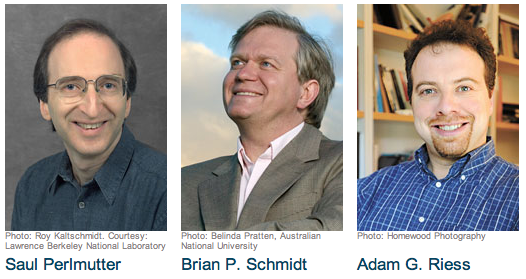
Photos of the 2011 Physics Nobel Prize Winners: Saul Perlmutter, Brian Schmidt and Adam Riess.

Photos of the 2011 Physics Nobel Prize Winners.

The Royal Swedish Academy of Sciences has decided to award the Nobel Prize in Physics for 2011 with one half to

Saul Perlmutter
The Supernova Cosmology Project, Lawrence Berkeley National Laboratory and University of California, Berkeley, CA, USA

and the other half jointly to

Brian P. Schmidt
The High-z Supernova Search Team, Australian National University, Weston Creek, Australia

and

Adam G. Riess
The High-z Supernova Search Team, Johns Hopkins University and Space Telescope Science Institute, Baltimore, MD, USA

“for the discovery of the accelerating expansion of the Universe through observations of distant supernovae”

Once again the USA dominates the physics category, Brian Schmidt is a USA and Australian citizen. It will be interesting to see if this starts to change in the next decade. I believe it will at some point fairly soon, the question is at what point.

“Some say the world will end in fire, some say in ice…” Robert Frost, Fire and Ice, 1920

What will be the final destiny of the Universe? Probably it will end in ice, if we are to believe this year’s Nobel Laureates in Physics. They have studied several dozen exploding stars, called supernovae, and discovered that the Universe is expanding at an ever-accelerating rate. The discovery came as a complete surprise even to the Laureates themselves.

In 1998, cosmology was shaken at its foundations as two research teams presented their findings. Headed by Saul Perlmutter, one of the teams had set to work in 1988. Brian Schmidt headed another team, launched at the end of 1994, where Adam Riess was to play a crucial role.

The research teams raced to map the Universe by locating the most distant supernovae. More sophisticated telescopes on the ground and in space, as well as more powerful computers and new digital imaging sensors (CCD, Nobel Prize in Physics in 2009), opened the possibility in the 1990s to add more pieces to the cosmological puzzle.

The teams used a particular kind of supernova, called type Ia supernova. It is an explosion of an old compact star that is as heavy as the Sun but as small as the Earth. A single such supernova can emit as much light as a whole galaxy. All in all, the two research teams found over 50 distant supernovae whose light was weaker than expected – this was a sign that the expansion of the Universe was accelerating. The potential pitfalls had been numerous, and the scientists found reassurance in the fact that both groups had reached the same astonishing conclusion.

For almost a century, the Universe has been known to be expanding as a consequence of the Big Bang about 14 billion years ago. However, the discovery that this expansion is accelerating is astounding. If the expansion will continue to speed up the Universe will end in ice.

The acceleration is thought to be driven by dark energy, but what that dark energy is remains an enigma – perhaps the greatest in physics today. What is known is that dark energy constitutes about three quarters of the Universe. Therefore the findings of the 2011 Nobel Laureates in Physics have helped to unveil a Universe that to a large extent is unknown to science. And everything is possible again.

As usually the Nobel committee does a great job of providing the public open scientific information. Others that claim to promote science can learn from them. They do a great job of making the science understandable to a lay person.

The discovery came as a complete surprise even to the Nobel Laureates themselves. What they saw would be like throwing a ball up in the air, and instead of having it come back down, watching as it disappears more and more rapidly into the sky, as if gravity could not manage to reverse the ball’s trajectory. Something similar seemed to be happening across the entire Universe.

The growing rate of the expansion implies that the Universe is being pushed apart by an unknown form of energy embedded in the fabric of space. This dark energy makes up a large part of the Universe, more than 70 %, and it is an enigma, perhaps the greatest in physics today. No wonder, then, that cosmology was shaken at its foundations when two different research groups presented similar results in 1998.

Related: The Nobel Prize in Physics 20092006 Nobel Prize in Physics2011 Nobel Prize in Physiology or MedicineIs Dark Matter an Illusion?5% of the Universe is Normal Matter, What About the Other 95%?
Continue reading

Molecule Found in Sharks Kills Many Viruses that are Deadly to People

photo of 3 dogfish sharks
Shark Molecule Kills Human Viruses, Too

“Sharks are remarkably resistant to viruses,” study researcher Michael Zasloff, of the Georgetown University Medical Center, told LiveScience. Zasloff discovered the molecule, squalamine, in 1993 in the dogfish shark, a small- to medium-size shark found in the Atlantic, Pacific, and Indian Oceans.

“It looked like no other compound that had been described in any animal or plant before. It was something completely unique,” Zasloff said. The compound is a potent antibacterial and has shown efficacy in treating human cancers and an eye condition known as macular degeneration, which causes blindness.

By studying the compound’s structure and how it works in the human body, Zasloff thought it might have some antiviral properties. He saw that the molecule works by sticking to the cell membranes of the liver and blood vessels. While there, it kicks off other proteins, some of which are essential for viruses to enter and survive in the cell.

The researchers decided to test the compound on several different live viruses that infect liver cells, including hepatitis B, dengue virus and yellow fever. They saw high efficacy across the board.

Zasloff hopes to start human trials in the next few years.

Marc Maresca, a researcher at Paul Cézanne University in Aix-en-Provence, France, who wasn’t involved in the study, agreed that the concentrations used were quite high, possibly in toxic ranges for some cells, but in an email to LiveScience Meresca also called the study “very exciting.”

Related: Alligator Blood Provides Strong Resistance to Bacteria and VirusesFemale Sharks Can Reproduce AloneMonarch Butterflies Use Medicinal Plants

Robot Tennis Partners Coming Soon?

The robots in the video, and many more, are being tested at the Flying Machine Arena at the The Institute for Dynamic Systems and Control, Department of Mechanical and Process Engineering, Swiss Federal Institute of Technology – Zurich.

They also usually have a number of challenging projects available. Qualified, motivated students should visit the Theses/Projects page and contact them to learn more. We need more people working on these types of things so I can have my robot basketball team available when I want to play.

Related: Robot Playing Table TennisRobocup 2010, Robot FootballDolphin Kick Gives Swimmers Edge

Synthetic Biologists Design a Gene that Forces Cancer Cells to Commit Suicide

Killing a cancer cell from the inside out

To create their tumor-killing program, the researchers designed a logic circuit — a system that makes a decision based on multiple inputs. In this case, the circuit is made of genes that detect molecules specific to a type of cervical cancer cell. If the right molecules are present, the genes initiate production of a protein that stimulates apoptosis, or programmed cell death. If not, nothing happens.

Because the genes used to create the circuits can be easily swapped in and out, this approach could also yield new treatments or diagnostics for many other diseases, according to Ron Weiss, an MIT associate professor of biological engineering and one of the leaders of the research team. “This is a general technology for disease-state detection,” he says.

the researchers created a synthetic gene for a protein, called hBax, that promotes cell death. They designed the gene with two separate safeguards against the killing of healthy, non-HeLa cells: It can be turned off by high levels of microRNAs that are ordinarily low in HeLa, and can also be deactivated by low levels of microRNAs that are normally plentiful in HeLa. A single discrepancy from the target microRNA profile is enough to shut off production of the cell-death protein.

If all microRNA levels match up with the HeLa profile, the protein is produced and the cell dies. In any other cell, the protein never gets made, and the synthetic genes eventually break down.

More very cool research. It is exciting to see how much can be done when we invest in science and engineering research. Of course the path from initial research to implemented solutions is long and complex and often fails to deliver on the initial hopes. But some remarkable breakthroughs achieve spectacular results that we benefit from every day.

Related: Cancer VaccinesResearchers Find Switch That Allows Cancer Cells to SpreadGlobal Cancer Deaths to Double by 2030Cloned Immune Cells Clear Patient’s Cancer

MIT Scientists Find New Drug That Could Cure Nearly Any Viral Infection

New drug could cure nearly any viral infection

The drug works by targeting a type of RNA produced only in cells that have been infected by viruses. “In theory, it should work against all viruses,” says Todd Rider, a senior staff scientist in Lincoln Laboratory‘s Chemical, Biological, and Nanoscale Technologies Group who invented the new technology.

There are a handful of drugs that combat specific viruses, such as the protease inhibitors used to control HIV infection, but these are relatively few in number and susceptible to viral resistance.

Rider drew inspiration for his therapeutic agents, dubbed DRACOs (Double-stranded RNA Activated Caspase Oligomerizers), from living cells’ own defense systems. When viruses infect a cell, they take over its cellular machinery for their own purpose — that is, creating more copies of the virus. During this process, the viruses create long strings of double-stranded RNA (dsRNA), which is not found in human or other animal cells.

As part of their natural defenses against viral infection, human cells have proteins that latch onto dsRNA, setting off a cascade of reactions that prevents the virus from replicating itself. However, many viruses can outsmart that system by blocking one of the steps further down the cascade.

Rider had the idea to combine a dsRNA-binding protein with another protein that induces cells to undergo apoptosis (programmed cell suicide) — launched, for example, when a cell determines it is en route to becoming cancerous. Therefore, when one end of the DRACO binds to dsRNA, it signals the other end of the DRACO to initiate cell suicide.

Combining those two elements is a “great idea” and a very novel approach, says Karla Kirkegaard, professor of microbiology and immunology at Stanford University. “Viruses are pretty good at developing resistance to things we try against them, but in this case, it’s hard to think of a simple path pathway to drug resistance,” she says.

Each DRACO also includes a “delivery tag,” taken from naturally occurring proteins, that allows it to cross cell membranes and enter any human or animal cell. However, if no dsRNA is present, DRACO leaves the cell unharmed.

Very cool stuff and potentially hugely beneficial. Just a reminder: this works against viruses – not bacteria (just as antibiotics do not work against viruses).

image showing the results of cultures treated with DRACO v. those not treated

Related: Science Explained: RNA Interference8 Percent of the Human Genome is Old Virus GenesVirus Engineered To Kill Deadly Brain Tumors
Continue reading