Tag Archives: university research

Quantum Information Theory Postulated As Source of Emergent Theory of Gravity

I love the advances we have made using our understanding of science and engineering, like the internet, air conditioning and antibiotics. I also love the discussion of research where we really have only educated guesses about what the scientific inquiry process is telling us about the way things are. This research from the University of York is very interesting.

Escaping gravity’s clutches: the black hole breakout

Professor Braunstein says: “Our results didn’t need the details of a black hole’s curved space geometry. That lends support to recent proposals that space, time and even gravity itself may be emergent properties within a deeper theory. Our work subtly changes those proposals, by identifying quantum information theory as the likely candidate for the source of an emergent theory of gravity.”

Dr Patra adds: “We cannot claim to have proven that escape from a black hole is truly possible, but that is the most straight-forward interpretation of our results. Indeed, our results suggest that quantum information theory will play a key role in a future theory combining quantum mechanics and gravity.”

It is too bad the University of York supports closed science and allows work to be withheld from the public to support outdated publishers business models. Luckily scientists often support open science and publish material openly – I have provided a link for those interested in science instead of the link the University of York gives to a publishers closed system.

Black Hole Evaporation Rates without Spacetime

Verlinde recently suggested that gravity, inertia, and even spacetime may be emergent properties of an underlying thermodynamic theory. This vision was motivated in part by Jacobson’s 1995 surprise result that the Einstein equations of gravity follow from the thermodynamic properties of event horizons. Taking a first tentative step in such a program, we derive the evaporation rate (or radiation spectrum) from black hole event horizons in a spacetime-free manner. Our result relies on a Hilbert space description of black hole evaporation, symmetries therein which follow from the inherent high dimensionality of black holes, global conservation of the no-hair quantities, and the existence of Penrose processes. Our analysis is not wedded to standard general relativity and so should apply to extended gravity theories where we find that the black hole area must be replaced by some other property in any generalized area theorem.

Related: Gravity and the Scientific MethodGravity May Emerge from Quantum InformationDoes Time ExistWebcast of Astronaut Testing Gravity on the Moonsupport open science

Evolution in New York City Wildlife

Evolution Right Under Our Noses by Carl Zimmer

White-footed mice, stranded on isolated urban islands, are evolving to adapt to urban stress. Fish in the Hudson have evolved to cope with poisons in the water. Native ants find refuge in the median strips on Broadway. And more familiar urban organisms, like bedbugs, rats and bacteria, also mutate and change in response to the pressures of the metropolis. In short, the process of evolution is responding to New York and other cities the way it has responded to countless environmental changes over the past few billion years. Life adapts.

Dr. Wirgin and his colleagues were intrigued to discover that the Hudson’s population of tomcod, a bottom-dwelling fish, turned out to be resistant to PCBs. “There was no effect on them at all,” Dr. Wirgin said, “and we wanted to know why.”

In March, he and his colleagues reported that almost all the tomcod in the Hudson share the same mutation in a gene called AHR2. PCBs must first bind to the protein encoded by AHR2 to cause damage. The Hudson River mutation makes it difficult for PCBs to grab onto the receptor, shielding the fish from the chemical’s harm.

The AHR2 mutation is entirely missing from tomcod that live in northern New England and Canada. A small percentage of tomcod in Long Island and Connecticut carry the mutation. Dr. Wirgin and his colleagues concluded that once PCBs entered the Hudson, the mutant gene spread quickly.

Carl Zimmer again does a good job of explaining science in an engaging way. It is interesting to learn about science and evolution in urban environments. Lots of life manages to survive the challenges of urban life and it is interesting to learn what scientists are finding about that life.

Related: Trying to Find Pest Solutions While Hoping Evolution Doesn’t Exist Doesn’t WorkMicrocosm by Carl ZimmerNew Yorkers Help Robot Find Its Way in the Big CityParasite RexBackyard Wildlife: Great Spreadwing Damselfly

Biologists Identified a New Way in Which Bacteria Hijack Healthy Cells

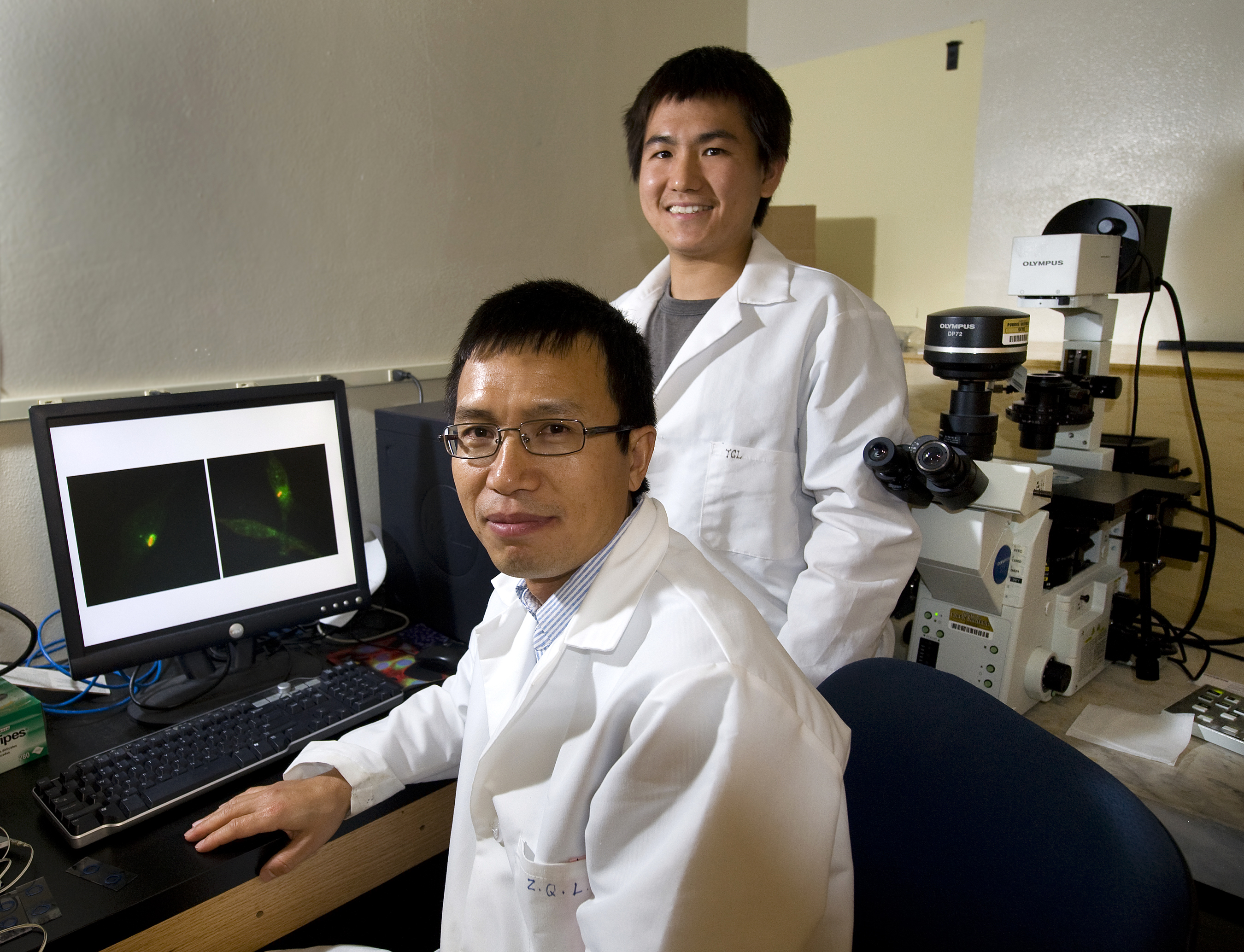
photo of Zhao-Qing Luo and Yunhao Tan

Associate professor of biological sciences Zhao-Qing Luo, foreground, and graduate student Yunhao Tan identified a new way in which bacteria modify healthy cells during infection. Shown on the computer screen are cells infected with a mutant strain of the bacteria Legionella pneumophila used in their research.

Purdue University biologists identified a new way in which bacteria hijack healthy cells during infection, which could provide a target for new antibiotics. Zhao-Qing Luo, the associate professor of biological sciences who led the study, said the team discovered a new enzyme used by the bacterium Legionella pneumophila – which causes Legionnaires’ disease – to control its host cell in order to take up residence.

“Legionnaires’ disease is a severe form of pneumonia, and this finding could lead to the design of a new therapy that saves lives,” Luo said. “At the same time it also provides great insight into a general mechanism of both bacterial infection and cell signaling events in higher organisms including humans.”

Successful infection by Legionella pneumophila requires the delivery of hundreds of proteins into the host cells that alter various functions to turn the naturally hostile environment into one tailor-made for bacterial replication. These proteins tap into existing communication processes within the cells in which an external signal, such as a hormone, triggers a cascade of slight modifications to proteins that eventually turns on a gene that changes the cell’s behavior, he said.

“Pathogens are successful because they know how information in our cells is relayed and they amplify some signals and block others in order to evade the immune system and keep the cell from defending itself,” Luo said. “Despite our understanding of this, we do not know much about how the proteins delivered by the bacteria accomplish this – how they work. This time we were able to pinpoint an enzyme and see how it disrupted and manipulated a specific signaling pathway in order to create a better environment for itself.”

The signaling pathway involved was only recently identified, and the discovery by Luo and graduate student Yunhao Tan also provides a key insight into its process. The signaling pathway involves a new form of protein modification called AMPylation in order to relay instructions to change cell behavior and has been found to be used by almost all organisms, Luo said.

The bacterium affects the host cell’s functions differently during different phases of the infection process, tapping into signaling pathways to turn on and off certain natural cellular activities. SidD stops the AMPylation process four hours after the start of infection in order to reverse an earlier modification that would be detrimental to the cell if left in place, he said.

Read the full press release.

Related: Using Bacteria to Carry Nanoparticles Into CellsDisrupting Bacterial Communication to Thwart ThemScientists Target Bacteria Where They LiveAre you ready for a world without antibiotics?

More Dark Matter Experiment Results

A dark-matter experiment deep in the Soudan mine of Minnesota now has detected a seasonal signal variation similar to one an Italian experiment has been reporting for more than a decade.

The new seasonal variation, recorded by the Coherent Germanium Neutrino Technology (CoGeNT) experiment, is exactly what theoreticians had predicted if dark matter turned out to be what physicists call Weakly Interacting Massive Particles (WIMPs).

“We cannot call this a WIMP signal. It’s just what you might expect from it,” said Juan Collar, associate professor in physics at the University of Chicago. Collar and John Orrell of Pacific Northwest National Laboratory, who lead the CoGeNT collaboration, are submitting their results in two papers to Physical Review Letters.

WIMPS might have caused the signal variation, but it also might be a random fluctuation, a false reading sparked by the experimental apparatus itself or even some exotic new phenomenon in atomic physics, Collar said.

Dark matter accounts for nearly 90 percent of all matter in the universe, yet its identity remains one of the biggest mysteries of modern science. Although dark matter is invisible to telescopes, astronomers know it is there from the gravitational influence it exerts over galaxies.

Theorists had predicted that dark matter experiments would detect an annual modulation because of the relative motion of the Earth and sun with respect to the plane of the Milky Way galaxy.
Continue reading

H-index Rank for Countries: for Science Publications

The SCImago Journal and Country Rank provides journal and country scientific indicators. As stated in previous posts, these types of rankings have limitations but they are also interesting. The table shows the top 6 countries by h-index and then some others I chose to list (the top 6 repeat from my post in 2008 – Country H-index Rank for Science Publications). The h-index provides a numeric indication of scientific production and significance (by looking at the citations given papers by other papers). Read more about the h-index (Hirsh index).

Country h-index h-index (2007) % of World
Population
total Cites
USA

1,139 793     4.5% 87,296,701
United Kingdom

689 465     .9% 21,030,171
Germany

607 408     1.2% 17,576,464
France

554 376     1.0% 12,168,898
Canada

536 370     .5% 10,375,245
Japan

527 372     1.8% 14,341,252
Additional countries of interest
18) China

279 161 19.4% 5,614,294
21) South Korea

258 161     .7% 2,710,566
22) Brazil

239 148  2.8% 1,970,704
25) India

227 146 17.5% 2,590,791
31) Singapore

196 .01% 871,512

Related: Top Countries for Science and Math Education: Finland, Hong Kong and KoreaWorldwide Science and Engineering Doctoral Degree Data Top 15 Manufacturing Countries in 2009Science and Engineering Doctoral Degrees WorldwideRanking Universities Worldwide (2008)Government Debt as Percentage of GDP 1990-2009: USA, Japan, Germany, China…

Evolution of Altruism in Robots

The webcast explores robots evolving cooperative behavior. A Quantitative Test of Hamilton’s Rule for the Evolution of Altruism (open access paper)

One of the enduring puzzles in biology and the social sciences is the origin and persistence of altruism, whereby a behavior benefiting another individual incurs a direct cost for the individual performing the altruistic action. This apparent paradox was resolved by Hamilton’s theory, known as kin selection, which states that individuals can transmit copies of their own genes not only directly through their own reproduction but also indirectly by favoring the reproduction of kin, such as siblings or cousins. While many studies have provided qualitative support for kin selection theory, quantitative tests have not yet been possible due to the difficulty of quantifying the costs and benefits of helping acts. In this study, we conduct simulations with the help of a simulated system of foraging robots to manipulate the costs and benefits of altruism and determine the conditions under which altruism evolves.

By conducting experimental evolution over hundreds of generations of selection in populations with different costs and benefits of altruistic behavior, we show that kin selection theory always accurately predicts the minimum relatedness necessary for altruism to evolve. This high accuracy is remarkable given the presence of pleiotropic and epistatic effects, as well as mutations with strong effects on behavior and fitness. In addition to providing a quantitative test of kin selection theory in a system with a complex mapping between genotype and phenotype, this study reveals that a fundamental principle of natural selection also applies to synthetic organisms when these have heritable properties.

Related: Robots That Start as Babies Master Walking Faster Than Those That Start as AdultsFriday Fun: Robocup 2010, Robot FootballToyota Develops Thought-controlled Wheelchair
Continue reading

Wave Disk Engine Could Increase Efficiency 5 Times

Norbert Müller’s group has received $2.5 million from the U.S. Department of Energy Advanced Research Projects Agency-Energy (ARPA-E) in 2010 to build and develop the wave disk engine, which uses turbo combustion “shock wave” technology to convert either liquid fuel or compressed natural gas or hydrogen into electrical power. With this engine, fuel efficiency for hybrid vehicles could increase 5 times compared to internal combustion engine vehicles on the road today (and 3.5 times less than current hybrid cars), while reducing costs by 30%. The goal of Müller’s team is to produce an engine that would give hybrid vehicles a 500-mile driving range and reduce carbon dioxide emissions by as much as 90%.

In the video he says they hope to have the engines in production vehicles within 3 years. My guess is he is being quite optimistic, but we will see. The new engine would allow 1,000 pounds to be removed from the weight of cars (by removing the need for drive train, radiator…).

Related: $10 Million X Prize for 100 MPG CarEconomic Benefits Brought by Investing in Engineering59 MPG Toyota iQ Diesel Available in Europe (2008)MIT Hosts Student Vehicle Design Summit (2006)

Cat Allergy Vaccine Created

McMaster University researchers have developed a vaccine which successfully treats people with an allergy to cats. Traditionally, frequent allergy shots have been considered the most effective way to bring relief — other than getting rid of the family pet — for the 8 to 10% of the population allergic to cats.

Both options, may now be avoided thanks to the work of immunologist Mark Larché, professor at the Michael G. DeGroote School of Medicine and Canada Research Chair in Allergy & Immune Tolerance.

Building on research he’s conducted for the past 10 years in Canada and Britain, Larché and his research team have developed a vaccine which is effective and safe with almost no side effects. The research is published in a the January 2011 issue of the Journal of Allergy & Clinical Immunology, a leading journal in the allergy field.

The researchers took one protein (molecule) that cats secrete on their fur which causes the majority of allergic problems. Using blood samples from 100 patient volunteers allergic to cats, they deconstructed the molecule and identified short regions within the protein which activate T-cells (helper cells that fight infection) in the immune system.

Using the amino acid code for the whole protein, researchers made synthetic versions of these regions. For the cat allergy vaccine, they found seven peptides (strings of amino acids). “And those synthetic peptides are what we mix together to make the vaccine,” said Larché. “We picked the peptides that would work in as much of the population as possible.”

Known as “peptide immunotherapy,” a low dose of the vaccine is given into the skin. Initially, four to eight doses a year may be required, but the side effects of the traditional allergy shots do not arise, Larché said. The optimal dose will be determined in phase three clinical trials which are getting underway with a much larger group of cat allergy sufferers.

The development of a vaccine to treat people allergic to cats is the first in a line of vaccines developed with Adiga Life Sciences, a company established at McMaster in 2008. It is a joint venture between McMaster University Circassia Ltd., a UK-based biotech company.

Adiga and McMaster are now collaborating on research into the use of peptide immunotherapy for house dust mite, ragweed, grass, birch tree and moulds

Related: MIT Engineers Design New Type of Nanoparticle for Vacines10 Questions to Ask Your Vet About Cat MedicationsVaccine For Strep Infections

MIT Engineers Design New Type of Nanoparticle for Vacines

MIT engineers have designed a new type of nanoparticle that could safely and effectively deliver vaccines for diseases such as HIV and malaria. The new particles, described in the Feb. 20 issue of Nature Materials, consist of concentric fatty spheres that can carry synthetic versions of proteins normally produced by viruses. These synthetic particles elicit a strong immune response – comparable to that produced by live virus vaccines – but should be much safer, says Darrell Irvine, author of the paper and an associate professor of materials science and engineering and biological engineering.

Such particles could help scientists develop vaccines against cancer as well as infectious diseases. In collaboration with scientists at the Walter Reed Army Institute of Research, Irvine and his students are now testing the nanoparticles’ ability to deliver an experimental malaria vaccine in mice.

Vaccines protect the body by exposing it to an infectious agent that primes the immune system to respond quickly when it encounters the pathogen again. In many cases, such as with the polio and smallpox vaccines, a dead or disabled form of the virus is used. Other vaccines, such as the diphtheria vaccine, consist of a synthetic version of a protein or other molecule normally made by the pathogen.

When designing a vaccine, scientists try to provoke at least one of the human body’s two major players in the immune response: T cells, which attack body cells that have been infected with a pathogen; or B cells, which secrete antibodies that target viruses or bacteria present in the blood and other body fluids.

For diseases in which the pathogen tends to stay inside cells, such as HIV, a strong response from a type of T cell known as “killer” T cell is required. The best way to provoke these cells into action is to use a killed or disabled virus, but that cannot be done with HIV because it’s difficult to render the virus harmless.

To get around the danger of using live viruses, scientists are working on synthetic vaccines for HIV and other viral infections such as hepatitis B. However, these vaccines, while safer, do not elicit a very strong T cell response. Recently, scientists have tried encasing the vaccines in fatty droplets called liposomes, which could help promote T cell responses by packaging the protein in a virus-like particle. However, these liposomes have poor stability in blood and body fluids.

Irvine, who is a member of MIT’s David H. Koch Institute for Integrative Cancer Research, decided to build on the liposome approach by packaging many of the droplets together in concentric spheres. Once the liposomes are fused together, adjacent liposome walls are chemically “stapled” to each other, making the structure more stable and less likely to break down too quickly following injection. However, once the nanoparticles are absorbed by a cell, they degrade quickly, releasing the vaccine and provoking a T cell response.

read the full press release

Related: New and Old Ways to Make Flu VaccinesEngineering Mosquitoes to be Flying VaccinatorsNew nanoparticles could improve cancer treatmentVaccines Can’t Provide Miraculous Results if We Don’t Take Them

Most Genes? A crustacean the size of a grain of rice

photo of Daphnia, a crustacean

“Daphnia are ubiquitous in freshwater ponds and lakes and are often used to assess the health of ponds. Since the creature is so well studied by ecologists, knowing its genetics should reveal a lot about how genes respond to different environments.

The first scientists to describe Daphnia thought they were a kind of flea because they assumed the red color came from sucking blood as fleas do. It turns out they’re not bloodsuckers – they’re blood makers. Daphnia have genes that make hemoglobin, so when the animal is stressed out, those genes switch on and the animal looks red.

In fact Daphnia have an astonishingly large number of genes. “We count more than 31,000 genes,” says [John] Colbourne. By comparison, the human genome has more like 23,000 genes. If Guinness tracks such things, Daphnia would hold the record for the most genes of any animal studied to date.

“Many of those genes – we estimate around 35 percent of them – are brand new to science,”

Daphnia can grow its own spear and helmet when threatened by an attacker

Related: Our Genome Changes as We AgeAmazing Designs of LifeOne Species’ Genome Discovered Inside Another SpeciesBdelloid Rotifers Abandoned Sex 100 Million Years Ago