Tag Archives: water

Agricultural Irrigation with Salt Water

Irrigation system can grow crops with salt water

A British company has created an irrigation system that can grow crops using salt water. The dRHS (Dutyion Root Hydration System) irrigation system consists of a network of sub-surface pipes, which can be filled with almost any water, whether pure, brackish, salted or polluted. The system can even take most industrial waste-water and use it without the need for a purification process.

The pipes are made from a plastic that retains virtually all contaminants while letting clean water through to the plants’ roots.

The dRHS system, which has been in development for ten years, was initially trialled in the UK using tomato plants, and has since been tried out in the US. The next trials will take place in Chile, Libya, Tanzania, Mauritius and Spain. Tonkin says 20,000 metres of pipe are on their way to the Middle East, where it will be tested with water that’s more saline than sea water.

It has also won international recognition for its work, most recently at the international Water Technology Idol event in Switzerland, organised by Global Water Intelligence magazine and the International Desalination Association.

Christopher Gasson from Global Water Intelligence magazine says that the competition was a three-way tie last year but this year, the winner stood out. “The dRHS irrigation system addressed a bigger problem than the other technology that it was competing against,” he said. “Agriculture water is where 70 per cent of water goes. By 2025 two thirds of the world’s population will experience water shortages and so farming will be badly hit.

This is good news. I am still skeptical that this is as good as the article makes it sound. Just as simple as “flushing out the pipes.” But I am hopeful we will find desalination-type solutions. Clean water is a huge problem facing the world now, basically I just figure with enough engineers focused on finding workable solutions we will find several that have a huge impact. If not, we are in real trouble.

Related: Cheap Drinking Water From Seawater (2006)Water From AirNearly Waterless Washing MachineWater and Electricity for All

Great Lake Sinkholes

Grand Valley State University Scientist Discovers Great Lake ‘sinkholes’

Biddanda said the sinkholes are home to “bizarre” ecosystems dominated by brilliant purple mats of cyanobacteria, or blue-green algae, but largely devoid of fish.

“Groundwater from beneath Lake Huron is dissolving minerals from the defunct seabed and carrying them into the lake to form these exotic, extreme environments,” Biddanda said. “Those ecosystems are in a class not only with Antarctic lakes, but also with deep-sea, hydrothermal vents and cold seeps.”

The Lake Huron sinkholes are dominated by brilliant purple mats of cyanobacteria — cousins of microbes found on the bottom of permanently ice-covered lakes in Antarctica — and pallid, floating pony-tails of other microbial life

Related: Bizarre Anaerobic Ecosystems Discovered In Lake HuronRadiation Tolerant BacteriaLife Far Beneath the Ocean
Continue reading

Waste Treatment Plants Result in Super Bacteria

Multiple antibiotic-resistant bacteria has emerged as one of the top public health issues worldwide in the last few decades as the overuse of antibiotics and other factors have caused bacteria to become resistant to common drugs. Chuanwu Xi‘s group chose to study Acinetobacter because it is a growing cause of hospital-acquired infections and because of its ability to acquire antibiotic resistance.

Xi said the problem isn’t that treatment plants don’t do a good job of cleaning the water—it’s that they simply aren’t equipped to remove all antibiotics and other pharmaceuticals entering the treatment plants.

The treatment process is fertile ground for the creation of superbugs because it encourages bacteria to grow and break down the organic matter. However, the good bacteria grow and replicate along with the bad. In the confined space, bacteria share resistant genetic materials, and remaining antibiotics and other stressors may select multi-drug resistant bacteria.

While scientists learn more about so-called superbugs, patients can do their part by not insisting on antibiotics for ailments that antibiotics don’t treat, such as a common cold or the flu, Xi said. Also, instead of flushing unused drugs, they should be saved and disposed of at designated collection sites so they don’t enter the sewer system.

The next step, said Xi, is to see how far downstream the superbugs survive and try to understand the link between aquatic and human superbugs. This study did not look past 100 yards.

Xi’s colleagues include visiting scholar Yongli Zhang; Carl Marrs, associate professor of public health; and Carl Simon, professor of mathematics.

Xi and colleagues found that while the total number of bacteria left in the final discharge effluent declined dramatically after treatment, the remaining bacteria was significantly more likely to resist multiple antibiotics than bacteria in water samples upstream. Some strains resisted as many as seven of eight antibiotics tested. The bacteria in samples taken 100 yards downstream also were more likely to resist multiple drugs than bacteria upstream.

Full press release

Related: How Bleach Kills BacteriaSuperbugs, Deadly Bacteria Take HoldBacteria Race Ahead of DrugsNew Family of Antibacterial Agents Discovered

Historical Engineering: Hanging Flume

Hanging flumephoto of hanging flume overlook in Colorado, by John Hunter, Creative Commons Attribution.

___________________

While driving from Dinosaur National Monument to Mesa Verde National Park last year I passed the sight above with the remnants of a hanging flume. The Montrose Placer Mining Company built a 13 mile canal and flume to deliver water from the San Miguel River for gold mining operations. The last 5 miles of the flume clung to the wall of the canyon itself, running along the cliff face in the photo above (see more photos).

Constructed between 1888 and 1891, the 4 foot deep 5 foot 4 inch wide hanging flume carried 23,640,000 gallons of water in a 24 hour period. The mining operations used water and sluice boxes to separate the gold from lighter materials (dirt and gravel).

The technology was not yet available to pump the water directly from the river at the necessary volume and pressure to wash the gold from the gravel, therefore they constructed the flume to transport the water.

Related: Mount Saint Helens Photosphotos of Manhattan (Rockefeller Center, Empire State Building…)C&O Towpath – Monocacy Aqueduct to Calico Rocks
Continue reading

European Eels in Crisis After 95% Decline in Last 25 years

Eels in crisis after 95% decline in last 25 years

But the action the Environment Agency is about to take is upsetting those who rely on the eel for their livelihoods. A ban on exporting eels out of Europe – they are a popular dish in the far east – is proposed, along with a plan to severely limit the fishing season and the number of people who will be allowed licences.

It seems pretty obvious we have over-fished the oceans. Without effective regulation we will destroy the future of both the wildlife and our food source.

Related: Fishless FutureSouth Pacific to Stop Bottom-trawlingNorth American Fish ThreatenedChinook Salmon Vanish Without a Trace

The eel remains one of the world’s most mysterious creatures. It is generally accepted that European eels – Anguilla anguilla – are born in the Sargasso Sea near Bermuda.

As leaf-like larvae, they are swept by the Gulf Stream towards Europe, a journey that may take a year. When the larvae reach the continental shelf they change into “glass eels” and in the spring begin to move through estuaries and into freshwater.

The animals develop pigmentation, at which point they are known as elvers and are similar in shape to the adult eel. Elvers continue to move upstream and again change colour to become brown or yellow eels.

When the fish reach full maturity – some can live to 40 and grow to 1m long – they migrate back to the ocean. Females are reported to carry as many as 10m eggs. They return to the Sargasso Sea, spawn and die.

Pi Ice Cube Trays

Pi ice cubes

Liven up a drink with Pi shaped Ice “cubes” from Think Geek:

But how about ice? You were planning to use that standard vaguely cubical stuff?… or worse the boring half-moon shape your fridge churns out? Well fear not intrepid nerdy party planner! ThinkGeek is here with the geekiest ice you’ll ever find… Pi ice! Yep these stylish silicone ice trays cast frozen H2O into the symbol for your favorite irrational number.

Related: Get Your Own Science ArtQubits Construction Toyposts on science related giftsInnovative Alarm ClocksWrite on Water

Antelope Island, Great Salt Lake Photos

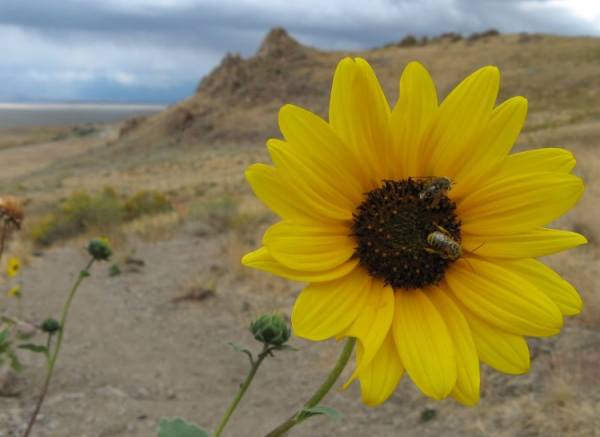
Yellow flower on Antelope Island

I have posted photos from the first day of my Utah trip: Antelope Island, Great Salt Lake and Salt Lake City. The Great Salt Lake is

High School Inventor Teams @ MIT

Sadly MIT deleted the video after having it live for several years.

Lemelson-MIT InvenTeams is a national grants initiative of the Lemelson-MIT Program to foster inventiveness among high school students. The webcast above shows a high school team presenting a project they completed to create a solution to provide clean water. This stuff is great. I love appropriate technology. I love seeing kids think and create effective solutions to real problems. This is how you get kids to learn – not boring classes (at least kids like me).

The students are passing on the project to students at their school to continue to work on. (MIT TechTV used to have many more presentation by other InvenTeams – not anymore 🙁 ) InvenTeams and MIT deserve a great deal of credit for creating such great learning opportunities and great solutions for the world.

InvenTeams composed of high school students, teachers and mentors are asked to collaboratively identify a problem that they want to solve, research the problem, and then develop a prototype invention as an in-class or extracurricular project. Grants of up to $10,000 support each team’s efforts. InvenTeams are encouraged to work with community partners, specifically the potential beneficiaries of their invention.

Related: Water and Electricity for AllWater Pump Merry-go-RoundEngineering a Better World: Bike Corn-ShellerInspiring a New Generation of InventorsKids in the Lab: Getting High-Schoolers Hooked on Science

Single-Celled Giant Provides New Early-Evolution Perspective

Discovery of Giant Roaming Deep Sea Protist Provides New Perspective on Animal Evolution
Biologist Mikhail “Misha” Matz and his colleagues recently discovered the grape-sized protists and their complex tracks on the ocean floor near the Bahamas. DNA analysis confirmed that the giant protist found by Matz and his colleagues in the Bahamas is Gromia sphaerica, a species previously known only from the Arabian Sea.

Matz says the protists probably move by sending leg-like extensions, called pseudopodia, out of their cells in all directions. The pseudopodia then grab onto mud in one direction and the organism rolls that way, leaving a track. Hr says the giant protists’ bubble-like body design is probably one of the planet’s oldest macroscopic body designs, which may have existed for 1.8 billion years.

“I personally think now that the whole Precambrian may have been exclusively the reign of protists,” says Matz. “Our observations open up this possible way of interpreting the Precambrian fossil record.”

He says the appearance of all the animal body plans during the Cambrian explosion might not just be an artifact of the fossil record. There are likely other mechanisms that explain the burst-like origin of diverse multicellular life forms.

Single-Celled Giant Upends Early Evolution

Slowly rolling across the ocean floor, a humble single-celled creature is poised to revolutionize our understanding of how complex life evolved on Earth.

A distant relative of microscopic amoebas, the grape-sized Gromia sphaerica was discovered once before, lying motionless at the bottom of the Arabian Sea. But when Mikhail Matz of the University of Texas at Austin and a group of researchers stumbled across a group of G. sphaerica off the coast of the Bahamas, the creatures were leaving trails behind them up to 50 centimeters (20 inches) long in the mud.

The trouble is, single-celled critters aren’t supposed to be able to leave trails. The oldest fossils of animal trails, called ‘trace fossils’, date to around 580 million years ago, and paleontologists always figured they must have been made by multicellular animals with complex, symmetrical bodies.

Related: Lancelet Genome Provides Answers on EvolutionMicroRNAs Emerged Early in EvolutionFossils of Sea MonsterSea Urchin Genome